Life at Molecular, Cellular and Tissue Level
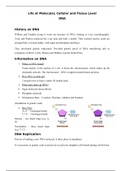
DNA
History on DNA
Wilkins and Franklin trying to work out structure of DNA, looking at x-ray crystallography.
Crick and Watson analyzed the x-ray data and built a model. They realized nucleic acids are
arranged like a twisted ladder, with sugar and phosphate and bases.
They developed genetic replication. Provided genetic proof of DNA transferring info to
cytoplasm via RNA. Crick, Watson and Wilkins won the Nobel Prize.
Information on DNA
1. Where is DNA found?
Found mainly in the nucleus of a cell. It forms the chromosomes, which makes up the
chromatin network. The chromosome – DNA wrapped around histone proteins.
2. How DNA is made up?
2 strands twist to form a stable 3D double helix.
3. What units make up DNA?
Sugar molecule (deoxyribose)
Phosphate molecule
Nitrogenous Base – Cytosine, Thymine, Adenine and Guanine.
(foundation of genetic code)
4. Base Pairs
A=T - 2 hydrogen bonds
C ≡ G – 3 hydrogen bonds
Purines – two fused rings (e.g. A,
G)
Pyrimidines – three fused rings
(e.g. T, C)
DNA Replication
Process of making a new DNA molecule. It takes place in interphase.
It is necessary as genetic code is passed on to each new daughter cell formed during cell division.
, How does replication take place? Free nucleotides in
Double helix unwinds, weak nucleoplasm become
Catalysed by the enzyme DNA
hydrogen break and a single attached to their
polymerase.
chain of bases are exposed. matching nitrogenous
bases.
A chromosome is formed.
2 daughter DNA molecules each
SEMI-CONSERVATIVE twist to form a double helix shape,
REPLICATION bonds to histone proteins.
Information on RNA
Made in the nucleus by DNA, and its involved in protein synthesis.
Structure
Consists of single strand
Much shorter
Sugar is ribose
Three bases same with DNA, except uracil replaces thymine.
Function – Carries instructions from DNA in nucleus to ribosomes where synthesis of proteins is
controlled.
Information on mtDNA
Why is DNA Present?
Mitochondria were prokaryotes. They entered a symbiotic relationship with eukaryotic cells
through endosmosis, therefore they have their own DNA.
Tracing genetic links
During fertilization, only chromosomes from sperm enter the egg cell, no organelles. mtDNA is
passed on through females and is used to establish a direct material genetic line. mtDNA mutates
occasionally, like substitution can take place where a nucleotide is replaced resulting in a marker.
Protein Synthesis
1. Transcription
, DNA makes and codes mRNA in the nucleus and the coded message in DNA is carried across
into mRNA, which carries it to the ribosome. Role of mRNA – sequence of amino acids
determined by instructions from genetic code.
Process starts when a Catalysed by the Causes 2 strands of DNA
small piece of DNA enzyme RNA to separate by breaking
(gene) unwinds. polymerase. hydrogen bonds.
Nucleotides join New nucleotides pair
DNA has transcribed
up, new strand of up to complementary
its genetic code to
mRNA formed. nucleotides.
the mRNA.
Completed strand
mRNA moves through
of mRNA breaks DNA rezips nuclear pores and carries
away from DNA.
genetic code to
ribosomes.
Each codeword is made up of any three bases (triplets) and is called a codon.
2. Translation
mRNA binds to ribosome, where the codon acts as a pattern that determines the AA’s. Role of
tRNA – each one has 3 bases called anti-codon, it picks up specific AA’s found in cytoplasm and
transfer to ribosome.
A chain of AA’s made up of less than 50 are called a polypeptide bond, more than 50 is protein.
tRNA molecule Polypeptide
Anti-codon bases link up AA’s link with
released to carry chains link
to complementary bases peptide bonds to form
specific AA to to form a
of the codon. polypeptide chain.
ribosome functional
protein.
Genetic Aberrations
Caused by mutations.
One or more nucleotides being damaged or lost by chance.
Breakdown of DNA by mutagens.
DNA
History on DNA
Wilkins and Franklin trying to work out structure of DNA, looking at x-ray crystallography.
Crick and Watson analyzed the x-ray data and built a model. They realized nucleic acids are
arranged like a twisted ladder, with sugar and phosphate and bases.
They developed genetic replication. Provided genetic proof of DNA transferring info to
cytoplasm via RNA. Crick, Watson and Wilkins won the Nobel Prize.
Information on DNA
1. Where is DNA found?
Found mainly in the nucleus of a cell. It forms the chromosomes, which makes up the
chromatin network. The chromosome – DNA wrapped around histone proteins.
2. How DNA is made up?
2 strands twist to form a stable 3D double helix.
3. What units make up DNA?
Sugar molecule (deoxyribose)
Phosphate molecule
Nitrogenous Base – Cytosine, Thymine, Adenine and Guanine.
(foundation of genetic code)
4. Base Pairs
A=T - 2 hydrogen bonds
C ≡ G – 3 hydrogen bonds
Purines – two fused rings (e.g. A,
G)
Pyrimidines – three fused rings
(e.g. T, C)
DNA Replication
Process of making a new DNA molecule. It takes place in interphase.
It is necessary as genetic code is passed on to each new daughter cell formed during cell division.
, How does replication take place? Free nucleotides in
Double helix unwinds, weak nucleoplasm become
Catalysed by the enzyme DNA
hydrogen break and a single attached to their
polymerase.
chain of bases are exposed. matching nitrogenous
bases.
A chromosome is formed.
2 daughter DNA molecules each
SEMI-CONSERVATIVE twist to form a double helix shape,
REPLICATION bonds to histone proteins.
Information on RNA
Made in the nucleus by DNA, and its involved in protein synthesis.
Structure
Consists of single strand
Much shorter
Sugar is ribose
Three bases same with DNA, except uracil replaces thymine.
Function – Carries instructions from DNA in nucleus to ribosomes where synthesis of proteins is
controlled.
Information on mtDNA
Why is DNA Present?
Mitochondria were prokaryotes. They entered a symbiotic relationship with eukaryotic cells
through endosmosis, therefore they have their own DNA.
Tracing genetic links
During fertilization, only chromosomes from sperm enter the egg cell, no organelles. mtDNA is
passed on through females and is used to establish a direct material genetic line. mtDNA mutates
occasionally, like substitution can take place where a nucleotide is replaced resulting in a marker.
Protein Synthesis
1. Transcription
, DNA makes and codes mRNA in the nucleus and the coded message in DNA is carried across
into mRNA, which carries it to the ribosome. Role of mRNA – sequence of amino acids
determined by instructions from genetic code.
Process starts when a Catalysed by the Causes 2 strands of DNA
small piece of DNA enzyme RNA to separate by breaking
(gene) unwinds. polymerase. hydrogen bonds.
Nucleotides join New nucleotides pair
DNA has transcribed
up, new strand of up to complementary
its genetic code to
mRNA formed. nucleotides.
the mRNA.
Completed strand
mRNA moves through
of mRNA breaks DNA rezips nuclear pores and carries
away from DNA.
genetic code to
ribosomes.
Each codeword is made up of any three bases (triplets) and is called a codon.
2. Translation
mRNA binds to ribosome, where the codon acts as a pattern that determines the AA’s. Role of
tRNA – each one has 3 bases called anti-codon, it picks up specific AA’s found in cytoplasm and
transfer to ribosome.
A chain of AA’s made up of less than 50 are called a polypeptide bond, more than 50 is protein.
tRNA molecule Polypeptide
Anti-codon bases link up AA’s link with
released to carry chains link
to complementary bases peptide bonds to form
specific AA to to form a
of the codon. polypeptide chain.
ribosome functional
protein.
Genetic Aberrations
Caused by mutations.
One or more nucleotides being damaged or lost by chance.
Breakdown of DNA by mutagens.