Materials Science and Engineering (MSE 170)
Examination Preparation wuestions
Question and Answers
Short Answer
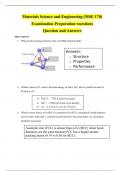
1. What are the missing element in the core MSE elements/skills
A
Answers:
A. Structure
B
B. Properties
C. Performance
C
2. Within a factor of 3, what is the bond energy of NaCl, SiC, and Ar (solid) (in units of
kJ/mol or eV)
• NaCl: ~750 kJ/mol (ionic)
• SiC: ~1200 kJ/mol (covalent)
• Ar: ~2 kJ/mol (van der Waals)
3. Which is more dense, a-Fe (BCC) or austenite iron (FCC), assuming Fe bond distances
are the same? (hint only 2 common crystal structures have hcp planes, no calculation
should be necessary)
Austenite iron (FCC) is denser than α-Fe (BCC) when bond
distances are the same because FCC has a higher atomic
packing factor (0.74 vs 0.68 for BCC).
, Worked Problems
P1. For an unknown metal element with a density of 19.3 g/cm3, the first 3 XRD powder
diffraction peaks are at 2ϴ = 40.294, 58.30, 73.25o. The x-ray has a wavelength of 0.1540 nm.
Using all the given data and your calculations, identify the metal from a periodic table. (multi-
step problem, show all work including determination of crystal structure from the XRD data and
using density data). Hint: ratio of the first 3 peaks’ d-spacing can help you decide on the crystal
structure type using a table on the provided equation sheet, you can assume that it is not simple
cubic, which is rare)
Examination Preparation wuestions
Question and Answers
Short Answer
1. What are the missing element in the core MSE elements/skills
A
Answers:
A. Structure
B
B. Properties
C. Performance
C
2. Within a factor of 3, what is the bond energy of NaCl, SiC, and Ar (solid) (in units of
kJ/mol or eV)
• NaCl: ~750 kJ/mol (ionic)
• SiC: ~1200 kJ/mol (covalent)
• Ar: ~2 kJ/mol (van der Waals)
3. Which is more dense, a-Fe (BCC) or austenite iron (FCC), assuming Fe bond distances
are the same? (hint only 2 common crystal structures have hcp planes, no calculation
should be necessary)
Austenite iron (FCC) is denser than α-Fe (BCC) when bond
distances are the same because FCC has a higher atomic
packing factor (0.74 vs 0.68 for BCC).
, Worked Problems
P1. For an unknown metal element with a density of 19.3 g/cm3, the first 3 XRD powder
diffraction peaks are at 2ϴ = 40.294, 58.30, 73.25o. The x-ray has a wavelength of 0.1540 nm.
Using all the given data and your calculations, identify the metal from a periodic table. (multi-
step problem, show all work including determination of crystal structure from the XRD data and
using density data). Hint: ratio of the first 3 peaks’ d-spacing can help you decide on the crystal
structure type using a table on the provided equation sheet, you can assume that it is not simple
cubic, which is rare)