
• Wrong document? Swap it for free
  • Written by students who passed
  • Immediately available after payment
  • Read online or as PDF
Sell
Where do you study
Your language
Document preview thumbnail
Preview 4 out of 106 pages
Exam (elaborations)

All The Comsae Final Exam Study Guide 2025/2026 Accurate Questions And Correct Detailed Answers With Rationales || 100% Guaranteed Pass Latest Version

Document preview thumbnail
Preview 4 out of 106 pages

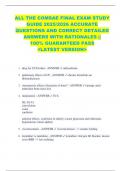
ALL THE COMSAE FINAL EXAM STUDY GUIDE 2025/2026 ACCURATE QUESTIONS AND CORRECT DETAILED ANSWERS WITH RATIONALES || 100% GUARANTEED PASS LATEST VERSION 1. drug for UC/Crohns - ANSWER sulfasalazine 2. pulmonary effects of CF - ANSWER chronic bronchitis an dbronchiectasis 3. osteoporosis affects what parts of bone? - ANSWER (spongy and ) trabecular bone mass loss 4. imipramine - ANSWER TCA SE: Tri-Cs convulsions coma cardiotox antichol effects- confusion in elderly; (acute glaucoma and orthostatic hypotension- block alpha1) 5. viscerosomatic - ANSWER visceral disease -- somatic finding 6. loratidine vs ranitidine - ANSWER loratidine: 2nd gen H1 blocker, doesnt cross BBB -- less sedating ranitidine: H2 receptor antagonist (like cimetidine) 7. cells w RBCs inside - ANSWER entaemoba histolytica 8. which type of pneumothorax causes tracheal deviation to the contra side? - ANSWER tension 9. intracerebral hemorrhage adjacent to a lesion that contains a tangle of numerous tortuous vessels - ANSWER AVM arteriovenous malformation 10. cavernous hemangioma - ANSWER benign tumor of liver, A/W VHL 11. anti-HepB surface antibody is only present in what pop - ANSWER recovered or immunized not in chronic or 12. proctalgia fugax - ANSWER levator ani syndrome 13. fasciculus is UMN or LMN lesion? - ANSWER LMN 14. ectopic gastric tissue - ANSWER meckels diverticulum can also have ectopic pancreatic tissue remnant of vitelline duct 15. antibodies in hashimotos attacks - ANSWER thyroid peroxidase or antithyroglobulin enlarged non tender thyroid 16. 2 factors that influence starling curve - ANSWER x axis- preload (EDV) y axis- stroke volume or CO 17. treatment for fibromyalgia - ANSWER TCA, SNRIs anticonvulsants 18. what blocks NE reuptake? - ANSWER TCA or SNRIs 19. possible complication of pagets bone disease - ANSWER osteocarcoma 20. what does Hct tell you? - ANSWER ratio of volume of RBCs compared to total blood volume 21. Hand Grip Maneuver - ANSWER increases systemic vascular resistance increases the intensity of MR, AR, VSD, MVP murmurs decreases the intensity of AS, hypertrophic cardiomyopathy murmurs. 22. Valsava Maneuver - ANSWER decreases venous return decreases the intensity of most murmurs increases the intensity of MVP, hypertrophic cardiomyopathy murmurs 23. Rapid Squatting Maneuver - ANSWER increases venous return, increases preload, increases afterload with prolonged squatting. 24. Mitral Regurgitation - ANSWER Holosystolic, high pitched "blowing murmur" that is loudest at the apex and radiates toward the axilla. enhances by maneuvers that increase TPR like squatting and hand grip or LA return like expiration. MR is often due to ischemic heart dsease, MVP or LV dilation. Rheumatic fever and infective endocarditis can cause either MR or TR 25. Tricuspid regurgitation - ANSWER holosystolic, high pitched "blowing murmur" that is loudest at the tricuspid area and radiates to right sternal border. Enhanced by maneuvers that increase RA return (e.g. inspiration). TR can be caused by RV dilation. Rheumatic fever and infective endocarditis can cause either MR or TR 26. Aortic Stenosis - ANSWER Crescendo - Decrescendo systolic ejection murmur follwing ejection click. The ejection clic is due to abrupt halting of valve leaflets). LV aortic pressure during systole. radiates to carotids/heart base. "pulsus parvus et tardus"- pulses are weak with a delayes peak. can lead to syncope, angina, and dyspnea on exertion (SAD). Often due to age - related calcific aortic stenosis or bicuspid aortic valve. 27. VSD - ANSWER Holosystolic hardh sounding murmur. loudest at tricuspid area, accentuated with hand grip maneuver due to increased afterload. 28. Mitral Valve Prolapse - ANSWER Late systolic crescendo murmur with midsystolic clid. Midsystolic click is due to sudden tensing of chordae tendineae. Most frequent valvular lesion. best heard over apex. loudest at S2. usually benign. can predispose to infective endocarditis. Can be caused by myxomatous degeneration (in developing countries), rheumatic fever, or chordae rupture. enhanced by maneuvers that decrease venous return (e.g. standing or valsalva) 29. Aortic Regurgitation - ANSWER immediate high pitched blowing diastolic decrescendo murmur. wife pulse pressure when chronic. can present with bounding pulses and head bobbing. often due to aortic root dilation, bicuspid aortic valve, endocarditis, or rheumatic fever. increased murmer during hand gri. vasodilators decrease the intensity of the murmur. 30. Mitral Stenosis - ANSWER follows opening snap which is due to abrupt halt in leaflet motion in diastole, after rapid opening due to fusion at leaflet tips. delayes rumbling late diastolic murmur. LALV pressure during diastole. often occurs secondary to rheumatic fever. chronic MS can result in LA dilation. Enhanced by maneuvers that increase LA return (e.g. expiration) 31. PDA - ANSWER continuous machine like murmer. loudest at S2. often due to congenital rubella or prematurity. best heard at left infraclavicular area. 32. normal pressure in the right atrium is? - ANSWER 5 mmHg 33. normal pressure in the right ventricle? - ANSWER 25/5 mmHg 34. normal pressure in the left atrium? - ANSWER 12 mmHg 35. normal pressure in the left ventricle? - ANSWER 130/0 mmHg 36. normal pressure in ascending aorta/ aortic arch? - ANSWER 130/90 mmHg 37. normal pressure in pulmonary artery/pulmonary trunk? - ANSWER 25/10 mmHg pulmonary artery is where PCWP is measures and is usually 12 mmHg. PCWP in mmHg is a good approximation of left atrial pressure. In mitral stenosis, PCWP is greater than LV diastolic pressure. PCWP is measures with a pulmonary artery catheter (Swan - Ganz catheter). 38. Hyaline Casts - ANSWER solidified Tamm - Horsfall mucoprotein that is secreted from the tubular epithelial cells of individual nephrons. They are increased in the urine when there is low urine flow, concentrated urine, or an acidic renal environment. Therefore, they are commonly increased in individuals with normal renal function who are severely dehydrated or after vigorous excercise. 39. Fatty Casts - ANSWER most commonly associated with nephrotic syndrome. Patients with nephrotic syndrome have hyperlipidemia and lipiduria because increased liver production of albumin leads indirectly to an increase in LDL and VLDL synthesis. Fatty casts form as the resultant lipid - rich epithelial cells are broken down in the glomeruli. 40. HLA-A3 - ANSWER associated with hemochromatosis 41. HLA-B8 - ANSWER associated with Grave's Disease 42. HLA-B27 - ANSWER associated with psoriatic arthritis, ankylosing spondylitis, inflammatory bowel disease and reiters syndrome. 43. HLA-DR3 - ANSWER associated with DM type 1 44. maneuvers that increase pre load - ANSWER mueller maneuver squatting 45. maneuver that increases afterload - ANSWER handgrip 46. maneuvers that decrease preload - ANSWER valsalva and standing 47. Metoclopramide - ANSWER an antiemetic and prokinetic drug for the GI tract. It stimulates peristalsis by antagonizing D2 (dopamine) receptors, thereby increasing resting tone, contractility LES tone, and overall motility. Used to treat Diabetic gastroporesis SE - extrapyramidal symptoms like parkinsonism and dystonia. 48. Meclizine - ANSWER an antihistamine used for nausea and motion sickness. it has anticholinergic properties and can thus produe drowsiness and dry mouth 49. Anion Gap Equation - ANSWER Na-Cl-bicarb normal is bw 8-16 50. MUDPILERS - ANSWER Methanol Uremia Diabetic Ketoacidosis Propylene Glycol Isoniazid Lactic Acidosis Ethylene Glycol/ Alcohol Renal Failure (chronic) Salicylates (aspirin) 51. Alzheimer Disease - ANSWER decrease acetylcholine level from a deficiency of choline acetyltransferase most notably in the basal nucleus of meynert which participates in memory and cognition also decreased levels in the hippocampus 52. trousseaus sign - ANSWER occlusion of brachial arter with BP cuff which leads to carpal spasm. present in hypoparathyroidism 53. Pseudohypoparathydoidism - ANSWER Albrights hereditary osteodystrophy autosomal dominant kidney unresponsiveness to PTH. leads to hypocalcemia, shortened 4th/5th digits, short stature. 54. Trousseau's Syndrome - ANSWER a migratory thrombophlebitis - presents with redness and tenderness on palpation of extremities. associated with a visceral malignancy mostly pancreatic adenocarcinoma or adenocarcinoma of the colon and lung etc. 55. treatment for legionares? - ANSWER respiratory floroquinolone 56. Polyostotic fibrous dysplasia - ANSWER bone is replaced by fibroblasts, collagen and irregular bony trabeculae. 57. McCune-Albright Syndrome - ANSWER a form of polyostotic fibrous dysplasia characterized by multiple unilateral bone lesions associated with endocrine abnormalities (precocious puberty) and cafe au lait spots. 58. treatment for tinea versicolor - ANSWER selenium sulfatide, topical miconazole 59. Papillary thyroid carcinoma - ANSWER malignant - good prognosis, lymphatic spread, most common thyroid cancer, papillary growth with optically clear nuclie (orphan annie nuclie) (ground glass chromatin) 60. Clomiphine - ANSWER a SERM that inhibits negative feedback of estrogen in the hypothalamus on gonadotropin release causing an increased release of LH and FSH from the anterior pituitary glans which stimulates ovulation. It is used to treat infertility in the setting of PCOS. 61. Osteitis fibrosa cystica - ANSWER bone pain, subperiosteal bone resorption on the radial aspect of middle phalanges along with brown tumors of the long bones. 62. Carcinoid Syndrome - ANSWER flushing wheezing, diahrrea and right sided valvular lesions especially tricuspid regurgitation. needs to have metastasized to the liver because if not and its in the GI tract it is subject to first pass effect so you will not see symptoms. 63. causes of epiddymitis 35 yo - ANSWER ecoli, pseudomonas, proteus 64. causes of epididymitis 35 yo - ANSWER chlamydia, gonnohrea. 65. Fanconi's syndrome - ANSWER proximal tubular reabsorption defect polyuria, renal tubular acidosis type II, growth failure, electrolyte imbalances, hypophosphatemic rickets. 66. GP120 - ANSWER HIV docking protein in viral envelope, formed from cleavage of GP160. responsible for attachment to host CD4+ T cell. ENV 67. GP41 - ANSWER HIV transmembrane protein in viral envelope, formed from cleavage of gp160. responsible for fusion and entry. ENV 68. p24 - ANSWER gag - HIV capsid protein 69. pol codes for? - ANSWER reverse transcriptase, aspartate protease, integrase. 70. B1 - ANSWER thiamine: TPP 71. B2 - ANSWER riboflavin: FAD, FMN 72. B3 - ANSWER Niacin: NAD+ 73. B5 - ANSWER pantothenic acid: CoA 74. B6 - ANSWER pyridoxine: PLP 75. B7 - ANSWER biotin 76. B9 - ANSWER folate 77. B12 - ANSWER cobalamin 78. vitamin C - ANSWER ascorbic acid 79. water solble vitamins - ANSWER all wash out easily from body except B12 and folate which are stored in the liver. B complex deficiencies often result in dermatitis, glossitis and diarrhea 80. Fat soluble vitamins - ANSWER ADEK. absorption is dependent on the gut (ileum) and pancrease. Toxicity is more common than for water soluble vitamins, because these accumulate in fat. Malabsorption syndromes (steatorrhea, such as cystic fibrosis and sprue, or mineral oil intake can cause fat soluble vitamin deficiencies. 81. Functions of Vitamin A (retinol) - ANSWER Antioxidant; constituent of visual pigments (retinal); essential for normal differentiation of epithelial cells into specialized tissue (pancreatic cells, mucus-secreting cells); prevents squamous metaplasia. used to treat measles and AML, subtype M3. used for wrinkles and acne. found in liver and leafy vegetables. 82. Vitamin A (retinol) deficiency - ANSWER causes night blindness and dry skin 83. Vitamin A (retinol) excess - ANSWER causes arthralgias, fatigue, headaches, skin changes, sore throat, alopecia. Teratogenic (cleft palate, cardiac abnormalities, microcephaly), so a negative pregnancy test and reliable contraception are needed before isotretinoin is prescribed for severe acne. acute excess vit A causes nasaue vomiting, vertigo and blurred vision. 84. Vitamin B1 (thiamine) functions - ANSWER in thiamine pyrophosphate (TPP) a cofactor for several enzymes in decarboxylation reactions: 1) pyruvate dehydrogenase (links glycolysis to TCA cycle) 2) alpha ketoglutarate dehydrogenase (TCA cycle) 3) transketolase 4) branched chain amino acid dehydrogenase. 85. Vitamin B1 (thiamine) defieincy - ANSWER impaired glucose breakdown leading to ATP depletion worsened by glucose infusionl highly aerobic tissues (brain and heart) are affected first. wenicke-korsakoff syndrome and beriberi. Seen in malnutrition as well as alcoholism (2ndary to malnutrition and malabsorption) 86. Wernicke Korsakoff - ANSWER confusion, opthalmoplegia, ataxia (classic triad)+ confabulation, personality change, memory loss (permanent) damage to medial dorsal nucleus of thalamus, mamillary bodies. 87. Dry Beribery - ANSWER polyneuritis, symmetrical muscle wasting 88. Wet beriberi - ANSWER high output cardiac failure (dilated cardiomyopathy) edema. 89. Vitamin B2 (riboflavin) function - ANSWER cofactor in oxydation and reduction (e.g. FADH2) FAD and FMN are derived from riboflavin (B2 = 2ATP) 90. Vitamin B2 (riboflavin) deficiency - ANSWER cheilosis (inflammation of lips, scaling and fissures at the corners of the mouth), corneal vascularization. 91. Vitamin B3 (niacin) function - ANSWER constituent of NAD+, NADP+ (used in redox reactions) derived from tryptophan. synthesis requires B6. NAD is derived from Niacin (B3 = 3ATP) 92. Vitamin B3 (niacin) deficiency - ANSWER glossitis. severe deficiency leads to pellagra which can be caused by hartnup disease (deficiency in tryptophan absorption), malignant carcinoid syndrome (increased tryptophan metabolism) and INH (decreased vitamin B6). symptoms of pellagro are diarrhea, dementia, dermititis and death. 93. Vitamin B3 (niacin) excess - ANSWER facial flushing (due to pharmacologic doses for treatment of hyperlipidemia) 94. Vitamin B5 (pantothenate) function - ANSWER essential component of CoA (a cofactor for acyl B5 is "pento" thenate. transfers) and fatty acid synthase. 95. Vitamin B5 (pantothenate) deficiency - ANSWER dermatitis, enteritis, alopecia, adrenal insufficiency.

Content preview

ALL THE COMSAE FINAL EXAM STUDY
GUIDE 2025/2026 ACCURATE
QUESTIONS AND CORRECT DETAILED
ANSWERS WITH RATIONALES ||
100% GUARANTEED PASS
<LATEST VERSION>


1. drug for UC/Crohns - ANSWER ✓ sulfasalazine

2. pulmonary effects of CF - ANSWER ✓ chronic bronchitis an
dbronchiectasis

3. osteoporosis affects what parts of bone? - ANSWER ✓ (spongy and )
trabecular bone mass loss

4. imipramine - ANSWER ✓ TCA

SE: Tri-Cs
convulsions
coma
cardiotox

antichol effects- confusion in elderly; (acute glaucoma and orthostatic
hypotension- block alpha1)

5. viscerosomatic - ANSWER ✓ visceral disease --> somatic finding

6. loratidine vs ranitidine - ANSWER ✓ loratidine: 2nd gen H1 blocker, doesnt
cross BBB --> less sedating

, ranitidine: H2 receptor antagonist (like cimetidine)

7. cells w RBCs inside - ANSWER ✓ entaemoba histolytica

8. which type of pneumothorax causes tracheal deviation to the contra side? -
ANSWER ✓ tension

9. intracerebral hemorrhage adjacent to a lesion that contains a tangle of
numerous tortuous vessels - ANSWER ✓ AVM arteriovenous malformation

10.cavernous hemangioma - ANSWER ✓ benign tumor of liver, A/W VHL

11.anti-HepB surface antibody is only present in what pop - ANSWER ✓
recovered or immunized

not in chronic or

12.proctalgia fugax - ANSWER ✓ levator ani syndrome

13.fasciculus is UMN or LMN lesion? - ANSWER ✓ LMN

14.ectopic gastric tissue - ANSWER ✓ meckels diverticulum

can also have ectopic pancreatic tissue

remnant of vitelline duct

15.antibodies in hashimotos attacks - ANSWER ✓ thyroid peroxidase or
antithyroglobulin

enlarged non tender thyroid

16.2 factors that influence starling curve - ANSWER ✓ x axis- preload (EDV)
y axis- stroke volume or CO

17.treatment for fibromyalgia - ANSWER ✓ TCA, SNRIs anticonvulsants

18.what blocks NE reuptake? - ANSWER ✓ TCA or SNRIs

,19.possible complication of pagets bone disease - ANSWER ✓ osteocarcoma

20.what does Hct tell you? - ANSWER ✓ ratio of volume of RBCs compared to
total blood volume

21.Hand Grip Maneuver - ANSWER ✓ increases systemic vascular resistance
increases the intensity of MR, AR, VSD, MVP murmurs
decreases the intensity of AS, hypertrophic cardiomyopathy murmurs.

22.Valsava Maneuver - ANSWER ✓ decreases venous return
decreases the intensity of most murmurs
increases the intensity of MVP, hypertrophic cardiomyopathy murmurs

23.Rapid Squatting Maneuver - ANSWER ✓ increases venous return, increases
preload, increases afterload with prolonged squatting.

24.Mitral Regurgitation - ANSWER ✓ Holosystolic, high pitched "blowing
murmur" that is loudest at the apex and radiates toward the axilla. enhances
by maneuvers that increase TPR like squatting and hand grip or LA return
like expiration. MR is often due to ischemic heart dsease, MVP or LV
dilation. Rheumatic fever and infective endocarditis can cause either MR or
TR

25.Tricuspid regurgitation - ANSWER ✓ holosystolic, high pitched "blowing
murmur" that is loudest at the tricuspid area and radiates to right sternal
border. Enhanced by maneuvers that increase RA return (e.g. inspiration).
TR can be caused by RV dilation. Rheumatic fever and infective
endocarditis can cause either MR or TR

26.Aortic Stenosis - ANSWER ✓ Crescendo - Decrescendo systolic ejection
murmur follwing ejection click. The ejection clic is due to abrupt halting of
valve leaflets). LV>> aortic pressure during systole. radiates to
carotids/heart base. "pulsus parvus et tardus"- pulses are weak with a delayes
peak. can lead to syncope, angina, and dyspnea on exertion (SAD). Often
due to age - related calcific aortic stenosis or bicuspid aortic valve.

, 27.VSD - ANSWER ✓ Holosystolic hardh sounding murmur. loudest at
tricuspid area, accentuated with hand grip maneuver due to increased
afterload.

28.Mitral Valve Prolapse - ANSWER ✓ Late systolic crescendo murmur with
midsystolic clid. Midsystolic click is due to sudden tensing of chordae
tendineae. Most frequent valvular lesion. best heard over apex. loudest at S2.
usually benign. can predispose to infective endocarditis. Can be caused by
myxomatous degeneration (in developing countries), rheumatic fever, or
chordae rupture. enhanced by maneuvers that decrease venous return (e.g.
standing or valsalva)

29.Aortic Regurgitation - ANSWER ✓ immediate high pitched blowing
diastolic decrescendo murmur. wife pulse pressure when chronic. can
present with bounding pulses and head bobbing. often due to aortic root
dilation, bicuspid aortic valve, endocarditis, or rheumatic fever. increased
murmer during hand gri. vasodilators decrease the intensity of the murmur.

30.Mitral Stenosis - ANSWER ✓ follows opening snap which is due to abrupt
halt in leaflet motion in diastole, after rapid opening due to fusion at leaflet
tips. delayes rumbling late diastolic murmur. LA>>LV pressure during
diastole. often occurs secondary to rheumatic fever. chronic MS can result in
LA dilation. Enhanced by maneuvers that increase LA return (e.g.
expiration)

31.PDA - ANSWER ✓ continuous machine like murmer. loudest at S2. often
due to congenital rubella or prematurity. best heard at left infraclavicular
area.

32.normal pressure in the right atrium is? - ANSWER ✓ <5 mmHg

33.normal pressure in the right ventricle? - ANSWER ✓ 25/5 mmHg

34.normal pressure in the left atrium? - ANSWER ✓ <12 mmHg

35.normal pressure in the left ventricle? - ANSWER ✓ 130/0 mmHg

Document information

Uploaded on
July 15, 2025
Number of pages
106
Written in
2024/2025
Type
Exam (elaborations)
Contains
Questions & answers
$15.99

Wrong document? Swap it for free Within 14 days of purchase and before downloading, you can choose a different document. You can simply spend the amount again.
Written by students who passed
Immediately available after payment
Read online or as PDF

Seller avatar
Reputation scores are based on the amount of documents a seller has sold for a fee and the reviews they have received for those documents. There are three levels: Bronze, Silver and Gold. The better the reputation, the more your can rely on the quality of the sellers work.
ProfBenjamin
3.7
(153)
Sold
775
Followers
19
Items
4049
Last sold
1 day ago


Why students choose Stuvia

Created by fellow students, verified by reviews

Quality you can trust: written by students who passed their tests and reviewed by others who've used these notes.

Didn't get what you expected? Choose another document

No worries! You can instantly pick a different document that better fits what you're looking for.

Pay as you like, start learning right away

No subscription, no commitments. Pay the way you're used to via credit card and download your PDF document instantly.

Student with book image

“Bought, downloaded, and aced it. It really can be that simple.”

Alisha Student

Working on your references?

Create accurate citations in APA, MLA and Harvard with our free citation generator.

Working on your references?

Frequently asked questions

