General Chemistry I: Study Guide
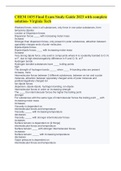
Chapter 1: Essential Ideas
1.1 Chemistry in Context
• Chemistry studies matter and the changes it undergoes.
• Applications: medicine, energy, environment, materials.
• Chemistry is closely connected to biology, physics, and the earth
sciences.
1.2 Phases and Classification of Matter
• States: solid, liquid, gas, plasma.
• Types: elements, compounds, mixtures.
→ Mixtures: homogeneous (uniform) vs. heterogeneous (not uniform).
1.3 Physical and Chemical Properties
• Physical properties: color, density, melting point (no change in identity).
• Chemical properties: flammability and reactivity (resulting in changes to
identity).
→ Examples = Physical (melting ice), Chemical (burning wood).
1.4 Measurements
• SI Units: meters (length), kilograms (mass), seconds (time), Kelvin
(temperature), moles (amount).
• Prefixes: kilo-, centi-, milli, etc.
• Volume = length³ (e.g., cm³ or mL).
1.5 Measurement Uncertainty, Accuracy, and Precision
• Accuracy: how close to the true value.
• Precision: how repeatable the measurements are.
• Use significant figures to reflect certainty.
**Remember: you cannot be more accurate than your least accurate digit**
,1.6 Mathematical Treatment of Measurements
• Significant figures in calculations:
o ×/÷ = least sig. Figs.
o +/− = least decimal places.
• Scientific notation helps with large/small numbers.
Chapter 2: Atoms, Molecules, and Ions
2.1 Early Atomic Theory
• Democritus: atoms are indivisible.
• Dalton's Atomic Theory: atoms make up elements and combine in ratios.
2.2 Evolution of Atomic Theory
• Discovery of electrons (Thomson), nucleus (Rutherford), protons &
neutrons.
2.3 Atomic Structure
• Proton (+), Neutron (0), Electron (−).
• Atomic number = protons = electrons (in a neutral atom).
• Mass number = protons + neutrons.
2.4 Chemical Formulas
• Molecular: exact number of atoms.
• Empirical: simplest ratio.
• Subscripts show how many atoms of each element.
2.5 The Periodic Table
• Organized by increasing atomic number.
• Groups (columns) = similar properties.
• Periods (rows) = energy levels.
2.6 Molecular and Ionic Compounds
• Ionic = metal + nonmetal (transfer of electrons).
• Molecular = nonmetal + nonmetal (sharing electrons).
• Formulas depend on charges (for ionic).
, 2.7 Chemical Nomenclature
• Ionic: metal (cation) + nonmetal (anion), with Roman numerals if
needed.
• Molecular: use prefixes (mono-, di-, tri...).
• Acids: binary (hydro- + -ic) vs. oxyacids (based on polyatomic ions).
Chapter 3: Composition of Substances and Solutions
3.1 Formula Mass and the Mole
• Mole = 6.022 × 10²³ particles.
• Molar mass = g/mol (from periodic table).
• Use molar mass to convert between grams moles particles.
3.2 Empirical and Molecular Formulas
• Empirical: simplest ratio.
• Molecular: actual number of atoms.
• Use percent composition and molar mass.
3.3 Molarity
• Molarity (M) = moles solute/liters solution.
• Used to calculate concentration.
3.4 Other Concentration Units
• Percent by mass, percent by volume, ppm, ppb.
• Useful in environmental and biological contexts.
Chapter 4: Stoichiometry
4.1 Balancing Chemical Equations
• The same number of each atom on both sides.
• Use coefficients, not subscripts.
4.2 Types of Chemical Reactions
• Synthesis, decomposition, single replacement, double replacement, and
combustion.
Chapter 1: Essential Ideas
1.1 Chemistry in Context
• Chemistry studies matter and the changes it undergoes.
• Applications: medicine, energy, environment, materials.
• Chemistry is closely connected to biology, physics, and the earth
sciences.
1.2 Phases and Classification of Matter
• States: solid, liquid, gas, plasma.
• Types: elements, compounds, mixtures.
→ Mixtures: homogeneous (uniform) vs. heterogeneous (not uniform).
1.3 Physical and Chemical Properties
• Physical properties: color, density, melting point (no change in identity).
• Chemical properties: flammability and reactivity (resulting in changes to
identity).
→ Examples = Physical (melting ice), Chemical (burning wood).
1.4 Measurements
• SI Units: meters (length), kilograms (mass), seconds (time), Kelvin
(temperature), moles (amount).
• Prefixes: kilo-, centi-, milli, etc.
• Volume = length³ (e.g., cm³ or mL).
1.5 Measurement Uncertainty, Accuracy, and Precision
• Accuracy: how close to the true value.
• Precision: how repeatable the measurements are.
• Use significant figures to reflect certainty.
**Remember: you cannot be more accurate than your least accurate digit**
,1.6 Mathematical Treatment of Measurements
• Significant figures in calculations:
o ×/÷ = least sig. Figs.
o +/− = least decimal places.
• Scientific notation helps with large/small numbers.
Chapter 2: Atoms, Molecules, and Ions
2.1 Early Atomic Theory
• Democritus: atoms are indivisible.
• Dalton's Atomic Theory: atoms make up elements and combine in ratios.
2.2 Evolution of Atomic Theory
• Discovery of electrons (Thomson), nucleus (Rutherford), protons &
neutrons.
2.3 Atomic Structure
• Proton (+), Neutron (0), Electron (−).
• Atomic number = protons = electrons (in a neutral atom).
• Mass number = protons + neutrons.
2.4 Chemical Formulas
• Molecular: exact number of atoms.
• Empirical: simplest ratio.
• Subscripts show how many atoms of each element.
2.5 The Periodic Table
• Organized by increasing atomic number.
• Groups (columns) = similar properties.
• Periods (rows) = energy levels.
2.6 Molecular and Ionic Compounds
• Ionic = metal + nonmetal (transfer of electrons).
• Molecular = nonmetal + nonmetal (sharing electrons).
• Formulas depend on charges (for ionic).
, 2.7 Chemical Nomenclature
• Ionic: metal (cation) + nonmetal (anion), with Roman numerals if
needed.
• Molecular: use prefixes (mono-, di-, tri...).
• Acids: binary (hydro- + -ic) vs. oxyacids (based on polyatomic ions).
Chapter 3: Composition of Substances and Solutions
3.1 Formula Mass and the Mole
• Mole = 6.022 × 10²³ particles.
• Molar mass = g/mol (from periodic table).
• Use molar mass to convert between grams moles particles.
3.2 Empirical and Molecular Formulas
• Empirical: simplest ratio.
• Molecular: actual number of atoms.
• Use percent composition and molar mass.
3.3 Molarity
• Molarity (M) = moles solute/liters solution.
• Used to calculate concentration.
3.4 Other Concentration Units
• Percent by mass, percent by volume, ppm, ppb.
• Useful in environmental and biological contexts.
Chapter 4: Stoichiometry
4.1 Balancing Chemical Equations
• The same number of each atom on both sides.
• Use coefficients, not subscripts.
4.2 Types of Chemical Reactions
• Synthesis, decomposition, single replacement, double replacement, and
combustion.