5.2 Reproduction in flowering plants
Flowers and their role in sexual reproduction
● Gametes are haploid (contain 1 set of chromosomes)
○ Male: pollen grains (花粉粒)/tube (花粉管)
○ Female: eggs
● When they join (fuse) together, fertilization has taken place
● Zygote is formed as result of fertilization, is single diploid cell (fertilized egg/ovum
cell)
● Then zygote divides into many cells (through mitotic cell division)
● Insect-pollinated flowers
(TB)
(SBA)
○
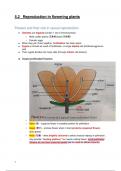
○ Stem (莖) - supports flower in suitable position for pollination
○ Sepal (萼片) - enclose flower when in bud (protects unopened flower),
often green
○ Petal (花瓣) - often brightly coloured to attract insects helping in pollination,
may provide “landing platform” for insects visiting flower; wind-pollinated
flowers do not have coloured petals (as no need to attract insects)
1
, ○ Stamen (雄蕊) - (collective) male part of flower
■ Anther (花藥) - contains developing pollen grains (containing male
cells), opens when pollen (dusty yellow powder) is mature, produce
male gametes — (in) pollen grains
■ Filament (絲狀物) - supports anther, extending anther up to an
accessible part of flower for pollinators to reach {insect-pollinating}/for
wind to disperse pollen {wind-pollinating}
○ Carpel (心皮) - (collective) female part of flower
■ Stigma (柱頭) - receives pollen during pollination, top of female part
of flower which collects pollen grains
■ Style (柱) - supports stigma and pollen tube which grows down it to
reach ovary, connects stigma to ovary, assist with fertilization by
being the location where pollen tubes travel to deliver sperm cells
to egg
■ Ovary (子房) - produces female gametes/egg cells
● Ovule (胚珠) - contain female egg cells/gametes, after
fertilization by male cell develops into seed, borne in ovary of
flower, consists of nucellus (細胞核) protected by integuments
(外皮), precursors (前體) of embryo/endosperm (胚乳) and
seed coat respectively
○ Nectary (蜜腺) - produces sugary solution called nectar, attracting insects for
pollination {nectar is food/“reward” for pollination by insects}
○ Peduncle (花梗) - stalk supporting an inflorescence/solitary flower
○ Receptacle (花托)
2
Flowers and their role in sexual reproduction
● Gametes are haploid (contain 1 set of chromosomes)
○ Male: pollen grains (花粉粒)/tube (花粉管)
○ Female: eggs
● When they join (fuse) together, fertilization has taken place
● Zygote is formed as result of fertilization, is single diploid cell (fertilized egg/ovum
cell)
● Then zygote divides into many cells (through mitotic cell division)
● Insect-pollinated flowers
(TB)
(SBA)
○
○ Stem (莖) - supports flower in suitable position for pollination
○ Sepal (萼片) - enclose flower when in bud (protects unopened flower),
often green
○ Petal (花瓣) - often brightly coloured to attract insects helping in pollination,
may provide “landing platform” for insects visiting flower; wind-pollinated
flowers do not have coloured petals (as no need to attract insects)
1
, ○ Stamen (雄蕊) - (collective) male part of flower
■ Anther (花藥) - contains developing pollen grains (containing male
cells), opens when pollen (dusty yellow powder) is mature, produce
male gametes — (in) pollen grains
■ Filament (絲狀物) - supports anther, extending anther up to an
accessible part of flower for pollinators to reach {insect-pollinating}/for
wind to disperse pollen {wind-pollinating}
○ Carpel (心皮) - (collective) female part of flower
■ Stigma (柱頭) - receives pollen during pollination, top of female part
of flower which collects pollen grains
■ Style (柱) - supports stigma and pollen tube which grows down it to
reach ovary, connects stigma to ovary, assist with fertilization by
being the location where pollen tubes travel to deliver sperm cells
to egg
■ Ovary (子房) - produces female gametes/egg cells
● Ovule (胚珠) - contain female egg cells/gametes, after
fertilization by male cell develops into seed, borne in ovary of
flower, consists of nucellus (細胞核) protected by integuments
(外皮), precursors (前體) of embryo/endosperm (胚乳) and
seed coat respectively
○ Nectary (蜜腺) - produces sugary solution called nectar, attracting insects for
pollination {nectar is food/“reward” for pollination by insects}
○ Peduncle (花梗) - stalk supporting an inflorescence/solitary flower
○ Receptacle (花托)
2