ISYE6644 (SIMULATION) LATEST
MIDTERM 1
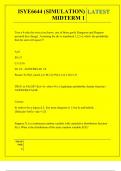
Toss a 4-side die twice (you know, one of those goofy Dungeons and Dragons
pyramid dice things). Assuming the die is numbered 1,2,3,4, what's the probability
that the sum will equal 3?
A) 0
B) 1/2
C) 13/16
D) 1/8 - ANSWERS-D) 1/8
P(sum=3)=P((1,2)or(2,1))=P(1,2)+P(2,1)=2(1/16)=1/8.
TRUE or FALSE? f(x)=3e−xforx>0 is a legitimate probability density function. -
ANSWERS-FALSE
Correct:
In order to be a legit p.d.f., f(x) must integrate to 1; but lo and behold. .
.∫Rf(x)dx=∫∞03e−xdx=3.☹
Suppose X is a continuous random variable with cumulative distribution function
F(x). What is the distribution of the nasty random variable F(X)?
END OF
PAGE
1
, ISYE6644 (SIMULATION) LATEST
MIDTERM 1
A) Normal
B) Unif (0,1)
C) Exponential
D) Weibull - ANSWERS-Unif (0, 1) - this is the Inverse Transform Theorem
Suppose U is a Unif (0,1) random variable. Name the distribution of X=−ℓn(1−U).
A) Normal
B) Unif (0, 1)
C) Exponential
D) Weibull - ANSWERS-C) Exponential
The abbreviation "m.g.f." stands for... - ANSWERS-Moment Generating Function
What is the concept of double expectation? - ANSWERS-Idea: the average
expected value of all of the conditional expected values is the overall population
average.
TRUE or FALSE? If 𝑋 and 𝑌 are uncorrelated, then they're independent. -
ANSWERS-False
END OF
PAGE
2
, ISYE6644 (SIMULATION) LATEST
MIDTERM 1
What is the most-important theorem in the universe? - ANSWERS-Central limit
theorem
What is the central limits theorem? - ANSWERS-In probability theory, the central
limit theorem establishes that, in some situations, when independent random
variables are added, their properly normalized sum tends toward a normal
distribution even if the original variables themselves are not normally distributed.
Let's take a bunch of independent observations from a "well-behaved" distribution.
The Central Limit Theorem says that the standardized sample mean of those
observations converges to what distribution? - ANSWERS-Normal
What are three things that help define what a statistic is? - ANSWERS-1) a statistic
is a function of the observations X1 through Xn and not dependent on any
unknowns. So basically something like the mean, cause you know all the
parameters
2) statistics are random variables
3) a statistic is usually used to estimate some unknown parameter from the
underlying probability distribution of the X's
What is unbiasedness? - ANSWERS-the expected value of Xbar (the sample mean)
equals the actual mean (mu)
END OF
PAGE
3
MIDTERM 1
Toss a 4-side die twice (you know, one of those goofy Dungeons and Dragons
pyramid dice things). Assuming the die is numbered 1,2,3,4, what's the probability
that the sum will equal 3?
A) 0
B) 1/2
C) 13/16
D) 1/8 - ANSWERS-D) 1/8
P(sum=3)=P((1,2)or(2,1))=P(1,2)+P(2,1)=2(1/16)=1/8.
TRUE or FALSE? f(x)=3e−xforx>0 is a legitimate probability density function. -
ANSWERS-FALSE
Correct:
In order to be a legit p.d.f., f(x) must integrate to 1; but lo and behold. .
.∫Rf(x)dx=∫∞03e−xdx=3.☹
Suppose X is a continuous random variable with cumulative distribution function
F(x). What is the distribution of the nasty random variable F(X)?
END OF
PAGE
1
, ISYE6644 (SIMULATION) LATEST
MIDTERM 1
A) Normal
B) Unif (0,1)
C) Exponential
D) Weibull - ANSWERS-Unif (0, 1) - this is the Inverse Transform Theorem
Suppose U is a Unif (0,1) random variable. Name the distribution of X=−ℓn(1−U).
A) Normal
B) Unif (0, 1)
C) Exponential
D) Weibull - ANSWERS-C) Exponential
The abbreviation "m.g.f." stands for... - ANSWERS-Moment Generating Function
What is the concept of double expectation? - ANSWERS-Idea: the average
expected value of all of the conditional expected values is the overall population
average.
TRUE or FALSE? If 𝑋 and 𝑌 are uncorrelated, then they're independent. -
ANSWERS-False
END OF
PAGE
2
, ISYE6644 (SIMULATION) LATEST
MIDTERM 1
What is the most-important theorem in the universe? - ANSWERS-Central limit
theorem
What is the central limits theorem? - ANSWERS-In probability theory, the central
limit theorem establishes that, in some situations, when independent random
variables are added, their properly normalized sum tends toward a normal
distribution even if the original variables themselves are not normally distributed.
Let's take a bunch of independent observations from a "well-behaved" distribution.
The Central Limit Theorem says that the standardized sample mean of those
observations converges to what distribution? - ANSWERS-Normal
What are three things that help define what a statistic is? - ANSWERS-1) a statistic
is a function of the observations X1 through Xn and not dependent on any
unknowns. So basically something like the mean, cause you know all the
parameters
2) statistics are random variables
3) a statistic is usually used to estimate some unknown parameter from the
underlying probability distribution of the X's
What is unbiasedness? - ANSWERS-the expected value of Xbar (the sample mean)
equals the actual mean (mu)
END OF
PAGE
3