1 of 17
Term
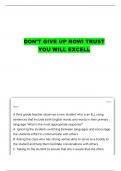
A third grade teacher observes a new student who is an ELL using
sentences that include both English words and words in their primary
language. What is the most appropriate response?
A. Ignoring the students switching between languages and encourage
the students effort to communicate with others
B. Asking the class who has strong verbal skills to serve as a buddy to
the student and help them facilitate conversations with others
C. Talking to the student to ensure that she is aware that she often
, mixes up the two languages
D. Providing student with bilingual dictionary
Give this one a try later!
C B
A D
Don't know?
2 of 17
Term
Which assessment strategy would provide the best measure of a
students mastery of the alphabet principle?
A. Asking students to identify by name a series of visually presented
uppercase and lowercase letters.
B. Having a student read aloud a list of high-frequency irregular sight
words.
C. Asking the student to segment a series of orally presented words
into component sounds
D. Having the students read aloud a list of phonetically regular
nonsense words
Give this one a try later!
Term
A third grade teacher observes a new student who is an ELL using
sentences that include both English words and words in their primary
language. What is the most appropriate response?
A. Ignoring the students switching between languages and encourage
the students effort to communicate with others
B. Asking the class who has strong verbal skills to serve as a buddy to
the student and help them facilitate conversations with others
C. Talking to the student to ensure that she is aware that she often
, mixes up the two languages
D. Providing student with bilingual dictionary
Give this one a try later!
C B
A D
Don't know?
2 of 17
Term
Which assessment strategy would provide the best measure of a
students mastery of the alphabet principle?
A. Asking students to identify by name a series of visually presented
uppercase and lowercase letters.
B. Having a student read aloud a list of high-frequency irregular sight
words.
C. Asking the student to segment a series of orally presented words
into component sounds
D. Having the students read aloud a list of phonetically regular
nonsense words
Give this one a try later!