D389 Learning Strategies in Higher Education Flash Cards ALL SOLUTION 2025 EDITION GUARANTEED GRADE A+3
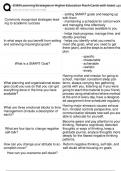
D389 Learning Strategies in Higher Education Flash Cards ALL SOLUTION 2025 EDITION GUARANTEED GRADE A+3 Commonly recognized strategies leading to academic success - setting SMART goals and keeping up with them - maintaining a schedule for school work and managing time effectively - access all resources available to you In what ways do you benefit from setting and achieving meaningful goals? - helps track progress, manage time, and identify priorities - helps you identify what you need to meet (the goal), what you need to get there (plan), and the steps to achieve this plan. What is a SMART Goal? - specific - measurable - achievable - realistic - timely What planning and organizational strategies could you use so that you can get everything done in the time you have available? Having motive and mission for going to school, maintain consistent sleep patterns, always carrying two gathering points with you, listening as if you were going to teach the material to your friend, process using what/when/where method at the end of every day, have a designated assignment time scheduled regularly. What are three emotional blocks to time management (include a description of each)? Having major stressors causes exhaustion, mindset controls perspective, and communication dictates how well you are able to advocate for yourself. What are four tips to change negative self-talk? Become aware and pay attention to your thinking, Reframe cognitively distorted thoughts or ways of thinking, keep a gratitude journal, analyze thoughts more deeply for the flawed negative thinking patterns. How can you change your attitude to accomplish more? Reform negative thinking, self-talk, and self-doubt while focusing on goals How can you overcome self-doubt? Identify and list what causes the doubt, let go of negative perceptions of reality, use positive thoughts and language, and stay steadily focused on your goals. Describe the Tapering Approach study strategy: by providing the method and advantages: Use and four-hour study block and divide it into one hour of studying, followed by a ten-minute break; next is 50 min of studying and a ten-minute break, lastly you have a 45-minute study block followed by a 5-minute break. The final two sessions are solid 30-minute power sessions. Identify commonly recognized strategies leading to success in studying and test-taking. PQ3R, Note taking using different methods such as the outline or mind mapping, methodical approaches, use questions to learn material. Cornell Method: way to divide the paper that helps avoid laborious measure for recopying notes Method: 2 1/1 inch left-handed margin used for labeling each idea and detail with a key word or clue, 6 inch right-handed margin used for copying notes as well as you can with as much information as possible Advantages: organized and systematic for recording both notes and key ideas and main points for reviewing notes, easy format for pulling out major concepts and ideas, simple and efficient, saves time and effort Outlining Method: Method: the most generalized information is listed as far left as possible, where each indentation expands on the more general term before it, can have multiple levels of specification by having multiple levels of indentations. Advantages: well organized if done properly, outlining records content as well as relationships, reduces editing and is easy to review by turning main points into questions Mind-Mapping: Method: visual notetaking form which relates each fact or idea to another through circles and lines connected; maximizes active participation, affords immediate knowledge as to its understanding and emphasizes critical thinking Advantages: helps to track information visually, relationships and connections can be easily seen, easy to edit, review calls for restructuring of thought processes, easily made into other forms of notes Charting Method: If the information is distinct or chronological, it may be helpful to set up your paper by drawing columns and labeling appropriate headings. Method: main points are listed at the tops of the columns and information is listed under the appropriated slot on the chart Advantages: helps track information in an organized and chronological fashion, reduces writing necessary, easy to review for memorization and comparison or to understand relationships, Sentence Method: used when course content is heavy and somewhat organized, but you don't know how it all relates Method: write every new thought/idea, topic, or fact on a new line, numbering or bulleting as you progress Advantages: slightly more organized than a paragraph, gets more or all of the information, thinking to tract content is still limited thought. What is the difference between notetaking for linear-vs-nonlinear concepts? Linear notes are most appropriate for sequential or chronological information, things that follow an order, such as history; Non-linear is appropriate for mapping/visual notetaking as the information isn't sequential or directly related. Pomodoro: includes intentional timed breaks Method: 25 min. Timer, specific parameters on what is to be completed, 5 min. Break, repeat; lengthen break after every 4th session. Advantages: helps keep focus when necessary and allows for break to renew attention span and aides in retention PQ3R: Review, Question, Read, Recite, Review Method: go through material, take notes and turn the main ideas into questions, read the questions, recite and review questions and answers as well as material that got you to the
Written for
- Institution
- D389 Learning Strategies in Higher Education Flash
- Course
- D389 Learning Strategies in Higher Education Flash
Document information
- Uploaded on
- January 13, 2025
- Number of pages
- 4
- Written in
- 2024/2025
- Type
- Exam (elaborations)
- Contains
- Questions & answers
Subjects
- what is a smart goal
-
d389 learning strategies in higher education flash
-
commonly recognized strategies leading to academic
-
in what ways do you benefit from setting and achie