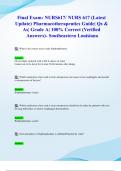
Examl3:lNURS617/lNURSl617l(Latestl
Update)lPharmacotherapeuticslGuide|lQsl&l
As|lGradelA|l100%lCorrectl(Verifiedl
Answers)-lSoutheasternlLouisiana
Q:lCausesloflFailureloflAntimicrobiallTherapyl
Answer:
1.lInadequatelefficacylagainstltheloffendinglorganisms
2.lInadequatelbioavailabilityloflthelselectedlagent
3.lInadequatelhostldefenselmechanisms
4.lInadequateldurationlofldrugltherapy
5.lSuperinfectionlorlbacteriallresistance
Q:lCausesloflFailureloflAntimicrobiallTherapy
1.lInadequatelefficacylagainstltheloffendinglorganismsl
Answer:
-lIncorrectlidentificationlofltheloffendinglorganism
-lUseloflaldrugltolwhichlorganismslhavelpreviouslylbecomelresistant
-lUseloflalmicrobiostaticlagentlwhenlalmicrobicidallagentlislnecessary
Q:lCausesloflFailureloflAntimicrobiallTherapy
2.lInadequatelbioavailabilityloflthelselectedlagentl
Answer:
-lUseloflanlincorrectldose
-lUseloflanlincorrectlroutelofladministration
-lUseloflanlincorrectldosinglinterval
-
lUseloflanlincorrectlantimicrobialltherapeuticlplan,lonelthatldoeslnotltakelintolconsiderationlthel
pharmacokineticlvariableslthatlexistlinltheltreatedlpatient
,Q:lCausesloflFailureloflAntimicrobiallTherapy
3.lInadequatelhostldefenselmechanismsl
Answer:
-
lFailingltolrecognizelthatlthelpatientlhaslinsufficientlimmunelresponseslneededltolassistlinlantim
icrobiallefficacy,lsuchlaslthoselwithlAIDS,lmalnutrition,limmunosuppression,lcancer,
patientslonlglucocorticoids,lpatientslwithllargelabscesses,lpatientslwithloverwhelminglsepsis,lan
dlpatientslharboringlnecroticltissues.
Q:lCausesloflFailureloflAntimicrobiallTherapy
4.lInadequateldurationlofldrugltherapyl
Answer:
Changingldrugslwithoutlevidencelofltreatmentlfailure
-
lTreatinglwithlcostlyldrugsl(thatlthelpatientlcannotlaffordltolbuy)lwhenllesslexpensiveldrugslwo
uldlhavelbeenlappropriate
-lTreatinglwithlhighlyltoxicldrugslwhenllesslharmfulldrugslwouldlhavelbeenlappropriate
-lFailureltolallowlforlvarianceslinlpatientlcompliancelforlalvarietyloflreasons
Q:lCausesloflFailureloflAntimicrobiallTherapy
5.lSuperinfectionlorlbacteriallresistancel
Answer:
Useloflbroad-spectrumlantibioticslwhenlmoreltargeted,lnarrow-
spectrumlagentslarelmorelappropriate
-lOtherlinappropriatelusesloflantimicrobiallagents
Q:lGenerallConsiderationslforlthelUseloflAntibioticsl
Answer:
ClassesloflAntibioticlDrugsl-lbasedlonlmechanismsloflactionloflthelantibiotics
1.lBlockadeloflpeptidoglycanlsynthesislislthelmajorlcomponentloflalbacteriallcelllwall.lBacterial
lcelllwallldestructionlallowslwaterltolenterlthelintracellularlmilieuloflthelbacteria,lcausingltheml
tolswell,llysel(explode)landldie.lInhibitionloflcelllwalllsynthesislislbacteriocidal.
,2.lDisruptionloflbacteriallcelllplasmalmembraneslbylbindingltollipoproteinslinlthelmembrane.lT
hislmechanismlonlyloccurslonlthelouterlmembraneloflsomelgram-negativelbacterial
organismslandlislusuallylbactericidal.
3.lBindingltolbacteriallribosomeslandlblockinglsomelbacteriallproteinlsynthesis.lDependinglonlt
helspecificlproteinlsyntheticlmechanismslblocked,lthelagentlcanlbelbactericidall(i.e.,lthe
aminoglycosides).lHowever,lMostlantibioticslthatlworklbylthislmechanismlarelbacteriostatic.
4.lBlockinglbacteriallDNAlreplication,lprobablylbylinterferinglwithlalspecificlenzymel(DNAlgy
rase).lThislmechanismlislusuallylbactericidallbutlcanlbelbacteriostaticldependinglonltheldose.
5.lPreventionloflnucleiclacidlsynthesislbylblockinglmRNAlandlsecondarilylpreventinglselectedl
proteinlsynthesis.lThislmechanismlislusuallylbactericidal.
6.lBlockinglfoliclacidlsynthesis:lThislislanlessentiallmetabolitelinlbacteriallmetabolismlthatlthel
bacteriumlmustlsynthesize.lBylblockinglthelsynthesisloflfoliclacid,lseverallmetaboliclprocessesl
arelinhibited.lThislprocesslislusuallylbacteriostatic.
Q:lBACTERIALlANTIBIOTIClRESISTANCE
-lResistanceltolantibioticslcanlbe:
(A)lIntrinsicl-l
Answer:
Resistancelthatlhaslalwayslexistedlinlthelstructureloflthelbacteria;litlislalwayslinherentlinlthelge
neticsloflthatlparticularlspecies.l(Forlexample,lgram-negativelbacterialare
nowlandlhavelalwayslbeenlresistantltolspecificlantibioticlagents.)
Q:lBACTERIALlANTIBIOTIClRESISTANCE
-lResistanceltolantibioticslcanlbe:
(B)lAcquiredl
Answer:
Resistancelthatloriginateslinlanlindividuallbacteriumlaslalresultloflalchromosomallmutationlorlt
heltransferloflchromosomallfragmentsloflDNAl(plasmidslorltransposons)lbetweenlbacterialthatli
slinducedlinlthemlbecauseloflcurrentlorlpriorlexposurelto
anlantibioticlagent.lAcquiredlresistancelusuallylresultslfromlselectivelantibioticlexposure,lwhich
lcanlresultlfromleitherlappropriatelorlinappropriatelusageloflthelantibioticlagent.
Q:lMECHANISMSlOFlANTIBIOTIClRESISTANCEl
Answer:
1.lImpermeabilityloflthelbacteriallcelllwallltolthelantibiotic
, 2.lActiveleffluxloflthelantibioticlfromlthelbacteriumlbeforelthelpharmacodynamicsloflthelantibi
oticlcanlbecomeleffective
3.lPlasmid-mediatedlalterationlorlinactivationloflthelantibioticlbylbacterially-
synthesizedlenzymes
4.lAlterationloflthelbacteria'sltargetlsite;lanlactionloflthelbacteriumlitself.
5.lBypassloflanlantibiotic-obstructedlmetaboliclpathway
6.lStructurallchangeloflanlantibiotic-bindinglsite
7.lStructurallchangeloflalbacteriallcelllcomponentlthatlislusuallylalteredlbylthelantibiotic
Q:lClassificationloflBacteriallOrganisms
GRAMlPOSITIVElAEROBESl(theselbacterialrequireloxygenltolsurvive)
-Coccil
Answer:
olstaphylococcus
olstreptococcus
olpneumococcus
Q:lClassificationloflBacteriallOrganisms
GRAMlPOSITIVElAEROBESl(theselbacterialrequireloxygenltolsurvive)
-Bacillil
Answer:
olcorynebacterium
ollisterial-linlquiz
olbacilluslanthracisl(Anthrax)
Q:lGRAMlPOSITIVElANAEROBESl(theselbacterialcanllivelinldeepltissueslwithllowllevelslo
floxygen)l
Answer:
-lclostridium
-lpeptococcus
-lpeptostreptococcus
Q:lGRAMlNEGATIVElAEROBES
-lCoccil
Update)lPharmacotherapeuticslGuide|lQsl&l
As|lGradelA|l100%lCorrectl(Verifiedl
Answers)-lSoutheasternlLouisiana
Q:lCausesloflFailureloflAntimicrobiallTherapyl
Answer:
1.lInadequatelefficacylagainstltheloffendinglorganisms
2.lInadequatelbioavailabilityloflthelselectedlagent
3.lInadequatelhostldefenselmechanisms
4.lInadequateldurationlofldrugltherapy
5.lSuperinfectionlorlbacteriallresistance
Q:lCausesloflFailureloflAntimicrobiallTherapy
1.lInadequatelefficacylagainstltheloffendinglorganismsl
Answer:
-lIncorrectlidentificationlofltheloffendinglorganism
-lUseloflaldrugltolwhichlorganismslhavelpreviouslylbecomelresistant
-lUseloflalmicrobiostaticlagentlwhenlalmicrobicidallagentlislnecessary
Q:lCausesloflFailureloflAntimicrobiallTherapy
2.lInadequatelbioavailabilityloflthelselectedlagentl
Answer:
-lUseloflanlincorrectldose
-lUseloflanlincorrectlroutelofladministration
-lUseloflanlincorrectldosinglinterval
-
lUseloflanlincorrectlantimicrobialltherapeuticlplan,lonelthatldoeslnotltakelintolconsiderationlthel
pharmacokineticlvariableslthatlexistlinltheltreatedlpatient
,Q:lCausesloflFailureloflAntimicrobiallTherapy
3.lInadequatelhostldefenselmechanismsl
Answer:
-
lFailingltolrecognizelthatlthelpatientlhaslinsufficientlimmunelresponseslneededltolassistlinlantim
icrobiallefficacy,lsuchlaslthoselwithlAIDS,lmalnutrition,limmunosuppression,lcancer,
patientslonlglucocorticoids,lpatientslwithllargelabscesses,lpatientslwithloverwhelminglsepsis,lan
dlpatientslharboringlnecroticltissues.
Q:lCausesloflFailureloflAntimicrobiallTherapy
4.lInadequateldurationlofldrugltherapyl
Answer:
Changingldrugslwithoutlevidencelofltreatmentlfailure
-
lTreatinglwithlcostlyldrugsl(thatlthelpatientlcannotlaffordltolbuy)lwhenllesslexpensiveldrugslwo
uldlhavelbeenlappropriate
-lTreatinglwithlhighlyltoxicldrugslwhenllesslharmfulldrugslwouldlhavelbeenlappropriate
-lFailureltolallowlforlvarianceslinlpatientlcompliancelforlalvarietyloflreasons
Q:lCausesloflFailureloflAntimicrobiallTherapy
5.lSuperinfectionlorlbacteriallresistancel
Answer:
Useloflbroad-spectrumlantibioticslwhenlmoreltargeted,lnarrow-
spectrumlagentslarelmorelappropriate
-lOtherlinappropriatelusesloflantimicrobiallagents
Q:lGenerallConsiderationslforlthelUseloflAntibioticsl
Answer:
ClassesloflAntibioticlDrugsl-lbasedlonlmechanismsloflactionloflthelantibiotics
1.lBlockadeloflpeptidoglycanlsynthesislislthelmajorlcomponentloflalbacteriallcelllwall.lBacterial
lcelllwallldestructionlallowslwaterltolenterlthelintracellularlmilieuloflthelbacteria,lcausingltheml
tolswell,llysel(explode)landldie.lInhibitionloflcelllwalllsynthesislislbacteriocidal.
,2.lDisruptionloflbacteriallcelllplasmalmembraneslbylbindingltollipoproteinslinlthelmembrane.lT
hislmechanismlonlyloccurslonlthelouterlmembraneloflsomelgram-negativelbacterial
organismslandlislusuallylbactericidal.
3.lBindingltolbacteriallribosomeslandlblockinglsomelbacteriallproteinlsynthesis.lDependinglonlt
helspecificlproteinlsyntheticlmechanismslblocked,lthelagentlcanlbelbactericidall(i.e.,lthe
aminoglycosides).lHowever,lMostlantibioticslthatlworklbylthislmechanismlarelbacteriostatic.
4.lBlockinglbacteriallDNAlreplication,lprobablylbylinterferinglwithlalspecificlenzymel(DNAlgy
rase).lThislmechanismlislusuallylbactericidallbutlcanlbelbacteriostaticldependinglonltheldose.
5.lPreventionloflnucleiclacidlsynthesislbylblockinglmRNAlandlsecondarilylpreventinglselectedl
proteinlsynthesis.lThislmechanismlislusuallylbactericidal.
6.lBlockinglfoliclacidlsynthesis:lThislislanlessentiallmetabolitelinlbacteriallmetabolismlthatlthel
bacteriumlmustlsynthesize.lBylblockinglthelsynthesisloflfoliclacid,lseverallmetaboliclprocessesl
arelinhibited.lThislprocesslislusuallylbacteriostatic.
Q:lBACTERIALlANTIBIOTIClRESISTANCE
-lResistanceltolantibioticslcanlbe:
(A)lIntrinsicl-l
Answer:
Resistancelthatlhaslalwayslexistedlinlthelstructureloflthelbacteria;litlislalwayslinherentlinlthelge
neticsloflthatlparticularlspecies.l(Forlexample,lgram-negativelbacterialare
nowlandlhavelalwayslbeenlresistantltolspecificlantibioticlagents.)
Q:lBACTERIALlANTIBIOTIClRESISTANCE
-lResistanceltolantibioticslcanlbe:
(B)lAcquiredl
Answer:
Resistancelthatloriginateslinlanlindividuallbacteriumlaslalresultloflalchromosomallmutationlorlt
heltransferloflchromosomallfragmentsloflDNAl(plasmidslorltransposons)lbetweenlbacterialthatli
slinducedlinlthemlbecauseloflcurrentlorlpriorlexposurelto
anlantibioticlagent.lAcquiredlresistancelusuallylresultslfromlselectivelantibioticlexposure,lwhich
lcanlresultlfromleitherlappropriatelorlinappropriatelusageloflthelantibioticlagent.
Q:lMECHANISMSlOFlANTIBIOTIClRESISTANCEl
Answer:
1.lImpermeabilityloflthelbacteriallcelllwallltolthelantibiotic
, 2.lActiveleffluxloflthelantibioticlfromlthelbacteriumlbeforelthelpharmacodynamicsloflthelantibi
oticlcanlbecomeleffective
3.lPlasmid-mediatedlalterationlorlinactivationloflthelantibioticlbylbacterially-
synthesizedlenzymes
4.lAlterationloflthelbacteria'sltargetlsite;lanlactionloflthelbacteriumlitself.
5.lBypassloflanlantibiotic-obstructedlmetaboliclpathway
6.lStructurallchangeloflanlantibiotic-bindinglsite
7.lStructurallchangeloflalbacteriallcelllcomponentlthatlislusuallylalteredlbylthelantibiotic
Q:lClassificationloflBacteriallOrganisms
GRAMlPOSITIVElAEROBESl(theselbacterialrequireloxygenltolsurvive)
-Coccil
Answer:
olstaphylococcus
olstreptococcus
olpneumococcus
Q:lClassificationloflBacteriallOrganisms
GRAMlPOSITIVElAEROBESl(theselbacterialrequireloxygenltolsurvive)
-Bacillil
Answer:
olcorynebacterium
ollisterial-linlquiz
olbacilluslanthracisl(Anthrax)
Q:lGRAMlPOSITIVElANAEROBESl(theselbacterialcanllivelinldeepltissueslwithllowllevelslo
floxygen)l
Answer:
-lclostridium
-lpeptococcus
-lpeptostreptococcus
Q:lGRAMlNEGATIVElAEROBES
-lCoccil