Pricing and Monetisation Strategies Summary:
Pricing Lecture 1:
The Marketing Framework:
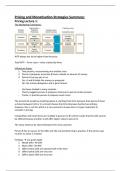
WTP always has to be higher than the price.
Total WTP – Firms costs = value created by firms
Ultimatum Game:
1. Two persons, encountering one another once
2. Person A proposes to person B how to divide an amount of money
3. Person B can say yes or no
- Yes: A and B divide the money as proposed
- No: the money disappears and is gone forever
- Has been studied in many contexts
- Theory suggests person A proposes minimum to person B who accepts
- Puzzle: In practice person A proposes much more
The economist would say anything above 0, starting from 0,01, because then person B have
a choice between 0,01 or 0, so B will choose the 0,01 otherwise he/she has nothing.
However, this is not fair which is a non-economic answer but is it super important to
consider in pricing.
Competition will mean there are multiple A persons to B’s which results that the 0,01 cannot
be offered because another A will offer higher value to person B.
The value needs to be shared between firm and customer.
Person B has to say yes to the offer just like real world pricing in practice, if the person says
no then no value is created.
Findings: → are quite stable
1. Modal offer: 40-50%
2. Mean offer: 30-40%
3. Offers below 20% are rejected half of the time
4. Offers below 10% are very rare
5. Offers above 50% are very rare
, 6. Offers around 40-50% are rarely rejected
How stable are these findings?
- Repetition: has little effect
- Stakes: some % effect, though person B will still reject larger offers with higher stakes
- Anonymity: has little effect
- Gender: same offers, women reject less often
- Race: little difference
- Age: little children make smaller offers than adults
- Brains: those who figured out the equilibrium offered 5% less
- Biology: high testosterone males reject more but make larger offers
- Beauty: somewhat higher offers to beautiful people
Dictator Game:
1. Two persons, encountering one another once
2. Person A proposes to person B how to divide an amount of money
3. Person B has to accept
People still transfer the same as the ultimatum game which is used to study altruism.
Pricing decisions:
- Sharing the value a company creates between itself and its customers
Sharing value between firms and customers which gets shifted due to competition. In a
competitive market customers have more surplus than a firm has margin. Vice versa in a
monopoly.
Customers get surplus, is utility and measured, how happy are you with the deal, your WTP
was higher than you had to pay. Buying at WTP does not make a customer happy, thus even
a monopolist needs to take this into account that the WTP exactly cannot be asked.
Firms get margin, measured.
Key Take Aways:
1. Pricing is the function that shares value between sellers and consumers, divides
value, need to think about consumer surplus, ethics, fairness.
2. Foundation of the course is economic frameworks + elements of psychology, focused
on marketing practice.
3. Course is going to be hands-on. Grading based on homework, cases, and exam.
Pricing Lecture 2: Measuring Preferences
,Pricing there are 3 fundamental ways:
1. Competitive based pricing → looking at competition for a benchmark → used when
products are very similar
2. Value based pricing → looks at valuation of consumer of product = WTP → used
when product is unique, monopolist
3. Cost based pricing → looking at company and looking at producing cheap products,
look where you will be profitable and determine margin for profit.
1. Issues in measuring consumer preference:
What are good measures of preference?
1. Purchase intention
2. Price elasticity → similar substitutes are available, the market will be very sensitive
to price → measure of much margin you can charge, not really a preference measure
3. Brand attitude → people may be willing to pay premium for a brand they like
(paracetamol)
4. Attribute importance → which aspects of the product makes the consumer happy,
what drives their preferences, but also how much does it cost to produce such
attributes
5. Willingness to pay
6. Brand loyalty
7. Sales → actual behaviour of consumers and their preference
Preferences:
- Intention to buy
o Too hard a question
o Overconfident about buying probability
- Self-reported importance weights
o Lack of discrimination, everything is important
- Trade-offs
o Benefits and costs
o What is desired most
- Actual purchase data
o Counts
o Sales force reports
Stated intention-to-buy measures:
, 1. Martin Luther King: 20 – 40
2. Long river Nile: 2000 – 10 000 km
3. How many countries in OPAC: 30 – 600
4. How many books in Old Testament: 80.000 – 120.000.000
5. Diameter of the moon: 10.000 – 500.000
6. Weight of a Boeing 747: 1.000 – 15.000
7. In what year was Mozart born: 1800 – 1950
8. How long is mama elephant pregnant: 1 – 3 years
9. What is the shortest air distance between London and Tokyo: 3.000 – 8.000 km
10. Deepest known point in oceans: 50.000 – 500.000 km
Toward Conjoint Analysis:
Conjoint Analysis:
- Conjoint is a survey-based research technique designed to force customers to make
trade-offs, thereby revealing their true preferences.
- In conjoint, products and services are treated as combinations of features
- Procedure produces a mathematical model of each customer’s “value system”
Aims to do two things really well:
1. Willingness to pay:
- Measure what individual consumers are willing to give up to obtain certain product
benefits
2. Distribution of willingness to pay:
- Measure how consumers differ in their willingness to pay
Pricing Lecture 1:
The Marketing Framework:
WTP always has to be higher than the price.
Total WTP – Firms costs = value created by firms
Ultimatum Game:
1. Two persons, encountering one another once
2. Person A proposes to person B how to divide an amount of money
3. Person B can say yes or no
- Yes: A and B divide the money as proposed
- No: the money disappears and is gone forever
- Has been studied in many contexts
- Theory suggests person A proposes minimum to person B who accepts
- Puzzle: In practice person A proposes much more
The economist would say anything above 0, starting from 0,01, because then person B have
a choice between 0,01 or 0, so B will choose the 0,01 otherwise he/she has nothing.
However, this is not fair which is a non-economic answer but is it super important to
consider in pricing.
Competition will mean there are multiple A persons to B’s which results that the 0,01 cannot
be offered because another A will offer higher value to person B.
The value needs to be shared between firm and customer.
Person B has to say yes to the offer just like real world pricing in practice, if the person says
no then no value is created.
Findings: → are quite stable
1. Modal offer: 40-50%
2. Mean offer: 30-40%
3. Offers below 20% are rejected half of the time
4. Offers below 10% are very rare
5. Offers above 50% are very rare
, 6. Offers around 40-50% are rarely rejected
How stable are these findings?
- Repetition: has little effect
- Stakes: some % effect, though person B will still reject larger offers with higher stakes
- Anonymity: has little effect
- Gender: same offers, women reject less often
- Race: little difference
- Age: little children make smaller offers than adults
- Brains: those who figured out the equilibrium offered 5% less
- Biology: high testosterone males reject more but make larger offers
- Beauty: somewhat higher offers to beautiful people
Dictator Game:
1. Two persons, encountering one another once
2. Person A proposes to person B how to divide an amount of money
3. Person B has to accept
People still transfer the same as the ultimatum game which is used to study altruism.
Pricing decisions:
- Sharing the value a company creates between itself and its customers
Sharing value between firms and customers which gets shifted due to competition. In a
competitive market customers have more surplus than a firm has margin. Vice versa in a
monopoly.
Customers get surplus, is utility and measured, how happy are you with the deal, your WTP
was higher than you had to pay. Buying at WTP does not make a customer happy, thus even
a monopolist needs to take this into account that the WTP exactly cannot be asked.
Firms get margin, measured.
Key Take Aways:
1. Pricing is the function that shares value between sellers and consumers, divides
value, need to think about consumer surplus, ethics, fairness.
2. Foundation of the course is economic frameworks + elements of psychology, focused
on marketing practice.
3. Course is going to be hands-on. Grading based on homework, cases, and exam.
Pricing Lecture 2: Measuring Preferences
,Pricing there are 3 fundamental ways:
1. Competitive based pricing → looking at competition for a benchmark → used when
products are very similar
2. Value based pricing → looks at valuation of consumer of product = WTP → used
when product is unique, monopolist
3. Cost based pricing → looking at company and looking at producing cheap products,
look where you will be profitable and determine margin for profit.
1. Issues in measuring consumer preference:
What are good measures of preference?
1. Purchase intention
2. Price elasticity → similar substitutes are available, the market will be very sensitive
to price → measure of much margin you can charge, not really a preference measure
3. Brand attitude → people may be willing to pay premium for a brand they like
(paracetamol)
4. Attribute importance → which aspects of the product makes the consumer happy,
what drives their preferences, but also how much does it cost to produce such
attributes
5. Willingness to pay
6. Brand loyalty
7. Sales → actual behaviour of consumers and their preference
Preferences:
- Intention to buy
o Too hard a question
o Overconfident about buying probability
- Self-reported importance weights
o Lack of discrimination, everything is important
- Trade-offs
o Benefits and costs
o What is desired most
- Actual purchase data
o Counts
o Sales force reports
Stated intention-to-buy measures:
, 1. Martin Luther King: 20 – 40
2. Long river Nile: 2000 – 10 000 km
3. How many countries in OPAC: 30 – 600
4. How many books in Old Testament: 80.000 – 120.000.000
5. Diameter of the moon: 10.000 – 500.000
6. Weight of a Boeing 747: 1.000 – 15.000
7. In what year was Mozart born: 1800 – 1950
8. How long is mama elephant pregnant: 1 – 3 years
9. What is the shortest air distance between London and Tokyo: 3.000 – 8.000 km
10. Deepest known point in oceans: 50.000 – 500.000 km
Toward Conjoint Analysis:
Conjoint Analysis:
- Conjoint is a survey-based research technique designed to force customers to make
trade-offs, thereby revealing their true preferences.
- In conjoint, products and services are treated as combinations of features
- Procedure produces a mathematical model of each customer’s “value system”
Aims to do two things really well:
1. Willingness to pay:
- Measure what individual consumers are willing to give up to obtain certain product
benefits
2. Distribution of willingness to pay:
- Measure how consumers differ in their willingness to pay