Summary Thermal Physics
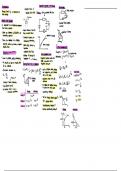
Thermal physics deals with the study of heat, temperature, and the transfer of energy between systems. Key concepts include: Temperature: A measure of the average kinetic energy of particles in a substance. Heat: The energy transferred between systems due to a temperature difference. Specific Heat Capacity: The amount of heat needed to raise the temperature of a unit mass of a substance by one degree Celsius. Latent Heat: The heat required for a substance to change state (e.g., from solid to liquid) without changing temperature. Internal Energy: The total energy stored within a system, including kinetic and potential energy of its particles. Thermodynamics: The study of energy transfers and transformations, governed by laws such as the first law (energy conservation) and second law (entropy increase).
Written for
- Study Level
- A/AS Level
- Examinator
- AQA
- Subject
- Physics
- Unit
- AQA A-Level Physics Paper 2 notes
Document information
- Uploaded on
- September 10, 2024
- Number of pages
- 2
- Written in
- 2024/2025
- Type
- SUMMARY
Subjects
-
thermal
-
specific latent heat
-
particles
-
collisions
-
solid
-
liquid
-
gas

Also available in package deal