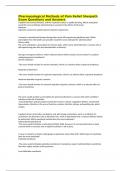
Pharmacological Methods of Pain Relief Sherpath Exam Questions and Answers
Pharmacological Methods of Pain Relief Sherpath Exam Questions and Answers A patient has received fentanyl, and her respiratory status is rapidly declining. Which medication would the nurse anticipate administering to counteract the effects of this drug? Naloxone Naloxone counteracts opioid-induced respiratory depression. A woman is administered fentanyl during labor and is still experiencing significant pain. Which prescription from the health care provider would the nurse anticipate for administration? Nitrous oxide The nurse anticipates a prescription for nitrous oxide, which can be administered to a woman who is still experiencing pain after the administration of fentanyl. During an emergency delivery, which maternal adverse effects would a nurse monitor in a patient undergoing general anesthesia? Uterine relaxation -The nurse should monitor for uterine relaxation, which is an adverse effect of general anesthesia. Respiratory depression -The nurse should monitor for respiratory depression, which is an adverse effect of general anesthesia Maternal aspiration of gastric contents -The nurse should monitor for maternal aspiration of gastric contents, which is an adverse effect of general anesthesia The nurse would question a prescription for spinal anesthesia for a woman with which condition? Infection at the site of insertion -Contraindications and precautions include the woman's refusal, coagulation defects, uncorrected hypovolemia, infection in the area of insertion, systemic infection, allergy, and possibly prior spinal surgery. A patient arrives at the labor and delivery unit with steady contractions and is 5 cm dilated. On assessment, the fetal heart rate is 200 beats/min, and it is determined that a cesarean delivery should be performed. Which anesthesia method does the nurse anticipate? Subarachnoid (spinal) block -The nurse would anticipate a subarachnoid block (SAB), because it is recommended when a quick cesarean birth is necessary and an epidural catheter is not in place. A nurse is caring for a patient undergoing an episiotomy repair after birth. Which types of anesthesia does the nurse anticipate? Pudendal anesthesia -The nurse would anticipate pudendal anesthesia for episiotomy repair. Pudendal blocks anesthetize the lower vagina and part of the perineum. Local infiltration anesthesia -The nurse would anticipate local infiltration, which is routinely used for episiotomy repair. Local infiltration anesthesia numbs the immediate area of the episiotomy or laceration. A nurse is caring for a patient in the first stage of labor who received a combined spinal-epidural (CSE) block with opioid analgesics for pain relief from uterine contractions. The nurse observes for which common side effects of these drugs? Nausea Nausea is a common side effect of intrathecal opioid analgesics. Nalbuphine is one drug that can counteract nausea from intrathecal opioid administration. Pruritus Pruritus is a common side effect of intrathecal opioid analgesics as a result of the release of histamine. Antihistamines, such as nalbuphine, can counteract pruritus from intrathecal administration. Vomiting Vomiting is a common side effect of intrathecal opioid analgesics. Nalbuphine is one drug that can counteract nausea from intrathecal opioid administration and will also decrease the incidence of vomiting. A nurse is managing the administration of nitrous oxide for a patient in labor. The nurse observes for which common side effects of nitrous oxide? Nausea Nausea is a common side effect of nitrous oxide. Vomiting may also be present with the administration of nitrous oxide. Nitrous oxide is administered by the labor and delivery nurse, and side effects should be reported to the health care provider or midwife who prescribed the medication. Dizziness Dizziness is a common side of nitrous oxide. Nitrous oxide is a gas that is inhaled and does not take away contraction pain but rather helps reduce anxiety and increases a feeling of well-being so that the labor pain is easier to deal with. Dysphoria Dysphoria is a common side effect of nitrous oxide. Because nitrous oxide is an inhalant, it creates a feeling of dysphoria and reduces anxiety so that labor pain is easier to deal with. Which prescription would the nurse expect to administer to a patient at high risk for maternal hypotension before epidural anesthesia? Intravenous fluids The nurse would anticipate intravenous fluids, which should be administered before epidural anesthesia. Which intervention is most appropriate to increase a laboring woman’s maternal cardiac output? Change maternal position.
Written for
- Institution
- Sherpath
- Module
- Sherpath
Document information
- Uploaded on
- May 22, 2024
- Number of pages
- 5
- Written in
- 2023/2024
- Type
- Exam (elaborations)
- Contains
- Questions & answers
Subjects
-
pharmacological methods of pain relief sherpath ex

Also available in package deal