

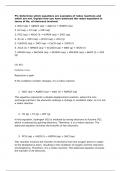
P5- Determine which equations are examples of redox reactions and
which are not. Explain how you have balanced the redox equations in
terms of No. of electrons involved.
1. NaCl (aq) + AgNO3 (aq) → AgCl (s) + NaNO3 (aq)
2. H2 (aq) + F2 (aq) → 2HF (aq)
3. PCl5 (aq) + 4H2O (l) → H3PO4 (aq) + 5HCl (aq)
4. Zn (s) + 2HCl (aq) → ZnCl2 (aq) + 2H2 (g)
5. Ca(OH)2 (aq) + 2HCl (aq) → CaCl2 (aq) + 2H2O (l)
6. 3CuS (s) + 8HNO3 (aq) → 3CuSO4 (aq) + 8NO (g) + 4H2O (l)
7. KMnO4 (aq) + 6H2SO4 (aq) → 2K2SO4 (aq) + 4MnSO4 (aq) + 6H2O (l) + 5O2
(g)
OIL RIG:
Oxidation is loss.
Reduction is gain
If the oxidation number changes, it's a redox reaction
1. NaCl (aq) + AgNO3 (aq) → AgCl (s) + NaNO3 (aq)
This equation represents a double displacement reaction, where the ions
exchange partners. No elements undergo a change in oxidation state, so it is not
a redox reaction.
2. H2 (g) + F2 (g) → 2HF (g)
In this equation, hydrogen (H2) is oxidized by losing electrons to fluorine (F2),
which is reduced by gaining electrons. Therefore, it is a redox reaction. The
balanced equation involves the transfer of two electrons.
3. PCl5 (aq) + 4H2O (l) → H3PO4 (aq) + 5HCl (aq)
This reaction involves the transfer of electrons from the oxygen atoms in water
to the phosphorus atom, resulting in the oxidation of oxygen and the reduction
of phosphorus. Therefore, it is a redox reaction. The balanced equation involves
the transfer of 20 electrons.
, 4. Zn (s) + 2HCl (aq) → ZnCl2 (aq) + H2 (g)
In this reaction, zinc (Zn) is oxidized by losing electrons to hydrogen ions (H+),
which are reduced by gaining electrons to form hydrogen gas (H2). Therefore, it
is a redox reaction. The balanced equation involves the transfer of two electrons.
5. Ca(OH)2 (aq) + 2HCl (aq) → CaCl2 (aq) + 2H2O (l)
This is an acid-base neutralization reaction involving the transfer of protons (H+)
from hydrochloric acid to the hydroxide ions (OH-) in calcium hydroxide. No
elements undergo a change in oxidation state, so it is not a redox reaction.
6. 3CuS (s) + 8HNO3 (aq) → 3Cu(NO3)2 (aq) + 2NO (g) + 4H2O (l) + 3S (s)
In this reaction, copper (Cu) in copper sulfide (CuS) is oxidized by nitric acid
(HNO3), and the nitrogen in HNO3 is reduced to form nitric oxide (NO) gas.
Therefore, it is a redox reaction. The balanced equation involves the transfer of
24 electrons.
7. KMnO4 (aq) + 8H2SO4 (aq) → K2SO4 (aq) + 2MnSO4 (aq) + 5O2 (g) +
8H2O (l)
In this reaction, the manganese in potassium permanganate (KMnO4) is reduced
from a +7 oxidation state to a +2 oxidation state, while the sulfuric acid (H2SO4)
is oxidized. Therefore, it is a redox reaction. The balanced equation involves the
transfer of 10 electrons.
P6- Descriptions of the observations from a test tube reaction of an
organic compound being oxidized with acidified potassium
permanganate:
OXIDATION OF
ALCOHOL
Ethanol Ethanoic acid
CH3CH2OH CH2 COOH
Start End
orange orange
orange light green
which are not. Explain how you have balanced the redox equations in
terms of No. of electrons involved.
1. NaCl (aq) + AgNO3 (aq) → AgCl (s) + NaNO3 (aq)
2. H2 (aq) + F2 (aq) → 2HF (aq)
3. PCl5 (aq) + 4H2O (l) → H3PO4 (aq) + 5HCl (aq)
4. Zn (s) + 2HCl (aq) → ZnCl2 (aq) + 2H2 (g)
5. Ca(OH)2 (aq) + 2HCl (aq) → CaCl2 (aq) + 2H2O (l)
6. 3CuS (s) + 8HNO3 (aq) → 3CuSO4 (aq) + 8NO (g) + 4H2O (l)
7. KMnO4 (aq) + 6H2SO4 (aq) → 2K2SO4 (aq) + 4MnSO4 (aq) + 6H2O (l) + 5O2
(g)
OIL RIG:
Oxidation is loss.
Reduction is gain
If the oxidation number changes, it's a redox reaction
1. NaCl (aq) + AgNO3 (aq) → AgCl (s) + NaNO3 (aq)
This equation represents a double displacement reaction, where the ions
exchange partners. No elements undergo a change in oxidation state, so it is not
a redox reaction.
2. H2 (g) + F2 (g) → 2HF (g)
In this equation, hydrogen (H2) is oxidized by losing electrons to fluorine (F2),
which is reduced by gaining electrons. Therefore, it is a redox reaction. The
balanced equation involves the transfer of two electrons.
3. PCl5 (aq) + 4H2O (l) → H3PO4 (aq) + 5HCl (aq)
This reaction involves the transfer of electrons from the oxygen atoms in water
to the phosphorus atom, resulting in the oxidation of oxygen and the reduction
of phosphorus. Therefore, it is a redox reaction. The balanced equation involves
the transfer of 20 electrons.
, 4. Zn (s) + 2HCl (aq) → ZnCl2 (aq) + H2 (g)
In this reaction, zinc (Zn) is oxidized by losing electrons to hydrogen ions (H+),
which are reduced by gaining electrons to form hydrogen gas (H2). Therefore, it
is a redox reaction. The balanced equation involves the transfer of two electrons.
5. Ca(OH)2 (aq) + 2HCl (aq) → CaCl2 (aq) + 2H2O (l)
This is an acid-base neutralization reaction involving the transfer of protons (H+)
from hydrochloric acid to the hydroxide ions (OH-) in calcium hydroxide. No
elements undergo a change in oxidation state, so it is not a redox reaction.
6. 3CuS (s) + 8HNO3 (aq) → 3Cu(NO3)2 (aq) + 2NO (g) + 4H2O (l) + 3S (s)
In this reaction, copper (Cu) in copper sulfide (CuS) is oxidized by nitric acid
(HNO3), and the nitrogen in HNO3 is reduced to form nitric oxide (NO) gas.
Therefore, it is a redox reaction. The balanced equation involves the transfer of
24 electrons.
7. KMnO4 (aq) + 8H2SO4 (aq) → K2SO4 (aq) + 2MnSO4 (aq) + 5O2 (g) +
8H2O (l)
In this reaction, the manganese in potassium permanganate (KMnO4) is reduced
from a +7 oxidation state to a +2 oxidation state, while the sulfuric acid (H2SO4)
is oxidized. Therefore, it is a redox reaction. The balanced equation involves the
transfer of 10 electrons.
P6- Descriptions of the observations from a test tube reaction of an
organic compound being oxidized with acidified potassium
permanganate:
OXIDATION OF
ALCOHOL
Ethanol Ethanoic acid
CH3CH2OH CH2 COOH
Start End
orange orange
orange light green


