Summary Chapter 3 (The Cell)-Human Anatomy
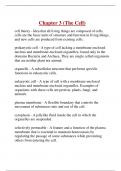
Chapter 3 (The Cell) Cell theory - Idea that all living things are composed of cells, cells are the basic units of structure and function in living things, and new cells are produced from existing cells. Prokaryotic cell - A type of cell lacking a membrane-enclosed nucleus and membrane-enclosed organelles; found only in the domains Bacteria and Archaea. They are single celled organisms that are neither plant nor animal. Organelle - A subcellular structure that performs specific functions in eukaryotic cells. Eukaryotic cell - A type of cell with a membrane-enclosed nucleus and membrane-enclosed organelles. Examples of organisms with these cells are protists, plants, fungi, and animals. Plasma membrane - A flexible boundary that controls the movement of substances into and out of the cell. Cytoplasm - A jellylike fluid inside the cell in which the organelles are suspended. Selectively permeable - A feature and a function of the plasma membrane that is essential to maintain homeostasis by regulating the passage of some substances while preventing others from entering the cell. Cell adhesion molecule - Proteins that allow cells to hook together and form attachments to the cytoskeleton for maintaining cellular shape. Simple diffusion - In this passive membrane process, molecules are moving from an area of higher concentration to an area of lower concentration. This molecular movement means moving down the concentration gradient. Concentration gradient - A difference in the concentration of a substance across a distance Facilitated diffusion - Movement of specific molecules across cell membranes through protein channels. Osmosis - Diffusion of molecules through a semipermeable membrane from a place of higher concentration to a place of lower concentration until the concentration on both sides is equal. Hypertonic solution - A solution in which the concentration of solutes is greater than that of the cell that resides in the solution. Isotonic solution - A solution with the same concentration of water and solutes as inside a cell, resulting in the cell retaining its normal shape because there is no net movement of water. Hypotonic solution - A solution in which the concentration of solutes is less than that of the cell that resides in the solution Active transport - Movement of substances from low to high concentration using selective carrier proteins, requiring energy in form of ATP Endocytosis - Cell membrane forms a pouch around the substance. The pouch closes and pinches off from the membrane to form a vesicle inside the cell. Vesicle - A membrane bound sac that contains materials involved in transport of the cell. Phagocytosis - "Cell Eating" of large particles. Pinocytosis - Cell drinking; uptake of liquid by a cell. Exocytosis - A process in which a vesicle inside a cell fuses with the cell membrane and releases its contents to the external environment. Transports to outside of cell. Nucleus - A membrane-bound organelle in the cell that contains DNA. Nuclear envelope - A double membrane perforated with protein-lined pores that control the flow of materials into and out of the nucleus. Nuclear pore - Allows the exchange of materials through openings in the nuclear envelope. Particularly proteins and RNA. Chromosome - Threadlike structures within the nucleus made in DNA and proteins called the histones. Nucleolus - A specialized structure in the nucleus, formed from various chromosomes and active in the synthesis of ribosomes. Ribosome - A cell organelle constructed in the nucleolus and functioning as the site of protein synthesis in the cytoplasm; consists of rrna and protein molecules, which make up two subunits. Endoplasmic reticulum - A series of membranes forming sacs and tubules that extends from the outer nuclear membrane into the cytoplasm. Rough endoplasmic reticulum - System of internal membranes within the cytoplasm. Membranes are rough due to the presence of ribosomes. Functions in transport of substances such as proteins within the cytoplasm. Smooth endoplasmic reticulum - Has no ribosomes, makes phospholipids and detoxifies alcohol & other drugs Golgi complex - A curved membrane stack resembling a stack of pancakes. It finishes the past transitional modifications, concentrates and packages proteins for export or storage. (FEDEX) Lysosome - enzyme-filled vesicles that bud-off from golgi An organelle containing digestive enzymes, responsible for sanitation; destroys unwanted or unneeded organelles or substances. Mitochondria - extracts energy from the breakdown of energy-rich molecules for use in cells, An organelle in eukaryotic cells that serves as the site of cellular respiration; uses oxygen to break down organic molecules and synthesize ATP Cytoskeleton - A network of protein fibers in the cytoplasm of a eukaryotic cell; includes microfilaments, intermediate filaments, and microtubules. Microtubule - A hollow rod of tubulin protein in the cytoplasm of all eukaryotic cells and in cilia, flagella, and the cytoskeleton; play a role in the separation Of chromosomes during cell division Microfilaments - Long, thin fibers that function in the movement and support of the cell Centriole - Formed in animal cells only from microtubules. They help organize cell structure and are located near nucleus. Cilia - Hair-like projections on the cell surface used for locomotion or the movement of fluid over a cell. Flagellum - A long, hairlike structure that grows out of a cell and enables the cell to move.
Written for
- Institution
- Human anatomy
- Course
- Human anatomy
Document information
- Uploaded on
- March 2, 2024
- Number of pages
- 15
- Written in
- 2023/2024
- Type
- SUMMARY
Subjects
- chapter 3 the cell
-
chapter 3 the cell human anatomy

Document also available in package deal