CRA ACRP Practice Exam Questions w/ explanation Solved 100% Correct
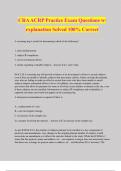
CRA ACRP Practice Exam Questions w/ explanation Solved 100% Correct A screening log is useful for determining which of the following? 1. trial reimbursement 2. subject IP compliance 3. active recruitment efforts 4. trends regarding evaluable subjects - Answer ️️ -1 and 3 only. E6 8.3.20 A screening log will provide evidence of an investigator's efforts to recruit subjects even if they are unable to identify subjects that meet entry criteria, which can help discriminate sites who are failing to make an effort to recruit from sites who have been unable to enroll subjects despite substantial efforts to do so. In addition, site contracts routinely contain provisions that allow for payment for some or all of the screen failures evaluated at the site, even if these subjects are not enrolled. Information on subject IP compliance and evaluability is captured elsewhere and would not appear on the screening log. A trial protocol amendment is required if there is A. a replacement of a site. B. a site investigator change. C. an increase in the sample size. D. a merger involving the sponsor. - Answer ️️ -an increase in the sample size. As per ICH E6 6.9.2, the number of subjects planned to be enrolled is a key component of protocols and amendments. Any changes to the original planned number of subjects would necessitate an amendment as it affects the statistics linked to the study. While the ICH E6 6.1 states that the sponsor's name and address, etc... are required, a merger does not necessarily mean that there was a change in sponsor name or address, etc... and therefore (D) is incorrect. The guidance also states, "...site specific information may be provided on separate protocol page(s), or addressed in a separate agreement..." which explains why (A) and (B) are not the best answers. After IP has been shipped out to the trial site, the trial monitor discovers that the investigator agreement has not been signed. Which of the following are the BEST courses of action for the CRA to take? 1. Check the site trial binder to ensure that the remainder of the trial documents are in order. 2. Document that there was an oversight in shipping out IP prior to the investigator agreement being signed. 3. Contact the site and ask them to ship back the IP to the CRA. 4. Instruct the site that they may not use the IP until the signed agreement is received by the sponsor. - Answer ️️ -2 and 4 only. ICH 5.14.2IP should not be shipped until all required documentation is received/review and approved from the investigator. Statements 1 & 3 do not assist in correcting the issue, while statements 2 & 4 would be the best course of action and would enable the CRA to document the issue as it occurred and instructing the investigator not to use the IP until all required documents were received and approved. A recruitment plan was developed by the research site for a new drug trial that involves enrollment of population between the ages of 6-10 years old. Which of the following activities should the CRA consider when reviewing the site's plan? 1. Verify that the IRB/IEC has reviewed the plan. 2. Verify that the IRB/IEC has approved the plan. 3. Ensure the ICF includes assent and consent. 4. Ensure the IRB/IEC requirements for assent are met. - Answer ️️ -2 and 4 only. ICH E6 4.4.1 specifies that the IRB/IEC should provide approval of recruitment proposals, and ICH E8 3.1.4.3 suggests that additional care should be taken when approving the recruitment of vulnerable populations, including minors. Children are generally not able to legally consent for themselves, but should indicate their agreement to participate to the extent they are capable of doing so. IRB/IECs often request that an age-appropriate assent form be created for this purpose. When choosing a CRO to manage a clinical trial, which of the following are required by ICH Guidelines? 1. Transfer of responsibilities must be documented in writing. 2. Responsibilities transferred to the CRO become the ultimate responsibility of the CRO. 3. A sponsor must transfer all of the responsibilities to one CRO. 4. Obligations not described in any written agreement shall be deemed not to have transferred. - Answer ️️ -1 and 4 only. ICH E6 5.2.1 supports that ultimate responsibility for data quality and integrity always resides with the sponsor, making option 2 incorrect. ICH E6 5.2 does not state that a sponsor can only transfer responsibilities to one CRO, therefore option 3 is incorrect. Which of the following activities should the CRA perform when reconciling an SAE Report with the CRF? 1. Ensure causal relationship assessment is the same on the SAE report as the AE CRF. 2. Verify the investigator agreement lists the hospital where the subject was treated. 3. Submit initial and any follow-up SAE reports to the IRB/IEC. 4. Confirm medications in SAE-related medical records are recorded on the CRF. - Answer ️️ - 1 and 4 only. E6 5.18.4 states that the monitor should ensure the CRF is complete and accurate, and is in agreement with source documents and other related trial documents. (2) is wrong because investigator agreements are device specific; also SAEs are independent of where the subject was treated. (3) CRAs do not submit to the IRB/IEC. A subject has a history of dermatitis. During visit 2 of the trial, the subject complained of a rash. The investigator interrupted the use of the IP and the rash disappeared. At the next visit, the IP was restarted. One day later, the rash reappeared. The investigator discontinued the subject from the trial. The causality can be determined as probably related to the IP based on: A. the placebo effect. B. a positive rechallenge. C .insufficient information. D. the history of dermatitis. - Answer ️️ -a positive rechallenge. ICH E2A attachment 1 section 4 describes the collection of rechallenge information in regard to AEs. Option A is incorrect as the placebo effect is the measurement of efficacy in a placebo. While the history of dermatitis may be thought of as explaining the rash, it is the rechallenge that helps to establish this an IP effect. The purpose of trial-specific monitoring procedures is to provide: A. a comprehensive safety review of the IP. B. a small-scale version of company SOPs. C. written guidelines for each individual trial. D. federal regulations and company SOPs in a user-friendly format. - Answer ️️ -written guidelines for each individual trial. ICG E6 5.18.5 specifies that "The monitor(s) should follow the sponsor's established written SOPs as well as those procedures that are specified by the sponsor for monitoring a specific trial", therefore "C" is the best option. Option A is not applicable, as safety review is not a purpose of monitoring procedures. The other options reference SOPs in a limited way which is not correct. A CRA is informed by a site that a trial subject called the site complaining of a generalized itchy rash all over her body. The PI has assessed the subject and administered a prohibited concomitant medication. Which of the following actions should the CRA recommend for the site? 1. Update the CRF. 2. Report this information to the IRB/IEC. 3. Notify the regulatory authority. 4. Instruct the subject to stop taking the prohibited medication. - Answer ️️ -1 and 2 only
Geschreven voor
- Instelling
- ACRP
- Vak
- ACRP
Documentinformatie
- Geüpload op
- 21 februari 2024
- Aantal pagina's
- 23
- Geschreven in
- 2023/2024
- Type
- Tentamen (uitwerkingen)
- Bevat
- Vragen en antwoorden
Onderwerpen
-
cra acrp practice exam questions w explanation so

Ook beschikbaar in voordeelbundel