
UNIT 3: CHAPTER 11: Managing Compensation and benefits
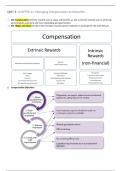
→ Def. Compensation extrinstic rewards such as salary and benefits, as well as intrinsic rewards such as achieving
personal goals, autonomy and more challenging job opportunities.
→ Def. Wages and Salary strictly to the monetary rewards paid to employees in exchange for the work they do.
1. Compensation Objectives
, 1) Attract Talented Employees
→ Job applicants are not aware of the exact compensation offered by different organisations for similar
jobs within the local labour market, they do compare job offers and pay scales.
→ Since it is easier to compare rands, job applicants will often attach more significance to the salaries
being offered than to other types of compensation, such as benefits and intrinsic rewards.
→ Employers in the same field must remain competitive within local labour market by offering salaries
that are similar to those offered by competing employers.
→ Salary survey is used: to estimate average salaries for entry-level positions. Secondly published data
can be used.
→ Salary Surveys:
o Difficult
o Expensive process
o Requires a lot of info
o Can cause problems involving labour unions
2) Retaining talented employees
→ Inadequate compensation is often one of the major causes of staff turnover. To retain talented
employees, the HR manager must make sure that there is equity in terms of compensation within
the organisation.
→ Job satisfaction is often considered to be a strong determinant of staff turnover.
→ Job evaluation: to provide equity among jobs, administrators usually create a systematic relationship
among the pay scale for various jobs within an organisation.
→ Def. Job evaluation: the systematic determination of the relative worth of a job within the firm that
results in a firm’s pay system.
→ Jobs are compared on the traditional basis of:
o Skills Required
o Effort required
o Responsibility of job holder
o Working conditions
→ The purpose of Job evaluation is to develop a system of compensation that employees will perceive
to be equitable. Job evaluation strives to obtain internal consistency among jobs.
3) Motivating talented employees
→ Employees expect that their performance will correlate with the rewards received from the firm.
→ Motivation and Performance Model:
→ Employees set expectations about rewards and compensation to be received of they achieve certain
levels of performance.
→ To safeguard this relationship between performance and motivation, the firm must provide:
o accurate performance appraisal
o performance rewards
o supervisors’ feedback
→ Def. Compensation extrinstic rewards such as salary and benefits, as well as intrinsic rewards such as achieving
personal goals, autonomy and more challenging job opportunities.
→ Def. Wages and Salary strictly to the monetary rewards paid to employees in exchange for the work they do.
1. Compensation Objectives
, 1) Attract Talented Employees
→ Job applicants are not aware of the exact compensation offered by different organisations for similar
jobs within the local labour market, they do compare job offers and pay scales.
→ Since it is easier to compare rands, job applicants will often attach more significance to the salaries
being offered than to other types of compensation, such as benefits and intrinsic rewards.
→ Employers in the same field must remain competitive within local labour market by offering salaries
that are similar to those offered by competing employers.
→ Salary survey is used: to estimate average salaries for entry-level positions. Secondly published data
can be used.
→ Salary Surveys:
o Difficult
o Expensive process
o Requires a lot of info
o Can cause problems involving labour unions
2) Retaining talented employees
→ Inadequate compensation is often one of the major causes of staff turnover. To retain talented
employees, the HR manager must make sure that there is equity in terms of compensation within
the organisation.
→ Job satisfaction is often considered to be a strong determinant of staff turnover.
→ Job evaluation: to provide equity among jobs, administrators usually create a systematic relationship
among the pay scale for various jobs within an organisation.
→ Def. Job evaluation: the systematic determination of the relative worth of a job within the firm that
results in a firm’s pay system.
→ Jobs are compared on the traditional basis of:
o Skills Required
o Effort required
o Responsibility of job holder
o Working conditions
→ The purpose of Job evaluation is to develop a system of compensation that employees will perceive
to be equitable. Job evaluation strives to obtain internal consistency among jobs.
3) Motivating talented employees
→ Employees expect that their performance will correlate with the rewards received from the firm.
→ Motivation and Performance Model:
→ Employees set expectations about rewards and compensation to be received of they achieve certain
levels of performance.
→ To safeguard this relationship between performance and motivation, the firm must provide:
o accurate performance appraisal
o performance rewards
o supervisors’ feedback


