🧫
Chpt 5: The Mitotic Cell Cycle
(Cell cycle and nuclear division)
Chromosomes
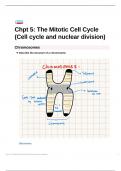
Describe the structure of a chromosome
Structures:
Chpt 5: The Mitotic Cell Cycle (Cell cycle and nuclear division) 1
, 1. Telomeres: A region of repetitive nucleotide sequences at each end of a
chromatid, which:
a. Allows chromosome to replicate properly during cell division: during
replication, chromosome is shortened (DNA is lost) - prevents loss of
entire genes
b. Help organise chromosomes in cells
c. Prevents the chromosomes from unravelling and sticking to other
chromosomes, by acting as a cap/aglet
2. Chromatids: Identical strands of DNA, bound by centromere (1 chromatid = 1
DNA molecule)
a. Sister chromatids: genetically identical chromatids that make up the stx
of the chromosome
3. Kinetochore: the protein structure on chromatids, next to centromere,
containing a binding site, site for the attachment of spindle fiber
4. Genes: small sections of DNA that code for a particular protein and give
rise to a specific feature
DNA structure is maintained by histone proteins
5. Centromere: a narrow region containing no DNA which binds the 2 sister
chromatids together
Cell cycle
Outline the stages of the mitotic cell cycle
1. Interphase: cell growth
Longest phase in the cell cycle
Longest phase: G1
Where cell grows to normal size after division and carries out normal
functions - making proteins
All genetic material is in the form of chromatins
Chpt 5: The Mitotic Cell Cycle (Cell cycle and nuclear division) 2
Chpt 5: The Mitotic Cell Cycle
(Cell cycle and nuclear division)
Chromosomes
Describe the structure of a chromosome
Structures:
Chpt 5: The Mitotic Cell Cycle (Cell cycle and nuclear division) 1
, 1. Telomeres: A region of repetitive nucleotide sequences at each end of a
chromatid, which:
a. Allows chromosome to replicate properly during cell division: during
replication, chromosome is shortened (DNA is lost) - prevents loss of
entire genes
b. Help organise chromosomes in cells
c. Prevents the chromosomes from unravelling and sticking to other
chromosomes, by acting as a cap/aglet
2. Chromatids: Identical strands of DNA, bound by centromere (1 chromatid = 1
DNA molecule)
a. Sister chromatids: genetically identical chromatids that make up the stx
of the chromosome
3. Kinetochore: the protein structure on chromatids, next to centromere,
containing a binding site, site for the attachment of spindle fiber
4. Genes: small sections of DNA that code for a particular protein and give
rise to a specific feature
DNA structure is maintained by histone proteins
5. Centromere: a narrow region containing no DNA which binds the 2 sister
chromatids together
Cell cycle
Outline the stages of the mitotic cell cycle
1. Interphase: cell growth
Longest phase in the cell cycle
Longest phase: G1
Where cell grows to normal size after division and carries out normal
functions - making proteins
All genetic material is in the form of chromatins
Chpt 5: The Mitotic Cell Cycle (Cell cycle and nuclear division) 2