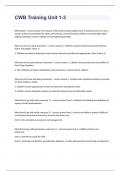
CWB Training Unit 1-3 questions n answers graded A+ 2023/2024
CWB Training Unit 1-3DSS Mission - correct answer The mission of the South Carolina department of social services is to serve South Carolina by promoting the safety, permanency, and well-being of children and vulnerable adults, helping individuals achieve stability and strengthening families. What are the two safety outcomes? - correct answer 1. Children are first and foremost protected from abuse and neglect. (Item 1) 2. Children are safely maintained in their homes whenever possible and appropriate. (Item 2/Item 3) What are the two permanency outcomes? - correct answer 1. Children have permanency and stability in their living situations. 2. The continuity of family relationships and connections is preserved for children. What are the three well-being outcomes? - correct answer 1. Families have enhanced capacity to provide for their children's needs. 2. Children receive appropriate services to meet their educational needs. 3. Children receive adequate services to meet their physical and mental health needs. What item(s) go with safety outcome 1? - correct answer Item 1: timeliness of initiating investigations of reports of child maltreatment. What item(s) go with safety outcome 2? - correct answer Item 2: services to family to protect child(ren) in the home and prevent removal or re-entry into foster care. Item 3: risk and safety assessment and management. What item(s) go with permanency outcome 1? - correct answer Item 4: stability of foster care placement. Item 5: permanency goal for child. Item 6: achieving reunification, guardianship, adoption, or other planned permanent living arrangement. What item(s) go with permanency outcome 2? - correct answer Item 7: placement with siblings. Item 8: visiting with parents and siblings in foster care. Item 9: preserving connections. Item 10: relative placement. Item 11: relationship of a child in care with parents. What item(s) go with well-being outcome 1? - correct answer Item 12: needs and services of child, parents, and foster parents. Item 13: child and family involvement in case planning. Item 14: caseworker visits with child. Item 15: caseworker visits with parents. What item(s) go with well-being outcome 2? - correct answer Item 16: educational needs of the child. What item(s) go with well-being outcome 3? - correct answer Item 17: physical health of the child. Item 18: mental/behavioral health of the child. Guiding Principles - correct answer To respect the humanity and dignity of each person for whom the agency delivers quality services. A. R. E. - correct answer Appearance Relationships Environment -refers to how we convey professionalism Oz Principle - correct answer Accountability: see it, own it, solve it, do it. Child Welfare Values - correct answer Self-Determination Nonmaleficence Beneficence Justice Fidelity Veracity Protection of Children Preservation of Families Respect for Families Competence Dignity and Worth of the Person Individualized Intervention Loyalty Diligence Confidentiality Child Welfare Imperatives - correct answer 1. At all times, the child's immediate and enduring safety and well-being must take precedence over the comfort of adults. 2. Child safety will always improve when the adults who care for them work together and support each other. 3. Children do not "disrupt". Adults fail to provide the adequate level of response to meet the child(ren)'s need. 4. Shared understanding and meaning always propel actions and drive results. 5. Children must never be left to protect or provide for themselves or others; that is the role of all responsible adults. Primary Culture - correct answer cannot change i.e. sex, age, mental/physical abilities and characteristics, sexual orientation, ethnic heritage, race. Secondary Culture - correct answer can change i.e. family status, work style, education, geographic location, military experience, work experience, income, religion, first language, organizational role and level, communication style. Verbal Communication - correct answer language Nonverbal Communication - correct answer body language, gestures, actions. Paraverbal Communication - correct answer tone, cadence, rate of speech. A.G.E. - correct answer Tool for building relationships. Acceptance: involves respect and validation, separating the person from their behaviors. Genuineness: involves being yourself, using humor and spontaneity, and being truthful. Empathy: an attempt to experience another's worldview and communicate an awareness of that experience with compassion. Interview - correct answer conversation b/w two or more people gathering information. conversation with a purpose. E.A.R.S. - correct answer Helps gather information. Elicit: the first question asked about a particular topic. Open-ended. Amplify: follow-up questions. Bulk of information/most critical information found here. Reflect: prior/during/after maltreatment. Helps interviewee process their experiences and understand the situation. Start over: ask another elicit question. What areas should you inquire about when gathering information through E.A.R.S.? - correct answer 1. Maltreatment 2. Nature (circumstances that led to maltreatment) 3. Child Functioning 4. Adult Functioning
Written for
- Institution
- CWB
- Course
- CWB
Document information
- Uploaded on
- December 11, 2023
- Number of pages
- 21
- Written in
- 2023/2024
- Type
- Exam (elaborations)
- Contains
- Questions & answers
Subjects

Also available in package deal