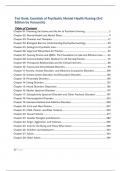
Walden NURS 6660 FINAL EXAM
Walden NURS 6660 FINAL EXAMQuestion 1 In which demographic is depression twice as prevalent in girls as compared to boys? A. Preschoolers B. School aged C. Adolescents D. All children Question 2 Andrew is a 14-year-old male who is being managed for bipolar I disorder. He was started on lithium 6 weeks ago and has achieved a serum level of 1.1 mEq/L according to his most recent blood work. Andrew says he does not feel any different, but both his parents and teachers report improvement in his mood. He has been more stable, is getting along better with friends and siblings, and is even more interested in his schoolwork. The PMHNP plans to maintain Andrew on this medication and knows that he will need which of the following ongoing laboratory assessments? A. Complete blood count, thyroid function tests, and serum calcium B. Liver function tests, complete blood count, and 12-lead electrocardiogram C. White blood cell differential, fasting glucose, and fasting lipid profile D. Comprehensive metabolic panel, complete blood count, and thyroid function tests 1 | P a g eQuestion 3 Confidentiality is a complex topic in the world of child and adolescent psychiatry. The last 40 to 50 years have been characterized by increased attention to this issue and the publication of various ethical codes and practice position statements by professional organizations. Which of the following is not a true statement with respect to confidentiality of the child or adolescent client? A. The PMHNP should not be concerned with consent for disclosure when child abuse or maltreatment has occurred. WALDEN UNIVERSITY NURS 6660 FINAL EXAM B. In 1979, the American Psychiatric Association (APA) stated that children 12 years of age or older can give consent for disclosure. C. The American Academy of Child and Adolescent Psychiatry (AACAP) Code of Ethics states that consent is not required for disclosure. D. Regardless of code or position statement by any organization, the best approach is when the child and PMHNP agree on disclosure. Question 4 Debi is a 15-year-old girl who is currently being treated for depression. Her parents have been very proactive and involved in her care, and Debi has achieved remission 2 months after beginning treatment with a combination of pharmacotherapy and cognitive behavioral therapy. While counseling Debi’s parents about important issues in management, the PMHNP advises that: A. There is a > 50% likelihood that Debi’s younger sibling will develop depressive symptoms B. The mean length of major depressive episode in adolescents is 4 months C. 20 to 40% of adolescents who have major depressive disorder will develop bipolar I within 5 yearsto D. Adolescent-onset depression typically needs long-term pharmacologic management prevent relapse Question 5 The therapeutic outcomes for children with disorders of written expression are most favorable when they are characterized by: Concomitant pharmacotherapy with a psychostimulant to promote attention and focus Multimodal therapy to include group interaction with peer-to-peer feedback on writing samples strategies, A variety of tutors who will offer a variety of writing techniques, composition and critiques Intensive, continuous administration of individually tailored, one-on-one expressive and creative writing therapy Question 6 When considering a diagnosis of developmental coordination disorder, the PMHNP knows that the diagnosis may be associated with: A. Above-average scores on performance subtests of standardized intelligence testing B. Below-average scores on verbal subtests of standardized intelligence testing C. Soft neurologic signs on physical examination such as slight reflex abnormalities D. Physical findings consistent with neuromuscular disease such as muscular dystrophy 3 | P a g eQuestion 7 Caylee is a 5-year-old girl who is referred for evaluation by child protective services. She was recently removed from her biological family and placed in foster care, as her home environment was reportedly unsafe due to conditions of extreme neglect. Her foster mother reports that Caylee is very quiet and withdrawn and always appears sad and disinterested in her surroundings; however, she becomes very irritable when anything unexpected or unplanned occurs. The foster mother became very concerned when it appeared that Caylee was hallucinating. The PMHNP considers that: A. Caylee is at high risk for suicide and precautions should be taken B. The hallucinations are consistent with brief psychotic disorder or schizophrenia C. The history and reported symptoms are typical of depressive disorder in young children D. This is a common situation when prepubertal children are removed from the biological parents regardless of how dysfunctional they are Question 8 Children with gender dysphoria typically have higher rates of all the following except: A. Depression B. Impulse control disorders C. Anxiety disorders D. Eating disorder Question 9 Eileen is a 23-month-old girl who is being evaluated for autism spectrum disorder because her pediatrician is concerned about the presence of developmental red flags. She has just a few words of speech and has not put together any meaningful two-word phrases. While taking a history from Eileen’s mother the PMHNP learns that forapproximately the last 2 months Eileen has been seen eating paint chips that are peeling off the baseboard and window sills in the family home; when she sees one she puts it in her mouth. This is a concern because they live in an old farmhouse and there may be lead-based paint in some of the paint layers. The PMHNP considers that which of the following is not consistent with a diagnosis of pica? A. A diagnosis of autism spectrum disorder B. Symptoms < 6 months duration C. The pattern of eating D. Lack of potential consequences Question 10 The current scholarly consensus is that the etiology of bulimia nervosa is multifactorial to include biological, sociocultural, family, cognitive-behavioral, and psychodynamic factors. When considering the etiology of bulimia nervosa, the PMHNP understands that:Family factors contributing to bulimia nervosa include emotional restraint, tight parental control of behavior, and avoidance of conflict. A. Lowered serotonin activity is seen in the brains of patients with bulimia nervosa. B. There is a disproportionate incidence in childhood sexual abuse in patients with bulimia nervosa. D. Cultural influences are much less implicit in the development of bulimia nervosa as compared to anorexia nervosa. Question 11 Standardized instructional programs used in the management of reading disorders include all the following except: 5 | P a g eA. The Orton Gillingham and Direct Instructional System for Teaching and Remediation B. Science Research Associates, Inc. Basic Reading Program C. Bridge Reading Program D. Woodcock-Johnson Psychoeducational Battery
Written for
- Institution
-
Chamberlian School Of Nursing
- Course
- Unknown
Document information
- Uploaded on
- November 28, 2023
- Number of pages
- 42
- Written in
- 2023/2024
- Type
- Exam (elaborations)
- Contains
- Unknown
Subjects
-
walden nurs 6660 final exam