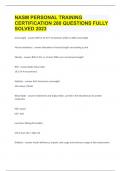
NASM PERSONAL TRAINING CERTIFICATION |280 QUESTIONS FULLY SOLVED 2023.
Overweight BMI of 25-29.9 or between 25lbs to 30lbs overweight Muscle imbalance Alteration of muscle length surrounding a joint Obesity BMI of 30+ or at least 30lbs over recommend weight BMI Body Mass Index 18.5-24.9 recommend Statistics 66% Americans overweight 34% obese (72mil) Blood lipids Cholesterol and triglycerides, carried in the bloodstream by protein molecules. HDL= good LDL= bad Less than 200mg/DL healthy More than 240 = high risk Diabetes Insulin deficiency, impairs carb usage and enhances usage of fats and proteins Type 1 diabetes Pancreas doesn't produce insulin Type 2 diabetes Obesity, 90-95% of diabetes. Cells are resistant and do not allow insulin to bring glucose into the cell Low back pain 80% of adults (office work, sitting too long, manual labor) Knee injury 80,000-100,000 ACL injuries. 70% noncontact injuries. Deconditioned Loss of physical fitness, muscle imbalances, decreased flexibility and lack of core and joint stability. Proprioceptively enriched environment Unstable yet controlled physical situation. Force body to us balance and stabilization OPT Model Stabilization endurance Strength endurance Strength hypertrophy Strength max strength Power Phase 1: stabilization endurance Increase muscular endurance and stability while developing neuromuscular efficiency (coordination). Muscular endurance Muscles ability to contract for an extended period of time Neuromuscular efficiency All muscles efficiently working together in all planes of motion (coordination) Phase 2: strength endurance Enhance stabilization while increasing prime mover strength Mod loads and reps 8-12 reps Prime mover The muscle that acts as the initial source of motive power Superset Set of two exercises performed back to back Phase 3: hypertrophy Goal of muscle growth. High volume Moderate to high loads 6-12 reps Phase 4: max strength Goal of max prime mover strength- heavy loads Low reps (1-5) Longer rest Rate of force production Muscles to exert maximal force output in a minimal amount of time Phase 5: power Development of speed and power As fast as can be controlled Human movement system Nervous, muscular and skeletal systems Kinetic chain Nervous, muscular and skeletal system Nervous system Billions of cells- communication network Divided into central and peripheral Central nervous system Brain and spinal cord Peripheral nervous system Nerves that connect brain to spinal cord to the rest of the body Sensory function Ability of CNS to sense change in external/internal environment Integrative function Nervous system to analyze and interpret sensory info to allow decision making and response Motor function Neuromuscular response to sensory info Neuron The functional unit of the nervous system Sensory neurons Transmit nerve impulses from effector sites via receptors to brain and spinal cord Interneurons Transmit nerve impulses from on neuron to another Motor neurons Transmit nerve impulses from brain and spinal cord to effector sites Mechanoreceptors Sensory receptors responsible for sensing distortion in body tissues Muscle spindles Receptors sensitive to change in length of the muscle and the rate of that change Golgi tendon organ Will cause muscle to relax Joint receptors Surround a joint and respond to pressure, acceleration and deceleration of the joint Skeletal system The body's frame work composed of bones and joints Axial skeleton Portion of the skeletal system that consists of the skull, rib cage, and vertebral column Appendicular skeleton Portion of the skeletal system that includes upper and lower extremities Remodeling Resorption and formation of bone Osteoclasts A type of bone cell that removes bone tissue Osyeoblasts A type of cell that is responsible for bone formation Types of bones Long Short Flat Irregular Sesamoid Epiphysis The end of long bonrs Diaphysis Shaft portion of a long bone Epiphyseal plate Connecting diaphysis to the epiphysis Arthrokinematics Joint motion
Written for
- Institution
-
Havard School
- Course
- Unknown
Document information
- Uploaded on
- October 27, 2023
- Number of pages
- 35
- Written in
- 2023/2024
- Type
- Exam (elaborations)
- Contains
- Questions & answers
Subjects
-
nasm personal training certification

Also available in package deal