MBCMI Final Review 1,2,3, and 4 Exam Questions With Correct Answers
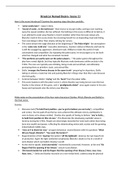
Define working language - Answer Any language the interpreter interprets in What is professional identity? - Answer It's the process of building up a sense of self in a work related context. It is professionally identifying yourself. Define Source language - Answer The language your interpret FROM What is community interpreting? - Answer A specialization of interpreting that facilitates access to community services. Define Target language - Answer The language you interpret INTO What is bias? - Answer It refers to a personal attitude or perspective that is not impartial and tends to favor one viewpoint or social group over another. It is usually unconscious. List the 3 stages of the encounter - Answer Pre-encounter, Encounter, Post-Encounter Why does a professional identity matter? - Answer Interpreters work in isolation. "Anything goes." If you have a sense of professional identity, you can learn to work "on the same page" as other interpreters. Then people know what to expect of professional interpreters. Identify seven steps of the encounter - Answer Pre-encounter: Preparation, briefing (optional) Encounter: Introduction, interpreting, mediation (if needed) Post-encounter: Debriefing (optional), analysis Define medical interpreting. - Answer Interpreting for patients, their families and healthcare providers, i.e., a specialization of interpreting that facilitates access to healthcare. Identify 4 interpretIng in protocols (that you learned in Module 2) - Answer Positioning Professional introductions First person Turn-taking (managing the flow: interrupting the session for accuracy) What is Project Implicit? - Answer It's a Harvard-based project suported by decades of research that lets you explore your own unconscious bias in a series of tests. What is the goal of effective positioning? (In other words, which guiding principle will help you decide which position to take?) - Answer Find the position that best promotes DIRECT COMMUNICATION. What is a language access law? - Answer It's a law that mandates or requires language assistance to help ensure equal access to public services to prevent or reduce discrimination. Write the 4 elements of an interpreter's introduction that come AFTER stating his/her name/organization. - Answer *Everything will be interpreted. *Everything will be kept confidential. *Please speak directly to the client/provider. *Please pause when I make a signal to let me interpret. Are medical interpreters community interpreters? - Answer YES!!!!!!!!!! Define intervening - Answer The act of interrupting a session for any reason. What are some exceptions to using first person? - Answer *Young children (esp. <7) *People suffering from dementia *People who are intoxicated/cases of substance abuse *Emergencies What should you do if a provider keeps speaking in third person? (E.g., "Ask him how long this has been going on." "Tell her to come back in three weeks.") - Answer * First, adopt an unobtrusive position and cut off eye contact. * If that does not work, intervene to perform a "role clarification" and remind the provider to please address the patient/client, not the interpreter. * If the provider persists, use a hand gesture to direct his/her attention to the patient/client. * If these attempts fail, as an absolute LAST RESORT consider interpreting in first person (but this is not technically accurate and NOT recommended). * Then mediate outside the session to point out that first person is much faster, promotes direct communication and trust, and is much easier to interpret. Name the most important language excess law in the US. - Answer Title VI of the Civil Rights Act of 1964. Why do memory skills matter for interpreters? - Answer Interrupting the speakers too often distracts them, can upset their train of thought and cause them to forget things. Also, you will never be a professional community interpreter w/o developing enough memory skills to avoid interrupting a complete thought or statement. What is the purpose of interpreting? - Answer To facilitate communication between 2 or more parties who do not share a common language. What is chunking? - Answer Breaking a message down into chunks of meaning to make them easier to remember. Define mediation - Answer Any act or utterance of the interpreter that goes beyond interpreting and is intended to address a barrier to communication or service delivery (or access to the service). When should you mediate? - Answer When the potential consequences of NOT intervening exceed the risk of intervening. How can imagery help an interpreter's memory? - Answer Try to visualize what you hear as a story and see "who did what to whom" List some message transfer skills for interpreters. - Answer *Anticipating *(Message analysis) *Parroting/shadowing *Paraphrasing Describe communicative autonomy. - Answer The capacity of each party in the encounter to be RESPONSIBLE FOR AND IN CONTROL OF HER OR HER OWN COMMUNICATION. Name the 3 modes of interpreting. - Answer * Consecutive * Simultaneous * Sight translation List some elements in the professional interpreter's tool kit. - Answer 1. Résumé. 2. Portfolio of credentials 3. Trade name 4. Business cards 5. Professional email. 6. Mobile phone with professional voice message. 7. Business forms 8. Website or social media presence. 9. Branding statement. 10. Consistency in marketing materials
Geschreven voor
- Instelling
- MBCMI
- Vak
- MBCMI
Documentinformatie
- Geüpload op
- 21 oktober 2023
- Aantal pagina's
- 10
- Geschreven in
- 2023/2024
- Type
- Tentamen (uitwerkingen)
- Bevat
- Vragen en antwoorden
Onderwerpen
-
mbcmi final review 123 and 4 exam stuvia
-
mbcmi final review 123 and 4 exam questions wit
-
define working language any language the interpret
-
what is professional identity its the process of

Ook beschikbaar in voordeelbundel