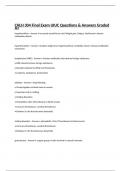
CHLH 304 Final Exam UIUC Questions & Answers Graded A+
hypothyroidism - Answer • Increased sensitivity to cold, Weight gain, Fatigue, Hashimoto's disease (antibodies attack) hyperthyroidism - Answer • Sudden weight loss, Rapid heartbeat, Irritability, Graves' disease (antibodies overactive) lymphocytes (WBC) - Answer o Produce antibodies that destroy foreign substances o WBC absorb/remove foreign substances o Disorders Related to White Cell Production • Leukemia, leukopenia, leukocytosis platlates - Answer o Stop bleeding o Clump together to block holes in vessels o Important role in clotting o Clotting Disorders • Hemophilia, Clots (Thromboses) in blood vessels • Coronary thromboses, cerebral thromboses • Embolus (A clot that becomes detached) clotting disorders - Answer • Hemophilia, Clots (Thromboses) in blood vessels • Coronary thromboses, cerebral thromboses • Embolus (A clot that becomes detached) granulocytes - Answer • Largest group of cells involved in natural immunity • Phagocytic cells that engulf target pathogens • Granulocytes include: • Neutrophils • Macrophages that release cytokines granulocytes - Answer Natural killer cells • Involved in natural immunity • Recognize non-self material and lyse those cells nervous system - Answer o Neurotransmitters • chemicals that regulate nervous system functioning. o Catecholamines • epinephrine and norepinephrine promote sympathetic nervous system activity. • released in substantial quantities during stressful times. o Disorders of the nervous system • Affect 25 million Americans • 12% of deaths are from nervous system disorders. • Epilepsy, Cerebral palsy, Parkinson's disease, Multiple sclerosis, Huntington's disease, Polio, Paraplegia, quadriplegia neurotransmitters - Answer • chemicals that regulate nervous system functioning catecholamines - Answer • epinephrine and norepinephrine promote sympathetic nervous system activity. • released in substantial quantities during stressful times. nervous system disorders - Answer • Affect 25 million Americans • 12% of deaths are from nervous system disorders. • Epilepsy, Cerebral palsy, Parkinson's disease, Multiple sclerosis, Huntington's disease, Polio, Paraplegia, quadriplegia renal system - Answer o Critically important in metabolism • Kidneys, ureters, urinary bladder, urethra • Kidneys regulate bodily fluids • Main function: to produce urine • Kidneys maintain an adequate balance of sodium and potassium ions • An analysis of urine offers important diagnostic clues to many disorders • Creatinine, BUN renal system disorders - Answer • Urinary tract infections - if untreated, they may lead to more serious infections. • Acute glomerular nephritis - usually a secondary response to a strep infection • Tubular necrosis - when cells in the tubules of the kidneys are destroyed, acute renal shut down can occur kidney failure - Answer • Artificial kidney, transplant, kidney dialysis • 3 types o Acute • Suddenly, severe infection, drugs, chemical agents or physical trauma • If problem treated, complete recovery of kidneys is possible. o Chronic • Gradually over years, cause weight loss, anemia, nausea or vomiting, muscle cramps, unusual itching o End-stage Kidney Disease • Causes anemia, high blood pressure, bone disease, heart failure and poor mental functioning acute kidney failure - Answer Suddenly, severe infection, drugs, chemical agents or physical trauma • If problem treated, complete recovery of kidneys is possible. chronic kidney failure - Answer • Gradually over years, cause weight loss, anemia, nausea or vomiting, muscle cramps, unusual itching end stage kidney disease - Answer • Causes anemia, high blood pressure, bone disease, heart failure and poor mental functioning respiratory system - Answer o Structure and function o Respiration (breathing) has 3 functions • To take in oxygen (metabolize food) • To excrete carbon dioxide • To regulate the composition of the blood o Involves a number of organs • Nose, mouth, pharynx, trachea, diaphragm, abdominal muscles, and lungs (in thoracic cavity) o Inspiration is active; expiration is passive (controlled by medulla—level of CO2) o Respiratory system disorders Typically short-lived problems • Asphyxia (reinhale expired air)(O2 lack -CO2 excess), Anoxia (O2 lack), Hyperventilation (Decrease CO2, Constriction of blood vessels, Reduced blood flow to brain) respiratory system organs - Answer • Nose, mouth, pharynx, trachea, diaphragm, abdominal muscles, and lungs (in thoracic cavity) respiratory system disorders - Answer • Viral Infections (Common cold, influenza) • Bacterial Infections (Strep throat, whooping cough (Pertussis), diphtheria) • Chronic Obstructive Pulmonary Disease (COPD) (Chronic bronchitis, Emphysema) • 4th leading killer in the U.S. • 85% of all cases are due to smoking
Written for
- Institution
- CHLH 304
- Course
- CHLH 304
Document information
- Uploaded on
- October 2, 2023
- Number of pages
- 17
- Written in
- 2023/2024
- Type
- Exam (elaborations)
- Contains
- Questions & answers
Subjects
- chlh 304 stuvia
-
chlh 304 final exam uiuc questions answers grade
-
hypothyroidism increased sensitivity to cold we
-
hyperthyroidism sudden weight loss rapid heartb

Also available in package deal