Case%Study,%Chapter%26,%Management%of%Patients%With%
Dysrhythmias%and%Conduction%Problems%
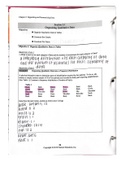
1. Janis White, 21 years of age, is a female patient who received a
permanent atrioventricular pacemaker for the diagnosis of sick sinus rhythm,
a disorder that leads to periods of tachycardia and periods of extreme
bradycardia or sinus arrest. The nurse received the end-of-shift report and
arrives at Ms. White’s room where she assesses the patient’s incision
dressing on the upper left chest and it is dry. The patient’s left arm is
edematous and ecchymotic and twice the size of the other arm. The patient
states that her left arm feels numb and tingling. The distal pulses are present
and at baseline. None of the findings were noted in the end-of-shift report.
(Learning Objective 6)
a. What nursing management should the nurse provide immediately?
Immediately get another set of hands. Take vital signs, measure B/P
on unaffected side. Get an ECG. Call the provider
b. Explain the general care of the patient after receiving an implanted
pacemaker. Monitor for complications of insertion such as:
Pneumothorax (collapsed lung), Hemothorax (collection of blood in the
pleural cavity), Perforation from the pacemaker lead, Cardiac
tamponade (pressure on the heart caused by fluid build-up around the
heart). *These complications are seen as shortness of breath, low
blood pressure, chest pain, or a rapid heart rate. -Monitor ECG for loss
of sensing, loss of capture, or failure to pace. -Provide pain
medications & interventions as needed. -Assess insertion site for
bleeding and infection. -Apply ice pack to minimize pain and swelling
for first 6 hours. -Maintain bedrest for 12 hours. -Restrict movement of
the affected arm for 12-24 hours. After 24 hours, assist with gentle
ROM exercises 3 times daily, to restore normal movement & prevent
stiffness. -Do not give aspirin or heparin for 48 hours. -I defibrillation
is necessary, Avon the area surrounding generator site. After
placement of a pacemaker, the ECG should be observed very
carefully to detect pacemaker
Dysrhythmias%and%Conduction%Problems%
1. Janis White, 21 years of age, is a female patient who received a
permanent atrioventricular pacemaker for the diagnosis of sick sinus rhythm,
a disorder that leads to periods of tachycardia and periods of extreme
bradycardia or sinus arrest. The nurse received the end-of-shift report and
arrives at Ms. White’s room where she assesses the patient’s incision
dressing on the upper left chest and it is dry. The patient’s left arm is
edematous and ecchymotic and twice the size of the other arm. The patient
states that her left arm feels numb and tingling. The distal pulses are present
and at baseline. None of the findings were noted in the end-of-shift report.
(Learning Objective 6)
a. What nursing management should the nurse provide immediately?
Immediately get another set of hands. Take vital signs, measure B/P
on unaffected side. Get an ECG. Call the provider
b. Explain the general care of the patient after receiving an implanted
pacemaker. Monitor for complications of insertion such as:
Pneumothorax (collapsed lung), Hemothorax (collection of blood in the
pleural cavity), Perforation from the pacemaker lead, Cardiac
tamponade (pressure on the heart caused by fluid build-up around the
heart). *These complications are seen as shortness of breath, low
blood pressure, chest pain, or a rapid heart rate. -Monitor ECG for loss
of sensing, loss of capture, or failure to pace. -Provide pain
medications & interventions as needed. -Assess insertion site for
bleeding and infection. -Apply ice pack to minimize pain and swelling
for first 6 hours. -Maintain bedrest for 12 hours. -Restrict movement of
the affected arm for 12-24 hours. After 24 hours, assist with gentle
ROM exercises 3 times daily, to restore normal movement & prevent
stiffness. -Do not give aspirin or heparin for 48 hours. -I defibrillation
is necessary, Avon the area surrounding generator site. After
placement of a pacemaker, the ECG should be observed very
carefully to detect pacemaker