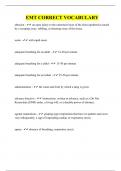
EMT CORRECT VOCABULARY
abrasion - an open injury to the outermost layer of the skin (epidermis) caused by a scraping away, rubbing, or shearing away of the tissue. acute - with rapid onset. adequate breathing for an adult - 12-20 per minute adequate breathing for a child - 15-30 per minute adequate breathing for an infant - 25-50 per minute administration - the route and form by which a drug is given. advance directive - instructions, written in advance, such as a Do Not Resuscitate (DNR) order, a living will, or a durable power of attorney. agonal respirations - gasping-type respirations that have no pattern and occur very infrequently; a sign of impending cardiac or respiratory arrest. apnea - absence of breathing; respiratory arrest. asystole - a heart rhythm indicating absence of any electrical activity in the heart aura - an unusual sensory sensation that may precede a seizure episode by hours or only a few seconds. auscultation - listening for sounds within the body with a stethoscope. AVPU - a mnemonic for alert, responds to verbal stimuli, responds to painful stimulus, unresponsive, to characterize levels of responsiveness. avulsion - an open injury characterized by a loose flap of skin and soft tissue that has been torn loose or pulled completely off. baroreceptors - stretch-sensitive receptors located in the aortic arch and carotid bodies that constantly measure the blood pressure. baseline vital signs - the first set of vital sign measurements to which subsequent measurements can be compared. bilaterally - on both sides basilar skull - floor of the skull. battle sign - discoloration of the mastoid suggesting basilar skull fracture. blood pressure - the force exerted by the blood on the interior walls of the blood vessels bloody show - the mucus and blood that are expelled from the vagina as labor begins. blunt trauma - a force that impacts or is applied to the body but is not sharp enough to penetrate it, such as a blow or a crushing injury. body mechanics - application of the study of muscles and body movement (kinesiology) to the use of the body and to the prevention and correction of problems related to posture and lifting. bradychardia - a heart rate less than 60 beats per minute. bradypnea - a breathing rate that is slower than the normal rate. brain herniation - compression and pushing of the brain through the foramen magnum. bronchi - the two main branches leading from the trachea to the lungs, providing the passageway for air movement. bronchioles - small branches of the bronchi bronchoconstriction - constriction of the smooth muscle of the bronchi and bronchioles causing a narrowing of the air passageway. bronchodilator - a drug that relaxes the smooth muscle of the bronchi and bronchioles and reverses bronchoconstriction
Written for
- Institution
- EMT
- Module
- EMT
Document information
- Uploaded on
- September 28, 2023
- Number of pages
- 23
- Written in
- 2023/2024
- Type
- Exam (elaborations)
- Contains
- Questions & answers
Subjects

Also available in package deal