ATI Fundamentals for Nursing ATI exam questions and answers
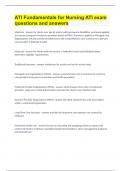
Medicare for clients over age 65 and/or with permanent disabilities. premiums applied as insurance program reimburses providers based on DRGs. Premiums applied as Managed Care Organizations (MCOs) provide enrolled clients with comprehensive care overseen by a primary care provider. Is federally funded. Medicaid for clients with low income. is federally funded and individual states determine eligibility requirements. Traditional Insurance reimburses for services on fee-for-service basis. Managed Care Organizations (MCOs) comprehensive care is overseen by a primary care provider & focuses on prevention and health promotion Preferred Provider Organizations (PPOs) client chooses from a list of contracted providers. using non-contracted providers increases the client's out of pocket costs Exclusive Provider Organizations (EPOs) the client chooses from a list of providers within a contracted organization Long-Term Care Insurance provides for long-term care expenses not covered by Medicare Preventive health care focuses on educating and equipping clients to reduce and control risk factors of disease. Examples include immunizations, stress management programs, and seat belt use Primary health care emphasizes health promotion, and includes prenatal and well-baby care, nutrition counseling, and disease control. is based on a sustained partnership between client and provider. examples include office or clinic visits and scheduled school/work centered screenings (vision, hearing, obesity) Secondary health care includes the diagnosis and treatment of emergency, acute illness, or injury. examples include care given in hospital settings (inpatient and EDs), diagnostic centers, or emergent care centers Tertiary health care involves the provision of specialized highly technical care. examples include oncology centers and burn centers Restorative health care involves intermediate follow-up care for restoring health. examples include home health care, rehab centers, and skilled nursing facilities Continuing health care designed to address long-term or chronic health care needs. examples include hospice, adult day care, and in-home respite care Health care regulatory agencies include: -US Dept of Health and Human Srvcs -US FDA -State and local public health agencies -State licensing boards (to ensure providers & agencies comply with state regulations) -the Joint Commission/JCAHO (set quality standards for accreditation of health care facilities) -Professional Standards Review Organizations (PSROs) -Utilization review committees (monitor for appropriate diagnosis and treatment of hospitalized clients) Clergy Job: provide spiritual care to client (pastors, rabbis, priests) Refer to when: the client requests communication or the family asks for prayer prior to client undergoing a procedure Registered dietitian Job: assess, plan for, and educate the client reg. nutritional needs; direct care of nutritional aids Refer to when: ex- the client has low nutrient levels and/or experienced a recent unexplained weight loss Lab tech Job: obtain specimens of the client's body fluids and perform the necessary diagnostic tests Refer to when: ex- the provider orders a CBC to be performed immediately Occupational therapist Job: assess and plan for the client to regain ADLs, esp motor skills of the upper extremities; direct care of occupational therapy assistants Refer to when: ex- client has difficulties using an eating utensil with dominate hand following a stroke Pharmacist Job: provide & monitor meds for the client as prescribed by the provider; supervises pharm techs in states in which the practice is allowed Refer to when: client concerns over meds; dosage concerns; etc Physical Therapist Job: assess and plan for client to increase musculoskeletal functions, esp of lower extremities, to maintain mobility; direct care of physical therapy assistants Refer to when: ex- following a hip replacement, a client requires assistance learning to ambulate and regain strength Provider Job: assess, diagnose, and treat cllient for disease and/or injury; includes MDs, DOs, APNs, and PAs Refer to when: ex- client experiences change in vital signs Rad Tech Job: position client and perform x-rays and other imaging procedures for providers to review for diagnosis of disorders of various body parts Refer to when: ex- provider orders x-ray of client's hip after a fall Respiratory therapist Job: evaluate resp status and provide prescribed resp treatments including O2 therapy, chest physiotherapy, inhalation therapy, and artificial mechanical ventilation Refer to when: ex- client with resp disease experiences SOB and requests nebulizer treatment that is ordered PRN Social Worker Job: work with client and client's family by coordinating inpatient and community resources to meet psychosocial and environmental needs that are necessary for recovery and/or discharge Refer to when: ex- client dying of cancer wishes to go home but is unable to perform ADLs; the spouse needs med equipment in the home to care for client Speech therapist Job: evaluate and make recommendations regarding the functions of speech, language, and swallowing impacted by various client disorders or injuries; teach client techniques and exercises to improve function when possible Refer to when: ex- a client is having difficulty swallowing a regular diet after trauma to the head and neck Registered Nurse (RN) -Functions under state nurse practice laws -Perform assessments; establish nursing diagnoses, goals, and interventions; conducts ongoing client evaluations -Participate in developing interdisciplinary plans for client care -Share best practices; continuing education Licensed Practical Nurse (LPN) -Works under supervision of the RN -Collaborate with other team members -Possess technical knowledge and skills -Participate in the delivery of nursing care, using the nursing process as a framework Unlicensed Assistive Personnel (UAP) -Includes CNAs, CMAs, and non-nursing personnel -Work under direct supervision of an RN or LPN -Specific tasks usually outlined in position description -Tasks may including feeding clients, preparing meals, lifting, basic care, measuring & recording vital signs, and ambulating clients The foundation of ethics is based on: an expected behavior of a certain group in relation to what is considered right and wrong; it is the study of conduct and character Morals are: the values and beliefs held by people that guide their behaviors and decision making Ethical theory examines: the different principles, ideas, systems, and philosophies used to make judgments about what is right/wrong and good/bad Ethical principles standards of what is right/wrong with regard to important social values and norms Autonomy ability of client to make personal decisions, even when those decisions may not be in the client's best interest Beneficence agreement that the care given is in the best interest of the client; taking positive actions to help others Fidelity agreement to keep one's promise to the client about care that was offered Justice fair treatment in matters related to physical and psychosocial care and use of resources Nonmaleficence avoidance of harm or pain as much as possible when giving treatments Hospital's ethics committee may meet to discuss/resolve unusual or complex ethical issues; not a legal entity Ethical dilemmas are: problems about which more than one choice can be made and the choice made is influenced by the values and beliefs of the decision makers A problem is an ethical dilemma if: -it cannot be solved solely by a review of scientific data -it involves a conflict between two moral imperatives -the answer will have a profound effect on the situation/client Steps in ethical decision making -identify whether or not the issue is indeed an ethical dilemma -state the ethical dilemma including all surrounding issues and individuals involved -list and analyze all possible options for resolving the dilemma and review implications of each option -select option that is in concert with the ethical principle applicable to this situation, the decision maker's values and beliefs, and the profession's values set forth for client care; justify why chosen over other options -apply this decision to the dilemma and evaluate the outcomes Advocacy support of the cause of the client regarding health, safety, and personal rights Responsibility willingness to respect obligations and follow through on promises Accountability ability to answer for one's own actions Confidentiality protection of privacy without diminishing access to quality care
Written for
- Institution
-
Stanford University
- Module
-
ATI RN FUNDAMENTALS
Document information
- Uploaded on
- September 18, 2023
- Number of pages
- 115
- Written in
- 2023/2024
- Type
- Exam (elaborations)
- Contains
- Questions & answers
Subjects
-
ati fundamentals for nursing ati exam questions
-
ati fundamentals for nursing ati

Also available in package deal