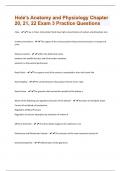
Hole's Anatomy and Physiology Chapter 20, 21, 22 Exam 3 Practice Questions Rated 100% Correct!!
False - True or False: Intracellular fluids have high concentrations of sodium and phosphate ions Urethra and Ureters - The organs of the urinary system whose primary function is transport of urine Kidneys Location - within the abdominal cavity between the twelfth thoracic and third lumbar vertebrae posterior to the parietal peritoneum Renal Pelvis - The superior end of the ureters is expanded to form the funnel-like Renal Papillae - The small elevations that project into the minor calyx Renal Cortex - The granular shell around the medulla of the kidney is Which of the following are regulatory functions of the kidney? - Excretion of metabolic waste Control of red blood cell production Regulation of Blood Pressure Regulation of calcium absorption by activation of vitamin d Afferent Arterioles - The direct blood supply to the nephrons is via Glomerulus and Glomerular Capsule - The structure of the renal corpuscle consists of Glomerulonephritis - Inflammation of the glomeruliEfferent Arteriole - Blood leaves the capillary cluster of the renal corpuscle via Inferior Vena Cava - The renal vein carries blood from the kidney and returns blood to the general circulation via Collecting Duct - the distal convoluted tubule empties urine into this structure Macula Densa - The tall, densely packed cells at the end of the nephron loop that regulate glomerular filtration rate The small diameter of the efferent arteriole in comparison with the afferent arteriole - The relatively high pressure in the glomerulus is due to Renal Medulla - Renal pyramids are located in the Aldosterone - High angiotensin, low sodium and low blood pressure should increase production of Increased Glomerular hydrostatic pressure - Causes increase in glomerular filtration rate Glomerulus - In the kidney, initial filtrate is made by Minor calyx - Immediately after leaving the collecting duct urine is first captured by Angiotensinogen to angiotensin - Renin catalyzes the conversion of Water; posterior pituitary gland - ADH helps retain ___ and is secreted from ___Micturition - Process of releasing urine to the outside
Written for
- Institution
- Hole\'s Anatomy and Physiology Chapter 20, 21, 22 E
- Course
- Hole\'s Anatomy and Physiology Chapter 20, 21, 22 E
Document information
- Uploaded on
- September 17, 2023
- Number of pages
- 8
- Written in
- 2023/2024
- Type
- Exam (elaborations)
- Contains
- Questions & answers
Subjects
-
holes anatomy and physiology chapter 20 21 22

Also available in package deal