Financial Analyst Interview Questions with Complete Answers
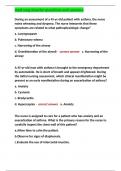
How do you analyze the financial statements? Correct Answer Leverage: Debt-to-Equity Ratio = Total Liabilities / Shareholders Equity Liquidity: Current Ratio = Current Assets / Current Liabilities Liquidity: Quick Ratio= (Current Assets - Inventories)/ Current Liabilities Profitability: Return on Equity (ROE)= Net Income/Shareholder's Equity Efficiency: Net Profit Margin=Net Profit / Net Sales Aside from the financial statements, what else do you need to consider when analyzing a company? Correct Answer Risk: It is vital to manage and maintain. Credit Risk- the risk that a company or individual will be unable to pay the contractual interest or principal on its debt obligations. Interest Rate Risk - the risk that an investment's value will change as a result of a change in interest rates. Market Risk- the day-to-day fluctuations in a stock's price. What is the difference between discount rate and cap rate? Correct Answer Cap rate- the ratio of Net Operating Income (NOI) to property asset value. Discount rate- the rate used in a discounted cash flow analysis to compute present values. The cap rate allows us to value a property based on a single year's NOI. The discount rate, on the other hand, is the investor's required rate of return. The discount rate is used to discount future cash flows back to the present to determine value and account's for all years in the holding period, not just a single year like the cap rate. What is the best way to get Earnings before interest and taxes (EBIT)? Correct Answer EBIT = Operating Revenue - Operating Expenses (OPEX) + Non-operating Income *Walk me through a DCF? Correct Answer Discounted cash flow (DCF) analysis uses future free cash flow projections and discounts them (most often using the weighted average cost of capital) to arrive at a present value, which is used to evaluate the potential for investment. If the value arrived at through DCF analysis is higher than the current cost of the investment, the opportunity may be a good one.
Schule, Studium & Fach
- Hochschule
- Financial Analyst
- Kurs
- Financial Analyst
Dokument Information
- Hochgeladen auf
- 1. september 2023
- Anzahl der Seiten
- 5
- geschrieben in
- 2023/2024
- Typ
- Prüfung
- Enthält
- Fragen & Antworten
Themen
-
how do you analyze the financial statements

Ebenfalls erhältlich im paket-deal