

PROPERTY AND POWER: Mutual Gains and Conflict
Bargaining, Institutions and Allocations (Unit 5)
WEEK 2 : Calculus behind MRS and MRT
Angela’s Optimisation Problem
Maximise U= U(t,B) subject to B=f(24-t)
To solve this find : MRS=MRT
Marginal Rate of Substitution
U=U(t,B)
MRS= |slope of IC| = |∆B/∆t|
For a specific utility level (c) we can represent the indifference curve as U(t,B)=c
dU
>0
dt
dU
>0
dB
dU dU
∆u≈ ∆ t+ ∆B
dt dB
dU dU
∆ t+ ∆ B=0
dt dB
dU
−
∆B dt −dU dB
= = x
∆t dU dt dU
dB
| ||
dU
MRS=
dt
dU
=
−dU dB
dt
x
dU |
dB
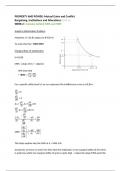
This helps explain why the MRS at A > MRS at B
At point B, we have so much free time that the implication is my marginal utility of free time
is quite low whilst my marginal utility of grain is quite high – makes the slope/MRS quite flat
,This contrasts with point A, we have little free time so my marginal utility of free time is
quite high and my marginal utility of grain is very low – my slope is steeper than B
Quasi-linear Preferences
LEIBNIZ 5.4.1
Angela is a farmer who values two things: grain (which she consumes) and free time.
In Unit 5 we assume that her preferences with respect to these two goods have a special
property: she values grain at some constant amount relative to free time, independently
of how much grain she already has. This Leibniz shows how to capture that property
mathematically.
In earlier Leibnizes we have made extensive use of the Cobb-Douglas utility function. We
now explore an alternative: the quasi-linear utility function.
Let t be Angela’s daily hours of free time, and c the number of bushels of grain that she
consumes per day. We assume, as in the main text, that the rate at which Angela is willing to
exchange grain for free time remains constant as her consumption of grain increases.
In other words, her marginal rate of substitution between hours of free time and bushels of
grain depends only on the free time and not at all on the grain. We have sketched indifference
curves with this property in Figure 1. For any given amount of free time, say t 0 , the slope of
the indifference curve at the point ( t 0 , c ) is the same for all c, which means that the tangent
lines in the figure are parallel.
Figure 1: Indifference curves with the property that MRS depends only on free time
,Quasi-linear Preferences
LIEBNIZ 5.4.1
A utility function with the property that the marginal rate of substitution (MRS) between and
depends only on is:
U ( t , c )=v ( t ) +c
where v is an increasing function: v’(t)>0 because Angela prefers more free time to less. This is called
a quasi-linear function because utility is linear in c and some function of t. We now show that this
utility function has the required property.
Angela’s marginal rate of substitution (MRS) between free time and consumption of grain is defined
as in Leibniz 3.2.1 as the absolute value of the slope of the indifference curve through the point (t, c).
It may be found by the formula we derived in the earlier Leibniz:
∂U
/∂ U
∂t
MRS=
∂c
, ∂U ∂U
In this case, =v ' ( t ) and =1, so
∂t ∂c
MRS=v ' ( t )
The same result can be obtained directly, without using the general formula. Each indifference curve is
of the form
v ( t ) +c=constant
Or c=k−v ( t ) , where k is a constant. Therefore
dc '
=−v ( t ) <0
dt
along an indifference curve. The curve slopes downwards and the absolute value of the slope is . Thus
the MRS is a function of alone, as we wished to prove.
In Figure 1, the indifference curves have the usual property of diminishing MRS, flattening as you
move to the right. For this to happen, v’(t) must fall as t increases. Thus v”(t)<0 : v is a concave
function. Because indifference curves are of the form ' c=constant−v (t)' , any two of them differ
by a constant vertical distance, as you can see in Figure 1. The reason why the curves in the diagram
bunch together horizontally at large values of c is simply that they are steeper there.
Quasi-linear Preferences
LIEBNIZ 5.4.1 SUMMARY
To summarize: the utility function
U ( t , c )=v ( t ) +c
where the function v is increasing and concave, is called quasi-linear. Using a utility function of this
form means that we are making a restrictive assumption about preferences, but it has a very useful
implication. Because utility is of the form ‘c + something’, it is measured in the same units as
consumption. Angela values t hours of free time as much as v(t) bushels of grain.
Bargaining, Institutions and Allocations (Unit 5)
WEEK 2 : Calculus behind MRS and MRT
Angela’s Optimisation Problem
Maximise U= U(t,B) subject to B=f(24-t)
To solve this find : MRS=MRT
Marginal Rate of Substitution
U=U(t,B)
MRS= |slope of IC| = |∆B/∆t|
For a specific utility level (c) we can represent the indifference curve as U(t,B)=c
dU
>0
dt
dU
>0
dB
dU dU
∆u≈ ∆ t+ ∆B
dt dB
dU dU
∆ t+ ∆ B=0
dt dB
dU
−
∆B dt −dU dB
= = x
∆t dU dt dU
dB
| ||
dU
MRS=
dt
dU
=
−dU dB
dt
x
dU |
dB
This helps explain why the MRS at A > MRS at B
At point B, we have so much free time that the implication is my marginal utility of free time
is quite low whilst my marginal utility of grain is quite high – makes the slope/MRS quite flat
,This contrasts with point A, we have little free time so my marginal utility of free time is
quite high and my marginal utility of grain is very low – my slope is steeper than B
Quasi-linear Preferences
LEIBNIZ 5.4.1
Angela is a farmer who values two things: grain (which she consumes) and free time.
In Unit 5 we assume that her preferences with respect to these two goods have a special
property: she values grain at some constant amount relative to free time, independently
of how much grain she already has. This Leibniz shows how to capture that property
mathematically.
In earlier Leibnizes we have made extensive use of the Cobb-Douglas utility function. We
now explore an alternative: the quasi-linear utility function.
Let t be Angela’s daily hours of free time, and c the number of bushels of grain that she
consumes per day. We assume, as in the main text, that the rate at which Angela is willing to
exchange grain for free time remains constant as her consumption of grain increases.
In other words, her marginal rate of substitution between hours of free time and bushels of
grain depends only on the free time and not at all on the grain. We have sketched indifference
curves with this property in Figure 1. For any given amount of free time, say t 0 , the slope of
the indifference curve at the point ( t 0 , c ) is the same for all c, which means that the tangent
lines in the figure are parallel.
Figure 1: Indifference curves with the property that MRS depends only on free time
,Quasi-linear Preferences
LIEBNIZ 5.4.1
A utility function with the property that the marginal rate of substitution (MRS) between and
depends only on is:
U ( t , c )=v ( t ) +c
where v is an increasing function: v’(t)>0 because Angela prefers more free time to less. This is called
a quasi-linear function because utility is linear in c and some function of t. We now show that this
utility function has the required property.
Angela’s marginal rate of substitution (MRS) between free time and consumption of grain is defined
as in Leibniz 3.2.1 as the absolute value of the slope of the indifference curve through the point (t, c).
It may be found by the formula we derived in the earlier Leibniz:
∂U
/∂ U
∂t
MRS=
∂c
, ∂U ∂U
In this case, =v ' ( t ) and =1, so
∂t ∂c
MRS=v ' ( t )
The same result can be obtained directly, without using the general formula. Each indifference curve is
of the form
v ( t ) +c=constant
Or c=k−v ( t ) , where k is a constant. Therefore
dc '
=−v ( t ) <0
dt
along an indifference curve. The curve slopes downwards and the absolute value of the slope is . Thus
the MRS is a function of alone, as we wished to prove.
In Figure 1, the indifference curves have the usual property of diminishing MRS, flattening as you
move to the right. For this to happen, v’(t) must fall as t increases. Thus v”(t)<0 : v is a concave
function. Because indifference curves are of the form ' c=constant−v (t)' , any two of them differ
by a constant vertical distance, as you can see in Figure 1. The reason why the curves in the diagram
bunch together horizontally at large values of c is simply that they are steeper there.
Quasi-linear Preferences
LIEBNIZ 5.4.1 SUMMARY
To summarize: the utility function
U ( t , c )=v ( t ) +c
where the function v is increasing and concave, is called quasi-linear. Using a utility function of this
form means that we are making a restrictive assumption about preferences, but it has a very useful
implication. Because utility is of the form ‘c + something’, it is measured in the same units as
consumption. Angela values t hours of free time as much as v(t) bushels of grain.


