The Cold War IB History Paper 2 with complete solution
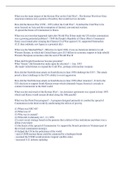
The Cold War IB History Paper 2 What was the main impact of the Korean War on the Cold War? - The Korean War froze Sino-American relations into a pattern of hostility that would last two decades How did the Korean War () affect the Cold War? - It shifted the Cold War to be more focused on Asia and the resumption of limited, conventional warfare. -It spread the threat of Communism to Korea What was an event that happened right after World War II that made the US realize communism was a growing potential problem? - 1949 the People's Republic of China (Mao's Communist Party) was formed after winning the Chinese Civil War against U.S.-supported Nationalists (U.S. then suddenly saw Japan as a potential ally) What was the Marshall Plan? - Effective in April 1948, it was an American initiative to aid Western Europe, in which the United States gave $13 billion in economic support to help rebuild Western European economies after the end of World War II When did Dwight Eisenhower become president? What "threats" did Eisenhower make upon his election? - - Jan. 1953 -He made veiled threats to expand the Cold War...perhaps with nuclear weapons How did the North Korean attack on South Korea in June 1950 challenge the UN? - The attack posed a direct challenge to the UN's ability to resist aggression. How did the North Korean attack on South Korea in June 1950 affect America? - It led to the US's decision to support South Korean troops which ultimately began America's crusade to contain Communism in the third world. What was the end result of the Korean War? - An Armistice agreement was signed in June 1953 which said Korea would remain divided along the 38th parallel What was the Point Four program? - A program designed primarily to combat the spread of Communism in the third world by ameliorating the effects of poverty (1) When was NSC-68? (2) What was it? (3) Why was it created? (4) What did it ultimately do? - (1) 1950 (2) a new secret strategy based on the premise that a defeat of free institutions anywhere was a defeat everywhere (3) the threat of the spread of Communism / to support the French position in Vietnam (part of the revised containment strategy) (4) helped the US be the policemen of the world - said a USSR nuclear threat could be countered by a hydrogen bomb - assumed the USSR would promote /support satellite states - increased U.S. defense spending Why did the US abandon isolationism? - - the oceans no longer offered them much protection from attack -the USSR (+ communism) was a growing threat -the USSR was building an atomic bomb (1) What caused NATO? (2) What was NATO? (3) When was it formed? - (1) The Soviet atomic bomb (2) an alliance that held that if the U.S. again withdrew into isolation, Western Europe would fall to the USSR and the situation would require U.S. intervention (3) 1949 Name a relevant communist Alliance created in 1950 - Sino-Soviet Treaty of 1950 (USSR promised aid ($$) to China) How did the Korean War affect the US's relationship with China? - The US branded China as an international aggressor, imposed a tighter economic embargo on trade with the Chinese, and banished any thought of giving the communists China's seat in the UN Relate the Korean War to a proxy war - -The Korean War seemed to confirm European fears that the Soviets were prepared to use their satellite states to fight proxy wars against the West in the Cold War - through the North Atlantic Treaty, the US was now firmly committed to come to the assistance of Western Europe in the event of a Soviet attack How did NATO take steps to enhance its military capabilities? - - agreeing to build a 96 division Ground Force to counter the Soviet military presence in Eastern Europe - strengthening NATO's Mediterranean flank by accepting Greece and Turkey as full alliance members in 1952 -Providing an additional four billion dollars of military assistance in fiscal year 1951 to help European allies rearm What was the Non-Alligned Movement and who was Gamal Nasser? - -the Movement Included 29 countries which agreed to resist colonialism and imperialism in all forms and promoted Afro-Asian co-operation -Nasser (leader of Egypt in 1954) was a primary leader of the N.A. Movement who sought to remove Western influence from the Middle East and was known as the father of Arab nationalism What was the Suez Canal Crisis? - - July 1956 - the Egyptian Army nationalized the Suez Canal - British and French shareholders of the Canal collaborated with the with the Israelis who were instructed to invade the Sinai Penninsula (Oct.) and secure the Canal. - The UN issued a proposal for the withdrawl of Israeli troops and opposed military action. - November 1956 - the U.S. sent an emergency force to the Middle East and stabilized the situation Why was the UN's resolution to the Suez Canal Crisis important? - - it created the Eisenhower Doctrine (as seen during the Crisis, the UK and France had lost their influence in the region and were no longer seen as dominant world powers....they needed U.S. assistance) What was the Eisenhower Doctrine? - - A plan stating that the U.S. would provide assistance to Middle Eastern countries to prevent the spread of communism and Soviet influence in that area - it gave the president the right to use force in the Middle East against overt armed aggression from any nation controlled by international communism - the administration was granted to send 200 million dollars a year in economic and military assistance to the Middle Eastern countries willing to resist Soviet control (by 1958, this involved 45 countries) When did Stalin die and how did his death have an important impact on the Cold War? - - March 1953 - new leaders took over the USSR and began to show that both foreign and domestic Soviet policies were changing When was Khrushchev's De-Stalinization speech and what did it do? - - February 1956 - the speech condemned Stalin's actions against the people of the Soviet Union -Mao = critical of speech / accused Khrushchev of revisionism (which strained Sino-Soviet relations) -Khrushchev began to loosen some of the USSR's governmental control over the private lives of citizenry How could the death of Stalin be seen as a lost chance for accomodation? - Some historians believe the death of Stalin created the opportunity for a Cold War "thaw" that never happened How did Eisenhower formally react to the death of Stalin? - -Eisenhower believed that Stalin's death might clear the way for fundamental changes in Soviet behavior and improvement in East-West relations. - he expressed willingness to begin arms reduction talks if the Soviets would take concrete steps to resolve outstanding differences with the West - he proposed the Soviets allowed free elections in Eastern Europe When was the Hungarian Uprising? Why is it significant to the Cold War? - - October - November 1956
Written for
- Institution
- The Cold War IB History Paper 2
- Course
- The Cold War IB History Paper 2
Document information
- Uploaded on
- April 15, 2023
- Number of pages
- 13
- Written in
- 2022/2023
- Type
- Exam (elaborations)
- Contains
- Questions & answers
Subjects
-
the cold war ib history paper 2 with complete solution

Also available in package deal