Unit 2 – Exercise Physiology
Assignment 1 – Investigation into initial & steady state responses
to exercise
Cardiovascular responses
Heart rate
Heart rate is the number of times the heart beats per
minute. It is measured in beats per minute (bpm). For an
average person, the resting heart rate can range
between 60-80bpm. However, an individual’s resting
heart rate can vary depending on age, gender, how much
regular exercise they do, and their lifestyle. For
example, if someone had a poor work-life balance, they
might be stressed. Someone who is stressed will have a
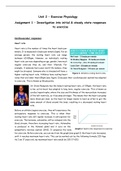
Figure 1: Athletes resting heart rates.
higher resting heart rate. Athletes have resting heart
rates that are lower than 60bpm (see figure 1) because their cardiovascular system has adapted
to exercise. This is known as Bradycardia.
Sir Steve Redgrave has the lowest resting heart rate, of 30bpm. His heart rate
is low, as his heart has adapted to long term, regular exercise. This is known as
cardiac hypertrophy, where the size and thickness of the myocardium increases
of the left ventricle, so it becomes stronger. This means that the heart can pump
more blood per beat, so the heart no longer needs to beat as often to get the
same amount of blood around the body, resulting in a decreased resting heart
rate.
Before an athlete begins exercise, they will experience the
anticipatory response to exercise. This is when their
resting heart rate will rapidly increase in anticipation for
exercise. The hormone, adrenaline, will be released into the
blood stream, therefore increasing heart rate. Adrenaline
is produced in the Adrenal gland and it acts on the
sympathetic nervous system (SNS). It prepares the body Graph 1: heart rate responses to exercise
for exercise. Before exercise, you can see from the graph (see graph 1) that heart rate increases,
until it reaches maximum heart rate. This can be worked out by the following formula 220-Age.
As I am 17 years old, my maximum heart rate would be 220-17=203.
, The heart rate is able to increase due to the SNS. The SNS speeds up the rate of the Sino-
Atrial Node. This fires more frequently so that the heart beats faster to supply more
oxygenated blood to the muscles. From the graph, you can see that once maximum heart rate is
achieved, the heart rate plateaus, as the cardiovascular system has met the demands of the
activity.
When exercising for long periods of time, the SNS speeds up the heart rate to remove waste
products such as carbon dioxide. When you exercise, waste products of metabolism, such as
carbon dioxide and lactic acid are produced. These get into blood, which lowers the pH of the
blood, making it more acidic. Chemoreceptors, specialised cells found in the muscles, aortic arch,
and carotid bodies, detect changes in chemical levels – specifically pH levels. If they detect a
lowered pH, they will send a signal to the brain to the medulla oblongata, known as the “cardiac
control centre”. The brain responds by activating the sympathetic nervous system, which causes
the SA node to fire more quickly. It sends an impulse between the intermodal and interatrial
pathway, and to the AV node. The impulse reaches the Bundle of His, and goes down the left and
right bundle branches. The impulse then reaches the purkinje fibres.
Stroke volume
Stroke volume is the volume of blood leaving the heart per beat. This is measured in millilitres of
blood (ml). At rest the stroke volume is between 70-90ml for an untrained individual but can be
as high as 110ml for a trained athlete. This can increase during exercise to values of 180-200ml.
Athletes have larger stroke volumes compared to non-athletes because their hearts have adapted
to exercise. The size and thickness of the myocardium, the middle layer of the heart, increases.
This is known as cardiac hypertrophy. It means that when the left ventricle contracts, more blood
can be pumped out per beat.
During exercise, stroke volume is affected by the
blood returning back to the heart, known as venous
return. Venous return is affected because gravity
is trying to draw the blood down into the limbs,
causing blood to pool. To prevent this, there are
two mechanisms that assist with venous return.
The first mechanism is the muscle pump (see figure
2). When the skeletal muscle contracts it squeezes
the veins, increasing blood flow to the heart. When
the muscle relaxes, the pressure is taken away
Figure 2: The muscle pump
from the veins and the valves close to stop the blood from pooling in the limbs.
There is also another pump called the respiratory pump. When the individual expires during
exercises, the diaphragm returns to the dome-shape and the intercostal and abdominal muscles
contract to force the rib cage down. This causes the pressure to increase inside the thoracic
cavity and therefore pressure is applied to the vessels encouraging an increase in venous return.
Assignment 1 – Investigation into initial & steady state responses
to exercise
Cardiovascular responses
Heart rate
Heart rate is the number of times the heart beats per
minute. It is measured in beats per minute (bpm). For an
average person, the resting heart rate can range
between 60-80bpm. However, an individual’s resting
heart rate can vary depending on age, gender, how much
regular exercise they do, and their lifestyle. For
example, if someone had a poor work-life balance, they
might be stressed. Someone who is stressed will have a
Figure 1: Athletes resting heart rates.
higher resting heart rate. Athletes have resting heart
rates that are lower than 60bpm (see figure 1) because their cardiovascular system has adapted
to exercise. This is known as Bradycardia.
Sir Steve Redgrave has the lowest resting heart rate, of 30bpm. His heart rate
is low, as his heart has adapted to long term, regular exercise. This is known as
cardiac hypertrophy, where the size and thickness of the myocardium increases
of the left ventricle, so it becomes stronger. This means that the heart can pump
more blood per beat, so the heart no longer needs to beat as often to get the
same amount of blood around the body, resulting in a decreased resting heart
rate.
Before an athlete begins exercise, they will experience the
anticipatory response to exercise. This is when their
resting heart rate will rapidly increase in anticipation for
exercise. The hormone, adrenaline, will be released into the
blood stream, therefore increasing heart rate. Adrenaline
is produced in the Adrenal gland and it acts on the
sympathetic nervous system (SNS). It prepares the body Graph 1: heart rate responses to exercise
for exercise. Before exercise, you can see from the graph (see graph 1) that heart rate increases,
until it reaches maximum heart rate. This can be worked out by the following formula 220-Age.
As I am 17 years old, my maximum heart rate would be 220-17=203.
, The heart rate is able to increase due to the SNS. The SNS speeds up the rate of the Sino-
Atrial Node. This fires more frequently so that the heart beats faster to supply more
oxygenated blood to the muscles. From the graph, you can see that once maximum heart rate is
achieved, the heart rate plateaus, as the cardiovascular system has met the demands of the
activity.
When exercising for long periods of time, the SNS speeds up the heart rate to remove waste
products such as carbon dioxide. When you exercise, waste products of metabolism, such as
carbon dioxide and lactic acid are produced. These get into blood, which lowers the pH of the
blood, making it more acidic. Chemoreceptors, specialised cells found in the muscles, aortic arch,
and carotid bodies, detect changes in chemical levels – specifically pH levels. If they detect a
lowered pH, they will send a signal to the brain to the medulla oblongata, known as the “cardiac
control centre”. The brain responds by activating the sympathetic nervous system, which causes
the SA node to fire more quickly. It sends an impulse between the intermodal and interatrial
pathway, and to the AV node. The impulse reaches the Bundle of His, and goes down the left and
right bundle branches. The impulse then reaches the purkinje fibres.
Stroke volume
Stroke volume is the volume of blood leaving the heart per beat. This is measured in millilitres of
blood (ml). At rest the stroke volume is between 70-90ml for an untrained individual but can be
as high as 110ml for a trained athlete. This can increase during exercise to values of 180-200ml.
Athletes have larger stroke volumes compared to non-athletes because their hearts have adapted
to exercise. The size and thickness of the myocardium, the middle layer of the heart, increases.
This is known as cardiac hypertrophy. It means that when the left ventricle contracts, more blood
can be pumped out per beat.
During exercise, stroke volume is affected by the
blood returning back to the heart, known as venous
return. Venous return is affected because gravity
is trying to draw the blood down into the limbs,
causing blood to pool. To prevent this, there are
two mechanisms that assist with venous return.
The first mechanism is the muscle pump (see figure
2). When the skeletal muscle contracts it squeezes
the veins, increasing blood flow to the heart. When
the muscle relaxes, the pressure is taken away
Figure 2: The muscle pump
from the veins and the valves close to stop the blood from pooling in the limbs.
There is also another pump called the respiratory pump. When the individual expires during
exercises, the diaphragm returns to the dome-shape and the intercostal and abdominal muscles
contract to force the rib cage down. This causes the pressure to increase inside the thoracic
cavity and therefore pressure is applied to the vessels encouraging an increase in venous return.