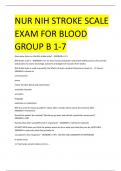
PrepU Quizzes F&E Med Surg (Answered) Complete Solution
PrepU Quizzes F&E Med Surg A nurse reviews the arterial blood gas (ABG) values of a client admitted with pneumonia: pH, 7.51; PaCO2, 28 mm Hg; PaO2, 70 mm Hg; and HCO3--, 24 mEq/L. What do these values indicate? Respiratory alkalosis - A client with pneumonia may hyperventilate in an effort to increase oxygen intake. Hyperventilation leads to excess carbon dioxide (CO2) loss, which causes alkalosis — indicated by this client's elevated pH value. With respiratory alkalosis, the kidneys' bicarbonate (HCO3-) response is delayed, so the client's HCO3- level remains normal. The below-normal value for the partial pressure of arterial carbon dioxide (PaCO2) indicates CO2 loss and signals a respiratory component. Because the HCO3- level is normal, this imbalance has no metabolic component. Therefore, the client is experiencing respiratory alkalosis. Which of the following arterial blood gas results would be consistent with metabolic alkalosis? Serum bicarbonate of 28 mEq/L - Evaluation of arterial blood gases reveals a pH greater than 7.45 and a serum bicarbonate concentration greater than 26 mEq/L. A group of nursing students are studying for a test over acid-base imbalance. One student asks another what the major chemical regulator of plasma pH is. What should the second student respond? Bicarbonate-carbonic acid buffer system - The major chemical regulator of plasma pH is the bicarbonate-carbonic acid buffer system. A client hospitalized for treatment of a pulmonary embolism develops respiratory alkalosis. Which clinical findings commonly accompany respiratory alkalosis? Light-headedness or paresthesia - The client with respiratory alkalosis may complain of light-headedness or paresthesia (numbness and tingling in the arms and legs). Nausea, vomiting, abdominal pain, and diarrhea may accompany respiratory acidosis. Hallucinations and tinnitus rarely are associated with respiratory alkalosis or any other acid-base imbalance. Which intervention is most appropriate for a client with an arterial blood gas (ABG) of pH 7.5, a partial pressure of arterial carbon dioxide (PaCO2) of 26 mm Hg, oxygen (O2) saturation of 96%, bicarbonate (HCO3-) of 24 mEq/L, and a PaO2 of 94 mm Hg? Instruct the client to breathe into a paper bag. - The ABG results reveal respiratory alkalosis. The best intervention to raise the PaCO2 level would be to have the client breathe into a paper bag. Administering a decongestant, offering fluids frequently, and administering supplemental oxygen wouldn't raise the lowered PaCO2 level. A client comes to the emergency department with status asthmaticus. His respiratory rate is 48 breaths/minute, and he is wheezing. An arterial blood gas analysis reveals a pH of 7.52, a partial pressure of arterial carbon dioxide (PaCO2) of 30 mm Hg, PaO2 of 70 mm Hg, and bicarbonate (HCO3??') of 26 mEq/L. What disorder is indicated by these findings? Respiratory alkalosis - Respiratory alkalosis results from alveolar hyperventilation. It's marked by a decrease in PaCO2 to less than 35 mm Hg and an increase in blood pH over 7.45. Metabolic acidosis is marked by a decrease in HCO3? to less than 22 mEq/L, and a decrease in blood pH to less than 7.35. In respiratory acidosis, the pH is less than
Written for
- Institution
- PrepU F&E Med Surg
- Course
- PrepU F&E Med Surg
Document information
- Uploaded on
- March 8, 2023
- Number of pages
- 8
- Written in
- 2022/2023
- Type
- Exam (elaborations)
- Contains
- Questions & answers
Subjects
-
prepu quizzes fampe med surg a nurse reviews the arterial blood gas abg values of a client admitted with pneumonia ph
-
751 paco2
-
28 mm hg pao2
-
70 mm hg and hco3
-
24 meql what do these v