NR 228 FINAL EXAM 2023 - QUESTION & ANSWER
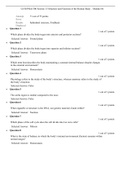
1. Which principle of health diet suggest selecting a wide range of foods as represented by the USDA’s MyPlate food plan? a) Variety b) Moderation c) Adequacy d) Energy density 2. A group of strategies used to increase the level of health of individuals, families, groups and communities is known as: a) Wellness b) health promotion c) tertiary prevention d) nutritional assessment 3. Food descriptions on labels assist us in better understanding the products inside of the package. Which of the following food description is false? a) “Extra lean” contains less than 5g of fat, 2g of saturated fat, and 95mg of cholesterol per serving. b) “Light or lite” products contain half the calories of two thirds the fat content of the original product. c) “Lean” contains less than 10f of fat, 4g of saturated fat, and 95mg of cholesterol per serving. d) “Good source of” contains 10%-19% of daily value for specific vitamin, mineral, or fiber in one serving. 4. Nutrients that DO NOT yield energy include: a) minerals, vitamins and water b) protein, water and vitamins c) water, vitamins, and carbohydrates d) minerals, vitamins, and proteins. NOTE: Energy-yielding nutrients are organic Carbohydrates, proteins, and lipids 5. The nutrients that provides the highest number of kcals per gram is: a) protein b) alcohol c) fat d) carbohydrate NOTE: Kcals values for carbohydrates (4gr), Protein (4gr), alcohol (7gr), Lipids/fat (9gr) 6. As a nurse, you know that health promotion typically, consist of strategies use to increase the level of the health of individuals, their families, groups, and entire communities. Example of health promotion strategies implement by nurse often include: a) Knowledge, power, and community services b) trust, government stipends, and managed care c) knowledge, techniques, and community support d) trust, cultural perception and knowledge 7. Water soluble and fat soluble describes the two classes of: a) fiber b) vitamin c) minerals d) carbohydrates NOTE: Fat soluble vitamins (A, D, E K), Water soluble vitamin (B, C). fat-soluble - absorbed like fats, 1st into the lymph and then into the blood; Usually occur together in fats and oils; Absorbed in the same manner as lipids. water-soluble - absorbed directly into the blood 8. A category of nutrients that assists other nutrients with metabolic functions throughout the body is: a) water b) protein c) vitamin d) minerals NOTE: Vitamins indirectly assist other nutrients through the complete processes of digestion, absorption, metabolism, and excretion. Water provides a fluid medium and a transport system for body processes. Protein makes up many body structures, enzymes, and components of the immune system. Minerals serve structural purposes and are found in body fluids. 9. The best source of action to provide adequate amounts of vitamins and minerals is to: a) promote weight loss b) eat a variety of foods c) eat at least three meals per day d) consume a high-fiber, low-fat diet. NOTE: Including a variety of foods increases the likelihood of obtaining adequate amounts of vitamins and minerals. Loss of weight will not contribute to adequate nutrient intake. Eating at least 3 meals per day may help increase nutrient intake to some extent, but they could still be meals that provide a limited assortment of foods. Similarly, a high-fiber, low-fat diet could consist of foods that are relatively low in vitamins and minerals. 10. If a college student is eating only one small meal per day in an attempt to lose weight and is takinghigh doses of vitamin and mineral supplements to try make up for the lack of food, he or she would be describe as having: a) malnutrition b) nonnutrition c) overnutrition d) disordered eating NOTE: An imbalance of nutrients and/or energy (in this case, high intake of some nutrients and low intake of energy) is called malnutrition. Overnutrition only refers to excessive intake or nutrients and/or energy. Disordered eating refers to unusual eating habits that may or may not lead to some form of malnutrition. Nonnutrition is not a recognized term. 11. A teenager client is hungry and goes to the refrigerator for a snack. A holiday has just been celebrated at her home, and many of her favorite foods are available. She selects some slices of roast turkey and a cup of her aunt’s special fruit salad. This is an example of: a) binging b) abundance c) food choice d) food preference NOTE: This teenager is able to select foods according to her preferences. Food choices are restricted by convenience, but many of her favorite foods are available so her choices are not limited. The food is abundant, and she may choose to binge and overeat, but her selections are made according to her food preference. 12. Economics is a significant factor influencing the nutritional status of communities. To overcome economic disadvantage, public health efforts include: a) the MyPyramid food guidance system b) educational program on food safety c) the U.S. government’s Food Stamp Program d) public service announcements on heath eating NOTE: The Food Stamp Program provides coupons to buy nutritious foods for individuals and families with incomes below certain levels. This can help improve the nutritional status of economically challenged families. The other public health efforts listed are not specifically aimed at people who have an economic disadvantage. 13. Between 1970 and 2000, nutritional concern centered on reducing nutrient excesses. Before 1070, the focus was to reduce: a) consumption of lipids b) low-carbohydrate diets c) nutrient deficiencies d) prevention of infection disease NOTE: Before 1970, most nutritional problems were attributed to nutrient deficiency. Later on, research showed the association between excessive lipid intakes and chronic disease. Lowcarbohydrate diets gained popularity for weight loss after 1970. Prevention of infectious disease is not a direct nutritional concern. 14. Of the following, the most important overall dietary modification to help reduce risk of chronic disease is: a) eating fewer foods that contain preservatives b) buying mostly locally grown foods c) eating more plant-based foods d) eating more animal-based foods NOTE: Scientific evidence from the nutrition evidence library shows that shifting to a more plant-based diet is one of four significant modifications to our dietary intake patterns that will improve the overall health of Americans. Preservatives per se have not been associated with health status (although foods that contain preservatives may be more highly processed and may be higher in fat, sugar, and sodium and lower in nutrients than foods without preservatives). Buying locally grown foods may be a good agricultural and economic practice, but does not affect health status. Eating more animal-based foods would be the opposite of what is recommended. 15. The “fruit & veggies – more matters” slogan is part of a campaign designed to increase of fruits& veggies among: a) school-age children b) people living in urban areas c) low-income individual and families d) all Americans NOTE: "Fruits & veggies—more matters" is part of the National Fruit and Vegetable Program, designed to increase intake of fruits and vegetables among all Americans. It is not specifically targeted at any age, demographic, or socioeconomic group. 16. One reason that increasing fruit & veggies consumption helps decrease dietary fat intake is because fruit & veggies: a) are natural appetite suppressants b) displace high-fat foods from the diet c) are rich antioxidants and phytochemicals d) decrease absorption of fat from foods
Geschreven voor
- Instelling
-
Chamberlain College Nursing
- Vak
-
NR 228
Documentinformatie
- Geüpload op
- 1 maart 2023
- Aantal pagina's
- 15
- Geschreven in
- 2022/2023
- Type
- Tentamen (uitwerkingen)
- Bevat
- Vragen en antwoorden
Onderwerpen
- nr 228 final exam
- nr 228
-
nr 228 final exam 2023 question amp answer
-
1 which principle of health diet suggest selecting a wide range of foods as represented by the usda’s myplate food plan a var