HFMA SET 1 Latest Updated
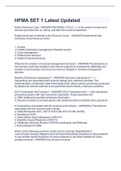
Define Revenue Cycle - ANSWER-REVENUE CYCLE ----- is the series of events and services provided prior to, during, and after the course of treatment Departments that contribute to the Revenue Cycle. - ANSWER-Departments that contribute to the Revenue Cycle. 1. Access 2. Health information management/ Medical records 3. Case-management 4. Patient Care Services 5. Patient Financial Services What led the creation of revenue management services? - ANSWER-The emphasis on the revenue cycle has resulted in the need to organize its components differently and created a new business unit known as revenue integrity or revenue management services. Benefit of Electronic transactions? - ANSWER-Electronic transactions."------ transactions are associated with revenue capture and collection activities. The implementation of electronic data interchange (EDI) allows actions previously conducted by telephone/ manual methods to be performed electronically ( improves workflow). 5010 Transaction Set Function? - ANSWER-5010 Transaction Set------new transaction processing system with new transaction standards. These standards will: a. Offer healthcare providers enhanced information. b. Require providers to provide payers with additional data to facilitate claim payments. 6 Transactions associated with the revenue cycle include: - ANSWER-6 Transactions associated with the revenue cycle include: a. Claim/Encounter (837-I, 837-P, 837-COB, 837-P COB, NCPD). b. Remittance (835). c. Claim Status Inquiry/Response (276/277). d. Eligibility Inquiry/Response (270/271). e. Healthcare Services Review (278) Pre-certification and Referrals. f. Acknowledgment (999) Which of the following would be a hard cost of customer dissatisfaction? Loss of future revenue Negative word-of-mouth advertising Decisions of future patients to use another facility Decisions of current patients to use other facilities for future ancillary services - ANSWER-loss of future revenue Define hard cost and soft cost. - ANSWER-1. Hard Cost -the loss of future revenue 2. Soft Cost- Negative word-of-mouth advertising that may influence others not to use the hospital. Single greatest reason for an inability to bill and collect accounts receivable in a timely manner? - ANSWER-Single greatest reason for an inability to bill and collect accounts receivable in a timely manner: Inadequate and incorrect information received from the admitting/patient access department The Access department's policies and procedures should also address the what 3 topics: - ANSWER-... The key is the timing of the collection of the financial data and payment is? - ANSWER-... When certain services are not covered, a Medicare patient should be issued a/an __________to notify the patient that they may be responsible for payment. - ANSWER-ABN---Advance Beneficiary Notice of Non-Coverage (ABN) Examples of when Medicare is secondary include: - ANSWER-... The COBRA benefit is provided to employees or their family members if they lose coverage due to a number of reasons, such as the following: (list 4) - ANSWER-The COBRA benefit is provided to employees or their family members if they lose coverage due to a number of reasons, such as the following: Loss of employment Reduction in hours worked Divorce Death of the supporting spouse The time required for gathering information has the highest return when the investment is made _________. Before the patient's arrival After discharge When the first bill comes off After the account goes to collections - ANSWER-Before the patient's arrival What are the 4 things included in claims adjudication? - ANSWER-Claims adjudication includes the following: 1.Determination of benefits levels and coverage 2. Coordination of benefits 3.Subrogation of third-party liability claims 4.Generation of appropriate explanation of benefit forms What are the twin goals of financial counseling? - ANSWER-The twin goals of financial counseling are: That the provider understands upfront a patient's ability to pay, and That the patient understands his or her financial responsibility to the provider. Accounts receivable (A/R) personnel must become key participants in the POS collection process. Is this statement true or false? - ANSWER-False Which of the following is true of deposits? A deposit should be requested to secure payment when precise charge calculations are not practical. Deposit policies should be reviewed and approved by the CFO. To facilitate calculation of deposits, credit references should be readily available. To facilitate internal reporting, deposit payments should be held in the general fund. - ANSWER-A deposit should be requested to secure payment when precise charge calculations are not practical. In __________, a provider arranges for patients to obtain loans through a local bank. In-house financing A bank financing agreement Charity care Bad debt write-off - ANSWER-In-house financing ----a provider arranges for patients to obtain loans through a local bank. The outpatient system will assign multiple APCs to outpatients to account for all of the following, EXCEPT the ___________. Diversity of sites of ambulatory care services Wide variety of patient needs addressed in the outpatient setting Intensity of physician care required High percentage of costs associated with ancillary services - ANSWER-Intensity of physician care required Why is the role of Access or Registration staff critical to billing? - ANSWER-Since billing occurs after the patient leaves the hospital or physician office, it is imperative that the Access or Registration staff obtains the correct information at time of registration. The Access department's policies and procedures should address the what topics: - ANSWER-The Access department's policies and procedures should address the following topics: 1) Hospital privileges of the admitting and attending physicians 2) Information required to establish a scheduled admission 3) Preadmission deposits, insurance deductibles and co-pays, and room preferences 4) Precertification requirements 5) Covered and non-covered services 6) Assignment of appropriate patient status 7) Elective admissions 8) Completion of physician orders (preadmission testing) 9) Safeguarding patient valuables 10) Privacy initiatives 11) Purpose of an advance directive and recording the presence/absence of a directive 12) Medical necessity (completeness of physician orders) Capture of necessary patient authorizations & consents include what 4 things? - ANSWER-Capture of necessary patient authorizations and consents: a. Consent for medical treatment b. Authorization to release information to the payer c. Assignment of benefits by the patient to the provider d. Financial responsibility agreement Role of Access in Revenue Collections - ANSWER-Role of Access in Revenue Collections Up-Front Collections 1) The pre-care function is also the time to talk with the patient about his or her financial obligations. The provider should let the patient know if there is a deductible or co-pay required and the organization's expectations of payment for services rendered. 2) This up-front communication with the patient helps alleviate possible future misunderstandings relating to when payment is expected from the patient. It also helps expedite payment to the provider. 3) If the provider chooses, this is also an appropriate time to inform the patient of any bad debt accounts in the provider's record and to request payment to settle the account. EMTALA 's rule on billing & collections - ANSWER-EMTALA only prohibits the withholding of treatment. It does not prohibit collecting financial data or payment for the services rendered. a. The key is the timing of the collection of the financial data and payment. b. It is acceptable to request co-pays and financial information from the patient after medical screening and stabilization are provided. c. It is also acceptable to request financial information and co-pays from the family members EMTALA & Managed Care Contracts - ANSWER-The directives from EMTALA supersede any managed care contracts that require preauthorization before providing treatment. What is the purpose of Advance Beneficiary Notice of Non-Coverage (ABN)? - ANSWER-Advance Beneficiary Notice of Non-Coverage (ABN) 1) The purpose of an ABN is to notify Medicare patients and beneficiaries that certain services are not covered by Medicare and that they will be responsible for payment for those services. The notice must be given to the beneficiary before services are rendered. 4 ways that ABN form is different from the Hospital-issued Notice of non-coverage (HINN): - ANSWER-ABN form is different from the Hospital-issued Notice of non-coverage (HINN): a. The ABN form lists the specific service the physician has ordered and the date the service is scheduled to be provided. The form also states that Medicare may not pay for these services, and if the patient elects to have the services provided, the patient will be financially responsible. b. Routinely issuing notices to patients on every encounter and/or for every service stating that Medicare may deny payment for services does not conform with Medicare ABN requirements. The ABN should only be issued after the provider has validated that the stated reason for the service is not a reason acceptable to Medicare as meeting medical necessity criteria. c. The beneficiary must sign the ABN form, and the provider must retain documentation that the patient received and signed the form. If the beneficiary should refuse to sign the form, the provider must note that fact on the form and retain the document in their files. Without a signed ABN, the provider may decide not to provide the services. d. The ABN is not used for inpatient services or for routine screening tests that are statutorily excluded from Medicare payment. Which Act is violated if provider fails to provide ABN? - ANSWER-If providers fail to provide an ABN when one is required, they may be held liable under the limitation on liability provision under section 1879 of the Social Security Act. What is the process for executing Advance Beneficiary Notice of Non-Coverage (ABN)? - ANSWER-Advance Beneficiary Notice of Non-Coverage (ABN) The GA modifier indicates that an ABN was provided by the provider and is on file in their office. The GA modifier is mandatory and must be used anytime an ABN is obtained. If an ABN is properly communicated and executed, then the provider may bill and collect from the beneficiary for that service. The provider must also bill Medicare for an initial determination when an ABN is issued due to the service likely being identified as not reasonable or necessary Two key Billing codes for determining ABN status - ANSWER-ii. Condition Code 21------If the service is traditionally not covered, a condition code of 21 is used, and this is considered a "no pay" claim. iii. Condition Code 20-----The claim will show condition code 20 to indicate the provider realizes the services are likely not covered, but an initial determination is requested Role of MSP questionnaire - ANSWER-Medicare as Secondary Payer (MSP) : 1) The Medicare Secondary Payer (MSP) questionnaire should be used when a Medicare patient also has other coverage to determine which payer has the primary payment responsibility. Alternative Coverage Arrangements: COBRA Conversion Policies: - ANSWER-Alternative Coverage Arrangements: COBRA Conversion Policie: 1) After the individual completes 18 months of coverage under COBRA, the individual is then able to take either a conversion policy with the group health plan or an individual plan. The issuer should offer the individual both options but explain the pros and cons of each. 2) If the individual elects to take the group plan under the conversion policy, it will terminate his or her eligibility for Healthcare Insurance Portability and Accountability Act (HIPAA) individual market protections, such as receiving a qualified product with no pre-existing condition exclusion Alternative Coverage Arrangements: The American Recovery and Reinvestment Act of 2009 (ARRA) - ANSWER-Alternative Coverage Arrangements: The American Recovery and Reinvestment Act of 2009 (ARRA) 1) The American Recovery and Reinvestment Act of 2009 (ARRA) provides COBRA premium assistance for certain individuals who were involuntarily terminated from their employment. Additionally, those who were involuntarily terminated and initially declined to elect COBRA coverage, or elected it and subsequently discontinued it, may also be given another opportunity to elect COBRA coverage. 2) ARRA applies to group health plans that employ at least 20 employees. ARRA also applies to the Federal Employees Health Benefits Program. State "mini-COBRA" plans provided through health insurance issuers are also subject to the ARRA premium assistance provisions, but not the additional election period requirement, unless state insurance law or regulation adopts that requirement. Access Role Prior to Admissions or Visit - ANSWER-Access Role Prior to Admissions or Visit The following functions should be performed before the patient arrives: a. Authorization and precertification for the service/procedure (and capturing of this information in the registration computer system) b. Communication of patient's portion (co-pay, deductible, or deposit) c. Communication of alternate payment methods (credit card, other loans, and finance charge considerations) d. If the patient indicates an inability to pay, involve a financial counselor in the process at that point (assuming this is not an emergency) e. Preregistration, with capture and data entry of the demographic and insurance information f. Scheduling of the service/procedure 2 Benefits of Preregistration? - ANSWER-2) Preadmission and preregistration reduces patient delays in the admitting/patient access department and allows the hospital to maximize its utilization of personnel. 3) Preadmission personnel can prepare charge plates or labels, identification bands, and complete many admission requirements before the actual admission What is courtesy discharge? - ANSWER-"Courtesy discharge," -- discharge method permits patients who have supplied all necessary demographic and insurance information and settled their financial responsibility with the hospital to be discharged without a required visit to the hospital's cashier or financial counselor. What is an indicator of effectiveness of hospital permissions? - ANSWER-The effectiveness of the hospital's preadmission program is demonstrated by the number of patients that are provided the opportunity to be discharged without asking the patient or patient's representative to visit with a financial counselor Claims adjudication includes the following: 4 things? - ANSWER-Claims adjudication includes the following: a. Determination of benefits levels and coverage b. Coordination of benefits c. Subrogation of third-party liability claims d. Generation of appropriate explanation of benefit forms When must a provider submit encounter data? What is encounter data? - ANSWER-A capitated and at-risk provider must also submit encounter data (specific patient data) to the managed care organizations with which it contracts. a. Encounter data are information (financial and clinical) about healthcare services provided to a managed care organization's enrollees. Encounter data are generally submitted in the form of a pseudo or zero-pay claim (UB-04 or CMS 1500) and helps the payer analyze a population's use of healthcare services and the cost of those services. How is encounter data used by Medicare & Medicaid? - ANSWER-In addition to being collected by commercial health maintenance organizations (HMOs), encounter data are used by Medicare and Medicaid to analyze the effect of managed care on beneficiaries. Submission of encounter data is required for an HMO to obtain a risk contract from Medicare and Medicaid. Define Financial Counseling. - ANSWER-Financial counseling refers to the process of extending credit to a patient and agreeing on a payment plan. It involves assisting the patient in identifying other payment sources that may be available to the patient. It also involves several activities that can take place before, during, or after a patient receives service As a collection technique, financial counseling should accomplish the following four critical tasks: - ANSWER-As a collection technique, financial counseling should accomplish the following four critical tasks: i. Inform the patient financial obligations and provider's payment policies ii. Perform a financial assessment to determine the patient's ability to pay iii. Evaluate applicable alternatives such as payment options, assistance programs such as state Medicaid programs, or free care, based on the financial assessment. iv. Resolve pending transactions (eg. bank loans or medical assistance applications) The twin goal of financial counseling: - ANSWER-The twin goal of financial counseling: i. The provider understands upfront a patient's ability to pay ii. Patient understand their financial responsibility to the provider 3 Steps in the credit-granting process: - ANSWER-Steps in the credit-granting process: i. Application =Gather accurate information ii. Verification=Evaluate credit worthiness iii. Determination =Make a credit decision What 4 things should be included in the patient credit application accomplish? - ANSWER-A patient's application for credit should be in the form of a patient financial statement. This document should: a. Stipulate what credit arrangement the patient seeks—evaluation and billing of third-party insurance coverage, a 90-day payment plan, an extended monthly payment plan, or reduction of total charges. b. Exact income and expense information plus patient's financial assets and liabilities. c. Proof of income, and the patient should sign the bottom of the statement acknowledging that the credit information provided is accurate. d. PFS departments can estimate a patient's charges by either assigning a provisional diagnosis-related group to the case or by estimating the charges based on an average of prior cases for the same treatment or procedure. Describe the Verification process of the Credit Granting Process: - ANSWER-Credit Granting Process: Verification Once a patient's credit application has been completed and signed, the PFS department verifies insurance benefits and eligibility, obtains a credit bureau report, and confirms bank and credit reference information. The patient's employment and income should be verified by telephone and by obtaining a copy of a recent pay stub. Function of PFS Department in the Credit Verification step? - ANSWER-PFS departments can estimate a patient's charges by either assigning a provisional diagnosis-related group to the case or by estimating the charges based on an average of prior cases for the same treatment or procedure. Disclosure of the finance charge and annual percentage rate is required by the which Act? - ANSWER-Disclosure of the finance charge and annual percentage rate is required by the Truth in Lending Act of 1968, whether or not interest is charged What is the Determination step of the Credit Granting Process? - ANSWER-Credit Granting Process: Determination The patient's gross annual income should be compared to some standard income measure that will indicate the patient's financial condition relative to society. The national Poverty Income Guidelines published annually by the Department of Health and Human Services provide such a standard of comparison. PFS personnel should use the patient's total discretionary income (that is, the patient's net income after paying all fixed expenses) to establish a monthly payment agreement with the patient. The final terms of a credit agreement must be determined and documented in writing. When should payment discounts be offered? - ANSWER-A discount is an allowance given by a provider for timely settlement of a debt and should be granted when it will change a debtor's behavior by inducing compliance from someone who otherwise would not comply with payment policies. How are allowance for patient discounts recorded? - ANSWER-Allowances for patient discounts should be recorded using a specific transaction code to facilitate summary reporting and monitoring Who approve payment discount guidelines - ANSWER-Payment discount guidelines should be established in a policy statement approved by the board of trustees. What factor influence the amount of payment discount? - ANSWER-The amount of payment discount will vary depending on the patient's ability to pay and may be comparable to discounts extended to managed care and commercial payers. 5) A minimum patient balance to which a discount may apply should be specifie Deposits and Point-of-Service (POS) Collections Definition - ANSWER-Deposits and Point-of-Service (POS) Collections A deposit should be requested to secure payment of a patient's obligation when precise charge calculations are impractical, such as before service. Advance deposits are an essential collection tool during preadmission screening, combining anticipated current charges with any prior outstanding balance. Two key guidelines for Deposits and Point-of-Service (POS) Collections - ANSWER-Deposits and Point-of-Service (POS) Collections Implementation guidelines include the following: a. Deposit policies should be reviewed and approved by the board of trustees. b. To facilitate calculation of deposits, a worksheet should be prepared. What are the 8 payment alternatives? - ANSWER-Payment in full upon discharge through any of the following methods: 1) Available demand deposit funds 2) Credit cards 3) Bank line of credit 4) Bank home equity loan 5) Credit union, available funds, or credit 6) Cash from sales of assets 7) Healthcare provider arranging external source of financing without recourse 8) Healthcare provider arranging external source of financing with interest charge 3 methods of extended payment plans - ANSWER-Extended payment plan through any of the following methods: 1) 90 days same-as-cash (three equal monthly payments) 2) Healthcare provider extending periodic payment privilege without interest charge 3) Healthcare provider extending periodic payment privilege with interest charge nd What would be considered an effective collection strategy? - ANSWER-An effective collection strategy includes reasonable payment alternatives for self-pay balances, such as installment programs, and outside financing methods, including loans and credit cards. Payment alternatives are useful techniques to help boost cash flow and reduce bad debts, but they require an increased level of management resources and controls to ensure they are used properly. Widely used method for collecting self-pay receivables? - ANSWER-Installment budget or contract payment plans, such programs are a widely used method for collecting self-pay receivables. In developing or evaluating an installment program, healthcare providers should recognize the risk factor or chance of financial loss inherent in this approach. What are the 2 primary risk factors? - ANSWER-In developing or evaluating an installment program, healthcare providers should recognize the risk factor or chance of financial loss inherent in this approach. 3) Primary risk factors include the following: a. Credit risk or the chance that a debtor will default and fail to repay all or part of an obligation. b. Opportunity risk, which is the loss of the use of funds (cash) by a provider while the funds remain tied up in a self-pay accounts receivable (A/R) What control issues should be defined when accepting criteria for credit approval? - ANSWER-Acceptance criteria determine an appropriate arrangement based on the amount of the obligation and the debtor's ability to pay from unrestricted cash flow. 5) Specific control issues that should be defined include the following: a. Minimum balance for which an installment program is applicable b. Minimum payment amount acceptable to the hospital c. Maximum acceptable contract duration Retail credit cards can be an effective payment alternative at which two points in the collection cycle? - ANSWER-Retail credit cards can be an effective payment alternative at two points in the collection cycle: a. Point of service b. Follow-up/dunning How should patients be reminded about acceptance of credit cards? - ANSWER-During the follow-up and dunning process, patients should be reminded of the acceptance of credit cards via printed messages on dunning statements and letters. Additionally, when a collection call leads to a discussion of payment alternatives, debtors may accept a telephone credit card transaction as an alternative payment option What 3 things should be screened when considering offering bankloans as option to pay off debt? What other ways can be advised to patients to get bank loan for debts - ANSWER-Negotiating strategies for payment alternatives with patients should include bank loans as a viable option for satisfying larger obligations. In evaluating a debtor's ability to pay, hospital collection personnel should screen a debtor's cash flow, real estate ownership, and current level of installment debt. 2) A credit bureau report also should be obtained. Patients having current or prior banking relationships, and those who are homeowners, should be asked to pursue bank financing to satisfy their hospital obligation. Bank credit options may include unsecured personal loans, bill-consolidation loans, and home equity financing. Among payment alternatives, two financing options employ charging interest and include the following: - ANSWER-Among payment alternatives, two financing options employ charging interest and include the following: 1. In-house financing 2. Bank Financing How can providers assist patient in obtaining a bank loan when patient lacks a banking relationship? - ANSWER-Providers should also establish a referral arrangement with one or more local banks or financial organizations to accommodate patients lacking a banking relationship In house financing: Why do providers shy away from charging interest to self-pay patients? What ACT regulates providers who charge interest to self-pay patients? - ANSWER-In-House Financing 1) Although it is becoming more common for large healthcare providers to charge interest, many providers still shy away from charging interest on their self-pay receivables. The reasons for this include a feeling on the part of the board of directors that charging interest is not compatible with the mission of providing care regardless of the patient's ability to pay; they are very sensitive to the feelings of their community. 2) If a provider charges interest, it is required to follow the Truth in Lending Act, which stipulates disclosures to consumers regarding annual percentage rates, finance charges, etc Describe bank financing as an option for patients to use to pay bills. - ANSWER-Bank Financing 1) In a bank financing agreement, a provider (generally hospitals, surgical centers, and surgeons) arranges for patients to obtain loans through a local bank. Typically, the provider will help the patient fill out a loan application and forward the application to the bank. 2) The bank makes a credit determination and pays the provider the balance due. The patient pays back the loan through installment payments to the bank. Credit requirements are typically more lenient than with a regular commercial loan because the bank purchases the receivable with recourse. In other words, if the patient defaults on the loan, the provider is obligated to repurchase the receivable with accrued interest. Who does Medicaid cover? - ANSWER-Among those included in that group are the following: a. Families and children receiving or linked in specific ways to assistance under the AFDC program. b. Children and pregnant or postpartum women whose income does not exceed standards related to federal guidelines. c. Aged, blind, or disabled individuals receiving or linked in specific ways to assistance under the federal SSI program or whose eligibility is determined under state standards that are less restrictive than the standards for SSI. d. Medicare-eligible individuals whose income does not exceed standards related to federal poverty guidelines. Coverage is generally limited to payment of all Medicare premiums, deductibles, and coinsurance. e. Other individuals who could qualify for public assistance as categorically needy if they applied, or who meet specified poverty standards, or who are "medically needy" (that is, who would qualify for public assistance except for their slightly excessive wealth but are too poor to pay their medical bills) may be covered if the state so chooses. Medicaid and citizenship status? - ANSWER-f. A state Medicaid plan must cover eligible residents of the state if they are U.S. citizens or certain lawfully admitted aliens. Because each state determines benefits and eligibility within federal guidelines, there are differences state by state in terms of who is eligible and for what benefits What is NPI? Which law supports use of NPI? - ANSWER-National Provider Identifier (NPI) In 2008, Medicare made a change to the National Provider Identifiers (NPIs) to identify the primary providers. The National Provider Identifier (NPI) is a Health Insurance Portability and Accountability Act (HIPAA) Administrative Simplification Standard. The NPI is a unique 10-digit identification number to be used for healthcare providers for submitting claims. Each provider who bills for services needs an NPI. As outlined
Written for
- Institution
- HFMA
- Course
- HFMA
Document information
- Uploaded on
- February 16, 2023
- Number of pages
- 32
- Written in
- 2022/2023
- Type
- Exam (elaborations)
- Contains
- Questions & answers
Subjects
- hfma
- hfma set 1
- hfma set 1 latest updated
- define revenue cycle
-
departments that contribute to the revenue cycle
-
what led the creation of revenue management services

Also available in package deal