
Chapter 2
Consumer Motivation
1. Defining Motivation
Motivation is defined as the factors that influence the behaviour of humans.
Motivation either pushes a person towards certain behaviour or pulls that person away
from other behaviour.
Emotion plays an important role as it determines its strength or intensity. Factors like
personality and attitude also impact motivation.
Lifestyles have become increasingly busy, and people need to make decisions based on the
information available to them.
Making choices has become more and more complex, with broader product ranges, more
competitors, and wider ranges which to purchase.
Internet closes the distance from the customer and product.
2. Theories of Motivation
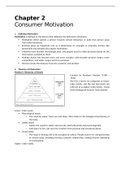
Maslow’s Hierarchy of Needs
Created by Abraham Maslow (1908 –
1970).
The first 3 levels are categories as lower-
order needs, and the last two levels are
referred to as higher-order needs – these
levels distinguish humans from animals.
Lower- order needs:
Physiological needs:
o The need for water, food, sex and sleep. They relate to the biological functioning of
the body.
Safety needs
o Satisfy the need for safety and security, both physically and psychologically.
o Safe place to live, job security, freedom from physical and emotional abuse.
Social needs:
o The need to belong and to be accepted by others. People search for companionship
in various ways, including forming romantic relationship, making friends, belonging
to social group.
Higher- order needs:
, Ego needs
o The need to acquire self-esteem and to be ambitious. In order to be recognized by
others, a person must achieve and be successful. This recognition leads to self-
respect and confidence.
Self- actualization
o The need to be able to give back to society what was learnt and experienced during
a person’s lifetime, while being creative and spontaneous. When people speak of
self-actualization, they mean fulfilling their full potential.
McClelland’s Need Theory
David McClelland (1917 – 1998) stated that
motivation needs are learnt throughout a person’s
life and that different individuals rate different
needs as more important than other needs.
There is no particular order of McClelland’s Theory
unlike Maslow’s.
McClelland’s Need Theory focuses on:
Need for Affiliation
The need to spend time with others and to
be part of a group and the desire to be
accepted by others. A person with a strong
need for affiliation might be satisfied in a
client service or interaction position.
Need for Achievement
The desire to overcome obstacles and accomplish goals. A person with a high need for
achievement need should try to avoid high-risk as well as low – risk situations as it is
important to ensure that he experiences success
Need for Power
This is the need to influence or control others, or to coach and encourage others. It can be
divided into two categories:
1. The individual need for power, which is often selfish and is perceived as being
undesirable.
2. Institutional power or social power, which strives to further the goals of the group.
The ERG
Theory of
Alderfer
Consumer Motivation
1. Defining Motivation
Motivation is defined as the factors that influence the behaviour of humans.
Motivation either pushes a person towards certain behaviour or pulls that person away
from other behaviour.
Emotion plays an important role as it determines its strength or intensity. Factors like
personality and attitude also impact motivation.
Lifestyles have become increasingly busy, and people need to make decisions based on the
information available to them.
Making choices has become more and more complex, with broader product ranges, more
competitors, and wider ranges which to purchase.
Internet closes the distance from the customer and product.
2. Theories of Motivation
Maslow’s Hierarchy of Needs
Created by Abraham Maslow (1908 –
1970).
The first 3 levels are categories as lower-
order needs, and the last two levels are
referred to as higher-order needs – these
levels distinguish humans from animals.
Lower- order needs:
Physiological needs:
o The need for water, food, sex and sleep. They relate to the biological functioning of
the body.
Safety needs
o Satisfy the need for safety and security, both physically and psychologically.
o Safe place to live, job security, freedom from physical and emotional abuse.
Social needs:
o The need to belong and to be accepted by others. People search for companionship
in various ways, including forming romantic relationship, making friends, belonging
to social group.
Higher- order needs:
, Ego needs
o The need to acquire self-esteem and to be ambitious. In order to be recognized by
others, a person must achieve and be successful. This recognition leads to self-
respect and confidence.
Self- actualization
o The need to be able to give back to society what was learnt and experienced during
a person’s lifetime, while being creative and spontaneous. When people speak of
self-actualization, they mean fulfilling their full potential.
McClelland’s Need Theory
David McClelland (1917 – 1998) stated that
motivation needs are learnt throughout a person’s
life and that different individuals rate different
needs as more important than other needs.
There is no particular order of McClelland’s Theory
unlike Maslow’s.
McClelland’s Need Theory focuses on:
Need for Affiliation
The need to spend time with others and to
be part of a group and the desire to be
accepted by others. A person with a strong
need for affiliation might be satisfied in a
client service or interaction position.
Need for Achievement
The desire to overcome obstacles and accomplish goals. A person with a high need for
achievement need should try to avoid high-risk as well as low – risk situations as it is
important to ensure that he experiences success
Need for Power
This is the need to influence or control others, or to coach and encourage others. It can be
divided into two categories:
1. The individual need for power, which is often selfish and is perceived as being
undesirable.
2. Institutional power or social power, which strives to further the goals of the group.
The ERG
Theory of
Alderfer


