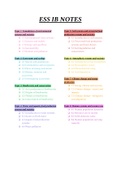
ESS IB NOTES
Topic 1: Foundations of environmental Topic 5: Soil systems and terrestrial food
systems and societies production systems and societies
❏ 1.1 Environmental value systems ❏ 5.1 Introduction to soil systems
❏ 1.2 Systems and models ❏ 5.2 Terrestrial food production
❏ 1.3 Energy and equilibria systems and food choices
❏ 1.4 Sustainability ❏ 5.3 Soil degradation and
❏ 1.5 Humans and pollution conservation
Topic 2: Ecosystems and ecology Topic 6: Atmospheric systems and societies
❏ 2.1 Species and populations ❏ 6.1 Introduction to the atmosphere
❏ 2.2 Communities and ecosystems ❏ 6.2 Stratospheric ozone
❏ 2.3 Flows of energy and matter ❏ 6.3 Photochemical smog
❏ 2.4 Biomes, zonation and ❏ 6.4 Acid deposition
succession
❏ 2.5 Investigating ecosystems Topic 7: Climate change and energy
production
Topic 3: Biodiversity and conservation ❏ 7.1 Energy choices and security
❏ 3.1 An introduction to biodiversity ❏ 7.2 Climate change—causes and
❏ 3.2 Origins of biodiversity impacts
❏ 3.3 Threats to biodiversity ❏ 7.3 Climate change—mitigation
❏ 3.4 Conservation of biodiversity and adaptation
Topic 4: Water and aquatic food production Topic 8: Human systems and resource use
systems and societies ❏ 8.1 Human population dynamics
❏ 4.1 Introduction to water systems ❏ 8.2 Resource use in society
❏ 4.2 Access to fresh water ❏ 8.3 Solid domestic waste
❏ 4.3 Aquatic food production ❏ 8.4 Human population carrying
systems capacity
❏ 4.4 Water pollution
, 1
Topic 2: Ecosystems and ecology
2.1 Species and populations
Species: A group of organisms, which share common characteristics, and can interbreed to
create fertile offspring.
Population: The number of organisms (of a specific species) in an area at a specific time
Habitat: the environment in which a specie normally lives (where)
Niche: particular set of biotic and abiotic conditions and resources to which an organism or
population responds (where and how)
Fundamental niche: full range of conditions and resources in which a species can survive and
reproduce. (capacity- ideal/max niche)
Realized niche: the actual conditions and resources in which a species exists due to the biotic
interactions. (what actually is)
Biotic factors: living things (organisms)
Abiotic factors: non-living things (temp, sunlight, precipitation)
Predation: where one species feeds on another
Herbivore: animals that feeds only off plants
Omnivore: animals that feeds on both animals and plants
Carnivore: animals that feeds on animals
Parasitism: the host of the parasite provides food for the bacteria, but in return causes the
host harm (ring-worm)
Mutualism: both parties benefit (symbiotic relationship) (sea anemones and clownfish)
Symbiotic relationship: a special type of interaction between species. Sometimes beneficial,
sometimes harmful.
Competition: species attempt to use the same amount of limited resources
Intraspecific: competition within one species (same herb/ pop of lions competing for food)
Interspecific: competition between different species (hyenas fighting w lions for food)
Carrying capacity: the amount of organisms a region can support without environmental
degradation
, 2
1. Exponential phase:
● Pop number increases (growth rate)
● High birth rate
● Low death rate
● No predation (NO LIMITING FACTORS)
● Large availability of resources
2. Transitional phase:
● Rate of pop growth slows down
● Predation appears
● Death rates start to rise and birth rates decrease
● Competition for resources starts/increases
3. Plateau phase:
● Death rate= birth rate
● Population number remains the same
● Predation acts as a limiting factors, causing the population to go back to its
equilibrium, which is that population’s carrying capacity
● Resources act as a limiting factor, keeping the population stable at its
carrying capacity.
Topic 1: Foundations of environmental Topic 5: Soil systems and terrestrial food
systems and societies production systems and societies
❏ 1.1 Environmental value systems ❏ 5.1 Introduction to soil systems
❏ 1.2 Systems and models ❏ 5.2 Terrestrial food production
❏ 1.3 Energy and equilibria systems and food choices
❏ 1.4 Sustainability ❏ 5.3 Soil degradation and
❏ 1.5 Humans and pollution conservation
Topic 2: Ecosystems and ecology Topic 6: Atmospheric systems and societies
❏ 2.1 Species and populations ❏ 6.1 Introduction to the atmosphere
❏ 2.2 Communities and ecosystems ❏ 6.2 Stratospheric ozone
❏ 2.3 Flows of energy and matter ❏ 6.3 Photochemical smog
❏ 2.4 Biomes, zonation and ❏ 6.4 Acid deposition
succession
❏ 2.5 Investigating ecosystems Topic 7: Climate change and energy
production
Topic 3: Biodiversity and conservation ❏ 7.1 Energy choices and security
❏ 3.1 An introduction to biodiversity ❏ 7.2 Climate change—causes and
❏ 3.2 Origins of biodiversity impacts
❏ 3.3 Threats to biodiversity ❏ 7.3 Climate change—mitigation
❏ 3.4 Conservation of biodiversity and adaptation
Topic 4: Water and aquatic food production Topic 8: Human systems and resource use
systems and societies ❏ 8.1 Human population dynamics
❏ 4.1 Introduction to water systems ❏ 8.2 Resource use in society
❏ 4.2 Access to fresh water ❏ 8.3 Solid domestic waste
❏ 4.3 Aquatic food production ❏ 8.4 Human population carrying
systems capacity
❏ 4.4 Water pollution
, 1
Topic 2: Ecosystems and ecology
2.1 Species and populations
Species: A group of organisms, which share common characteristics, and can interbreed to
create fertile offspring.
Population: The number of organisms (of a specific species) in an area at a specific time
Habitat: the environment in which a specie normally lives (where)
Niche: particular set of biotic and abiotic conditions and resources to which an organism or
population responds (where and how)
Fundamental niche: full range of conditions and resources in which a species can survive and
reproduce. (capacity- ideal/max niche)
Realized niche: the actual conditions and resources in which a species exists due to the biotic
interactions. (what actually is)
Biotic factors: living things (organisms)
Abiotic factors: non-living things (temp, sunlight, precipitation)
Predation: where one species feeds on another
Herbivore: animals that feeds only off plants
Omnivore: animals that feeds on both animals and plants
Carnivore: animals that feeds on animals
Parasitism: the host of the parasite provides food for the bacteria, but in return causes the
host harm (ring-worm)
Mutualism: both parties benefit (symbiotic relationship) (sea anemones and clownfish)
Symbiotic relationship: a special type of interaction between species. Sometimes beneficial,
sometimes harmful.
Competition: species attempt to use the same amount of limited resources
Intraspecific: competition within one species (same herb/ pop of lions competing for food)
Interspecific: competition between different species (hyenas fighting w lions for food)
Carrying capacity: the amount of organisms a region can support without environmental
degradation
, 2
1. Exponential phase:
● Pop number increases (growth rate)
● High birth rate
● Low death rate
● No predation (NO LIMITING FACTORS)
● Large availability of resources
2. Transitional phase:
● Rate of pop growth slows down
● Predation appears
● Death rates start to rise and birth rates decrease
● Competition for resources starts/increases
3. Plateau phase:
● Death rate= birth rate
● Population number remains the same
● Predation acts as a limiting factors, causing the population to go back to its
equilibrium, which is that population’s carrying capacity
● Resources act as a limiting factor, keeping the population stable at its
carrying capacity.