

ATI RN Community Health proctored exam 2020
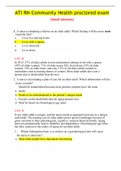
1. A nurse is obtaining a history on an older adult. Which finding will the nurse most typically find? a. Lives in a nursing home b. Lives with a spouse c. Lives divorced d. Lives alone ANS: B In 2012, 57% of older adults in non-institutional settings lived with a spouse (45% of older women, 71% of older men); 28% lived alone (35% of older women, 19% of older men); and only 3.5% of all older adults resided in institutions such as nursing homes or centers. Most older adults have lost a spouse due to death rather than divorce. 2. A nurse is developing a plan of care for an older adult. Which information will the nurse consider? Should be standardized because most geriatric patients have the same a. needs b. Needs to be individualized to the patient’s unique needs c. Focuses on the disabilities that all aging persons face d. Must be based on chronological age alone ANS: B Every older adult is unique, and the nurse needs to approach each one as a unique individual. The nursing care of older adults poses special challenges because of great variation in their physiological, cognitive, and psychosocial health. Aging does not automatically lead to disability and dependence. Chronological age often has little relation to the reality of aging for an older adult. 3. Which information from a co-worker on a gerontological unit will cause the nurse to intervene? a. Most older people have dependent functioning. b. Most older people have strengths we should focus on. c. Most older people should be involved in care decision. d. Most older people should be encouraged to have independence. .....................................................................................CONTINUED
Document information
- Uploaded on
- September 6, 2021
- Number of pages
- 24
- Written in
- 2021/2022
- Type
- Exam (elaborations)
- Contains
- Questions & answers


