
ons
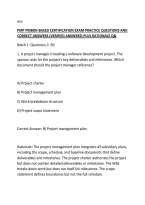
PMP PMBOK-BASED CERTIFICATION EXAM PRACTICE QUESTIONS AND
CORRECT ANSWERS (VERIFIED ANSWERS) PLUS RATIONALE Q&
Batch 1: Questions 1–50
1. A project manager is leading a software development project. The
sponsor asks for the project's key deliverables and milestones. Which
document should the project manager reference?
A) Project charter
B) Project management plan
C) Work breakdown structure
D) Project scope statement
Correct Answer: B) Project management plan
Rationale: The project management plan integrates all subsidiary plans,
including the scope, schedule, and baseline documents that define
deliverables and milestones. The project charter authorizes the project
but does not contain detailed deliverables or milestones. The WBS
breaks down work but does not itself list milestones. The scope
statement defines boundaries but not the full schedule.
,2. During project execution, a team member identifies a risk that was
not previously documented. What should the project manager do
FIRST?
A) Escalate to the sponsor
B) Update the risk register
C) Implement a workaround
D) Add contingency reserve
Correct Answer: B) Update the risk register
Rationale: Newly identified risks should first be documented in the risk
register as part of the Identify Risks process. Escalation may be needed
later if the risk is beyond the project manager's authority. A
workaround is used for unplanned risks that have already occurred.
Contingency reserve is used for known risks.
3. A project manager wants to ensure that quality is built into the
product rather than inspected at the end. Which approach best
supports this?
A) Quality control inspections
,B) Statistical sampling
C) Quality assurance audits
D) Prevention over inspection
Correct Answer: D) Prevention over inspection
Rationale: PMBOK emphasizes "prevention over inspection" as a core
quality principle. Quality should be planned, designed, and built into
the product. Quality control and inspections detect defects after the
fact. Statistical sampling is a QC technique. Audits verify compliance but
do not inherently prevent defects.
4. Which document formally authorizes the existence of a project and
provides the project manager with authority to apply organizational
resources?
A) Project management plan
B) Business case
C) Project charter
D) Benefits management plan
, Correct Answer: C) Project charter
Rationale: The project charter formally authorizes the project and gives
the project manager authority. The business case justifies the project.
The benefits management plan describes how benefits will be
delivered. The project management plan describes how the project will
be executed.
5. A project manager is estimating activity durations using historical
data from similar projects. Which technique is being used?
A) Parametric estimating
B) Analogous estimating
C) Three-point estimating
D) Bottom-up estimating
Correct Answer: B) Analogous estimating
Rationale: Analogous estimating uses historical data from similar
projects. Parametric estimating uses statistical relationships. Three-
point estimating uses optimistic, pessimistic, and most likely estimates.
PMP PMBOK-BASED CERTIFICATION EXAM PRACTICE QUESTIONS AND
CORRECT ANSWERS (VERIFIED ANSWERS) PLUS RATIONALE Q&
Batch 1: Questions 1–50
1. A project manager is leading a software development project. The
sponsor asks for the project's key deliverables and milestones. Which
document should the project manager reference?
A) Project charter
B) Project management plan
C) Work breakdown structure
D) Project scope statement
Correct Answer: B) Project management plan
Rationale: The project management plan integrates all subsidiary plans,
including the scope, schedule, and baseline documents that define
deliverables and milestones. The project charter authorizes the project
but does not contain detailed deliverables or milestones. The WBS
breaks down work but does not itself list milestones. The scope
statement defines boundaries but not the full schedule.
,2. During project execution, a team member identifies a risk that was
not previously documented. What should the project manager do
FIRST?
A) Escalate to the sponsor
B) Update the risk register
C) Implement a workaround
D) Add contingency reserve
Correct Answer: B) Update the risk register
Rationale: Newly identified risks should first be documented in the risk
register as part of the Identify Risks process. Escalation may be needed
later if the risk is beyond the project manager's authority. A
workaround is used for unplanned risks that have already occurred.
Contingency reserve is used for known risks.
3. A project manager wants to ensure that quality is built into the
product rather than inspected at the end. Which approach best
supports this?
A) Quality control inspections
,B) Statistical sampling
C) Quality assurance audits
D) Prevention over inspection
Correct Answer: D) Prevention over inspection
Rationale: PMBOK emphasizes "prevention over inspection" as a core
quality principle. Quality should be planned, designed, and built into
the product. Quality control and inspections detect defects after the
fact. Statistical sampling is a QC technique. Audits verify compliance but
do not inherently prevent defects.
4. Which document formally authorizes the existence of a project and
provides the project manager with authority to apply organizational
resources?
A) Project management plan
B) Business case
C) Project charter
D) Benefits management plan
, Correct Answer: C) Project charter
Rationale: The project charter formally authorizes the project and gives
the project manager authority. The business case justifies the project.
The benefits management plan describes how benefits will be
delivered. The project management plan describes how the project will
be executed.
5. A project manager is estimating activity durations using historical
data from similar projects. Which technique is being used?
A) Parametric estimating
B) Analogous estimating
C) Three-point estimating
D) Bottom-up estimating
Correct Answer: B) Analogous estimating
Rationale: Analogous estimating uses historical data from similar
projects. Parametric estimating uses statistical relationships. Three-
point estimating uses optimistic, pessimistic, and most likely estimates.


