
A & P Semester 1 Final Exam Study Guide
Study online at https://quizlet.com/_47mwux
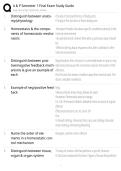
1. Distinguish between anato- A:Study of structure(forms) of body parts
my/physiology P:Study of the function of those body parts
2. Homeostasis & the compo- -Receptor:Provide info about specific conditions(stimuli) in the
nents of homeostatic mecha- internal environment
nisms -Set point(Control Center):Tells what a particular value should
be
-Effectors:Bring about responses that alter conditions in the
internal environment
3. Distinguish between posi- Neg:Deviation from set point is corrected(moves in opp or neg
tive/negative feedback mech- direction) & because the correction reduces that action of the
anisms & give an example of effectors.
each Pos:Process that moves condition away from normal state. Pro-
duces unstable conditions
4. Example of neg/positive feed- Neg:
back Stimulus:Room temp drops below set point
Receptors:Thermostat detects change
Ctr Cntr:Thermostat detects deviation from set point & signals
effector
Effectors:Heat turns on, AC turns off
Pos:
In blood clotting, chemicals that carry out clotting stimulate
more clotting, minimizing bleeding.
5. Name the order of ele- Receptor, control center, effector
ments in a homeostatic con-
trol mechanism
6. Distinguish between tissue, T:Group of similar cells that perform a specific function
organ & organ system O:Structure composed of at least 2 types of tissues that perform
, A & P Semester 1 Final Exam Study Guide
Study online at https://quizlet.com/_47mwux
a specific function
OS:Organs that function closely together
7. Structures/location of Cranial Brain
cavity
8. Structures/location of Tho- Heart, lungs, pleural & mediastinum
racic cavity
9. Structures/location of Ab- Stomach, liver, spleen, gallbladder, kidneys, urinary, & most
dominal cavity small/large intestines
10. Structures/location Pelvic End of large intestines, urinary, bladder, internal reproductive
cavity organs, uterus
11. Superior/inferior Above & below
12. Proximal/distal P:Closer to origin of body part
D:Farther from origin of body part
13. Anterior/posterior A:(Ventral)Toward the front
P:(Dorsal)Toward the back
14. Medial/lateral M:Toward or at midline of body
L:Away from midline of body/toward the side
15. Superficial/deep S:Near surface
D:Away from body surface, more internal
16. Transverse plane (Horizontal)Plane that divides body into superior/inferior
17. Coronal plane (Frontal)Refers to a plane that divides body into anterior/pos-
terior regions
18. Dorsal Near the back surface of the body. Cranial/spinal activity
Study online at https://quizlet.com/_47mwux
1. Distinguish between anato- A:Study of structure(forms) of body parts
my/physiology P:Study of the function of those body parts
2. Homeostasis & the compo- -Receptor:Provide info about specific conditions(stimuli) in the
nents of homeostatic mecha- internal environment
nisms -Set point(Control Center):Tells what a particular value should
be
-Effectors:Bring about responses that alter conditions in the
internal environment
3. Distinguish between posi- Neg:Deviation from set point is corrected(moves in opp or neg
tive/negative feedback mech- direction) & because the correction reduces that action of the
anisms & give an example of effectors.
each Pos:Process that moves condition away from normal state. Pro-
duces unstable conditions
4. Example of neg/positive feed- Neg:
back Stimulus:Room temp drops below set point
Receptors:Thermostat detects change
Ctr Cntr:Thermostat detects deviation from set point & signals
effector
Effectors:Heat turns on, AC turns off
Pos:
In blood clotting, chemicals that carry out clotting stimulate
more clotting, minimizing bleeding.
5. Name the order of ele- Receptor, control center, effector
ments in a homeostatic con-
trol mechanism
6. Distinguish between tissue, T:Group of similar cells that perform a specific function
organ & organ system O:Structure composed of at least 2 types of tissues that perform
, A & P Semester 1 Final Exam Study Guide
Study online at https://quizlet.com/_47mwux
a specific function
OS:Organs that function closely together
7. Structures/location of Cranial Brain
cavity
8. Structures/location of Tho- Heart, lungs, pleural & mediastinum
racic cavity
9. Structures/location of Ab- Stomach, liver, spleen, gallbladder, kidneys, urinary, & most
dominal cavity small/large intestines
10. Structures/location Pelvic End of large intestines, urinary, bladder, internal reproductive
cavity organs, uterus
11. Superior/inferior Above & below
12. Proximal/distal P:Closer to origin of body part
D:Farther from origin of body part
13. Anterior/posterior A:(Ventral)Toward the front
P:(Dorsal)Toward the back
14. Medial/lateral M:Toward or at midline of body
L:Away from midline of body/toward the side
15. Superficial/deep S:Near surface
D:Away from body surface, more internal
16. Transverse plane (Horizontal)Plane that divides body into superior/inferior
17. Coronal plane (Frontal)Refers to a plane that divides body into anterior/pos-
terior regions
18. Dorsal Near the back surface of the body. Cranial/spinal activity


