

·
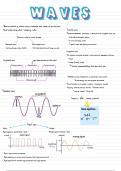
Waves are produced by vibrations causing a disturbance which spreads out from the source
Waves transfer without matter Transverse
transferring
·
wave s
energy
:
The particle
·
oscillations perpendicular to the direction of propagation of the wave
Waves are a method of transfer of energy
Visible light/electromagnetic radiation
S wave s
(secondary waves)
B
Mechanical waves .
" Electromagnetic waves :
-ground rises & falls (building m o re up & down
need to through a medium (matter) don't need a medium (can travel vacuum)
-
through
-
a
go
Longitudinal waves :
The
·
ocsillation of particles parallel to the direction of of the
is
propagation wave
<
Sound
Longitudinal wave where particles further apart
region
: are
<
Pwaves (primary waves)
Compression Rarefaction Compression Ground is compressed buildings ,
shake from side to side
monmesman -
Amplitude : maximum displacement of molecules from mean
position
Wavelength The more
energy a wave has , the greater the amplitude
Period (measured Seconds)
-
: time taken for on e complete ocsillation in
-frequency : number of waves per unit time (measured in Hertz)
Transverse wave :
·
I wave
per second = 1 Hertz (Hz)
wavelength (1)
crest/peak -
frequency :triod
⑮
(inversely proportional
G equilibrium
33 Wave
equation :
-
V = f)
trough
speed frequency wavelength
Signal types :
A ·
Digital :
Analogue :
Digital Signals a re discrete (fixed in Value Analogue signals are continuous in values
Digital signals are easier to
regenerate
Digital signals have an increased rate of transmission (faster data transmission rate)
Digital Signals have an increased
range of transmission (over longer distances)
Waves are produced by vibrations causing a disturbance which spreads out from the source
Waves transfer without matter Transverse
transferring
·
wave s
energy
:
The particle
·
oscillations perpendicular to the direction of propagation of the wave
Waves are a method of transfer of energy
Visible light/electromagnetic radiation
S wave s
(secondary waves)
B
Mechanical waves .
" Electromagnetic waves :
-ground rises & falls (building m o re up & down
need to through a medium (matter) don't need a medium (can travel vacuum)
-
through
-
a
go
Longitudinal waves :
The
·
ocsillation of particles parallel to the direction of of the
is
propagation wave
<
Sound
Longitudinal wave where particles further apart
region
: are
<
Pwaves (primary waves)
Compression Rarefaction Compression Ground is compressed buildings ,
shake from side to side
monmesman -
Amplitude : maximum displacement of molecules from mean
position
Wavelength The more
energy a wave has , the greater the amplitude
Period (measured Seconds)
-
: time taken for on e complete ocsillation in
-frequency : number of waves per unit time (measured in Hertz)
Transverse wave :
·
I wave
per second = 1 Hertz (Hz)
wavelength (1)
crest/peak -
frequency :triod
⑮
(inversely proportional
G equilibrium
33 Wave
equation :
-
V = f)
trough
speed frequency wavelength
Signal types :
A ·
Digital :
Analogue :
Digital Signals a re discrete (fixed in Value Analogue signals are continuous in values
Digital signals are easier to
regenerate
Digital signals have an increased rate of transmission (faster data transmission rate)
Digital Signals have an increased
range of transmission (over longer distances)


