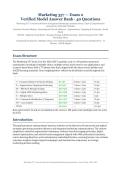
Marketing 357 — Exam 2
Verified Model Answer Bank · 40 Questions
Marketing 357: Consumer Behavior & Integrated Marketing Communications | Exam 2 Comprehensive
Assessment | 2026/2027 Syllabus
Consumer Decision-Making · Psychological & Social Influences · Segmentation, Targeting & Positioning · Brand
Equity
IMC Mix · Digital & Social Media · Message Strategy & Media Planning · Sales Promotion & PR · CRM ·
Marketing Ethics
Undergraduate Business | Multiple-Choice, Case Analysis & Applied Scenario Format | 40 Questions · 75
Minutes · AACSB Aligned
Exam Structure
The Marketing 357 Exam 2 for the 2026/2027 academic cycle is a 40-question proctored
examination consisting of multiple-choice, multiple-select, short-answer case applications, and
scenario-based items with a 75-minute time limit, aligned with the latest course syllabus and
AACSB learning standards. Item weighting below reflects the distribution used throughout this
bank.
Section Items Weighting Points
I — Consumer Behavior & Decision-Making Q1–Q8 8 items × 2 pts 16 pts
II — Segmentation, Targeting & Positioning Q9–Q15 7 items × 2 pts 14 pts
III — IMC Mix & Message Strategy Q16–Q22 7 items × 2 pts 14 pts
IV — Digital, CRM & Marketing Ethics Q23–Q28 6 items × 2 pts 12 pts
V — Multiple Select Q29–Q30 2 items × 3 pts 6 pts
VI — Framework Identification (7 diagrams) Q31–Q37 7 items × 5 pts 35 pts
VII — Case Analysis Q38–Q40 3 items × 6 pts 18 pts
TOTAL 40 items — 115 pts
Raw points total 115 and are normalized to the course's 100-point scale (multiply each raw score
by 0.87).
Introduction
This guide prepares undergraduate business students on the theoretical frameworks and applied
strategies governing consumer behavior and integrated marketing communications. The content
emphasizes analytical segmentation techniques, evidence-based messaging principles, digital
channel optimization, and ethical brand management aligned with AMA professional standards,
course learning objectives, and contemporary marketing literature, ensuring learners can evaluate
consumer insights, design targeted campaigns, and demonstrate competency in strategic
marketing decision-making.
Marketing 357 · Consumer Behavior & Integrated Marketing Communications · Exam 2 Bank · 2026–2027
,Section I · Consumer Behavior & Decision-Making (Q1–Q8)
Question 1 (2 points · Multiple Choice)
A consumer realizes their laptop is too slow for their coursework. Which stage of the consumer
decision-making process does this represent?
A. Information search
B. Problem recognition ✓
C. Evaluation of alternatives
D. Post-purchase behavior
Correct Answer: B. Problem recognition
Rationale: Problem recognition occurs when a consumer perceives a gap between their actual state and a
desired state — here, inadequate versus adequate computing power. The gap may be triggered internally by a
felt need or externally by advertising or social comparison. No search or evaluation has yet begun, so options A
and C describe later stages.
References: Kotler & Keller, Marketing Management, 16th ed. Ch. 6; MKTG 357 lecture materials, Exam 2 unit.
Question 2 (2 points · Multiple Choice)
The set of brands a consumer actively considers when making a purchase decision is called the:
A. Total set
B. Awareness set
C. Evoked (consideration) set ✓
D. Inept set
Correct Answer: C. Evoked (consideration) set
Rationale: The evoked or consideration set is the small subset of brands — typically three to five — that a
consumer seriously weighs. It is drawn from the awareness set, which is itself drawn from the total set of
available brands. Because purchase almost never occurs outside the evoked set, achieving inclusion in it is a
primary objective of brand awareness advertising.
References: Kotler & Keller, Marketing Management, 16th ed. Ch. 6; Journal of Consumer Research, research on
consideration set formation.
Question 3 (2 points · Multiple Choice)
After an expensive purchase, a consumer feels anxious about whether they chose correctly. This
psychological state is:
A. Selective distortion
B. Cognitive dissonance ✓
C. Subliminal perception
D. Reference group influence
Correct Answer: B. Cognitive dissonance
Rationale: Cognitive dissonance is post-purchase discomfort arising from the tension between the chosen
option and the forgone attractive features of alternatives. It intensifies with price, involvement, and
irreversibility. Marketers reduce it with reassuring follow-up communication, generous return policies,
warranties, and owner communities that validate the decision.
References: Kotler & Keller, Marketing Management, 16th ed. Ch. 6; Festinger's dissonance theory as applied in Journal
of Consumer Research.
Marketing 357 · Consumer Behavior & Integrated Marketing Communications · Exam 2 Bank · 2026–2027
, Question 4 (2 points · Multiple Choice)
A consumer notices advertisements for cars only after deciding to buy one. This illustrates:
A. Selective attention ✓
B. Selective distortion
C. Selective retention
D. Perceptual defense
Correct Answer: A. Selective attention
Rationale: Selective attention is the filtering process by which consumers screen out most of the stimuli they
encounter and notice those relevant to current needs. Selective distortion is the tendency to interpret
information to fit existing beliefs, and selective retention is remembering only supportive information. All three
are perceptual screens that reduce the effective reach of advertising.
References: Kotler & Armstrong, Principles of Marketing, 19th ed. Ch. 5; Kotler & Keller, Marketing Management, 16th
ed. Ch. 6.
Question 5 (2 points · Multiple Choice)
A luxury watch brand emphasizes prestige and social status in its advertising. Which level of
Maslow's hierarchy is being targeted?
A. Physiological
B. Safety
C. Esteem ✓
D. Self-actualization
Correct Answer: C. Esteem
Rationale: Esteem needs encompass status, recognition, prestige, and self-respect, which is exactly what
conspicuous luxury goods signal. Self-actualization appeals instead emphasize self-fulfillment and reaching
one's potential — the difference between 'others will admire you' and 'become who you are'.
References: Kotler & Keller, Marketing Management, 16th ed. Ch. 6; Kotler & Armstrong, Principles of Marketing, 19th
ed. Ch. 5.
Question 6 (2 points · Multiple Choice)
A teenager buys a particular brand of sneakers because their peer group wears them. This is an
example of:
A. Cultural influence
B. Reference group influence ✓
C. Economic influence
D. Selective retention
Correct Answer: B. Reference group influence
Rationale: Reference groups are the individuals or groups that serve as a point of comparison in forming
attitudes and behavior. Membership groups exert direct influence, while aspirational groups shape behavior
without actual membership. Their influence is strongest for conspicuous, publicly consumed products such as
apparel, which is why sneaker marketing relies heavily on peer and athlete endorsement.
References: Kotler & Keller, Marketing Management, 16th ed. Ch. 6; Journal of Consumer Research, reference group
research.
Marketing 357 · Consumer Behavior & Integrated Marketing Communications · Exam 2 Bank · 2026–2027
Verified Model Answer Bank · 40 Questions
Marketing 357: Consumer Behavior & Integrated Marketing Communications | Exam 2 Comprehensive
Assessment | 2026/2027 Syllabus
Consumer Decision-Making · Psychological & Social Influences · Segmentation, Targeting & Positioning · Brand
Equity
IMC Mix · Digital & Social Media · Message Strategy & Media Planning · Sales Promotion & PR · CRM ·
Marketing Ethics
Undergraduate Business | Multiple-Choice, Case Analysis & Applied Scenario Format | 40 Questions · 75
Minutes · AACSB Aligned
Exam Structure
The Marketing 357 Exam 2 for the 2026/2027 academic cycle is a 40-question proctored
examination consisting of multiple-choice, multiple-select, short-answer case applications, and
scenario-based items with a 75-minute time limit, aligned with the latest course syllabus and
AACSB learning standards. Item weighting below reflects the distribution used throughout this
bank.
Section Items Weighting Points
I — Consumer Behavior & Decision-Making Q1–Q8 8 items × 2 pts 16 pts
II — Segmentation, Targeting & Positioning Q9–Q15 7 items × 2 pts 14 pts
III — IMC Mix & Message Strategy Q16–Q22 7 items × 2 pts 14 pts
IV — Digital, CRM & Marketing Ethics Q23–Q28 6 items × 2 pts 12 pts
V — Multiple Select Q29–Q30 2 items × 3 pts 6 pts
VI — Framework Identification (7 diagrams) Q31–Q37 7 items × 5 pts 35 pts
VII — Case Analysis Q38–Q40 3 items × 6 pts 18 pts
TOTAL 40 items — 115 pts
Raw points total 115 and are normalized to the course's 100-point scale (multiply each raw score
by 0.87).
Introduction
This guide prepares undergraduate business students on the theoretical frameworks and applied
strategies governing consumer behavior and integrated marketing communications. The content
emphasizes analytical segmentation techniques, evidence-based messaging principles, digital
channel optimization, and ethical brand management aligned with AMA professional standards,
course learning objectives, and contemporary marketing literature, ensuring learners can evaluate
consumer insights, design targeted campaigns, and demonstrate competency in strategic
marketing decision-making.
Marketing 357 · Consumer Behavior & Integrated Marketing Communications · Exam 2 Bank · 2026–2027
,Section I · Consumer Behavior & Decision-Making (Q1–Q8)
Question 1 (2 points · Multiple Choice)
A consumer realizes their laptop is too slow for their coursework. Which stage of the consumer
decision-making process does this represent?
A. Information search
B. Problem recognition ✓
C. Evaluation of alternatives
D. Post-purchase behavior
Correct Answer: B. Problem recognition
Rationale: Problem recognition occurs when a consumer perceives a gap between their actual state and a
desired state — here, inadequate versus adequate computing power. The gap may be triggered internally by a
felt need or externally by advertising or social comparison. No search or evaluation has yet begun, so options A
and C describe later stages.
References: Kotler & Keller, Marketing Management, 16th ed. Ch. 6; MKTG 357 lecture materials, Exam 2 unit.
Question 2 (2 points · Multiple Choice)
The set of brands a consumer actively considers when making a purchase decision is called the:
A. Total set
B. Awareness set
C. Evoked (consideration) set ✓
D. Inept set
Correct Answer: C. Evoked (consideration) set
Rationale: The evoked or consideration set is the small subset of brands — typically three to five — that a
consumer seriously weighs. It is drawn from the awareness set, which is itself drawn from the total set of
available brands. Because purchase almost never occurs outside the evoked set, achieving inclusion in it is a
primary objective of brand awareness advertising.
References: Kotler & Keller, Marketing Management, 16th ed. Ch. 6; Journal of Consumer Research, research on
consideration set formation.
Question 3 (2 points · Multiple Choice)
After an expensive purchase, a consumer feels anxious about whether they chose correctly. This
psychological state is:
A. Selective distortion
B. Cognitive dissonance ✓
C. Subliminal perception
D. Reference group influence
Correct Answer: B. Cognitive dissonance
Rationale: Cognitive dissonance is post-purchase discomfort arising from the tension between the chosen
option and the forgone attractive features of alternatives. It intensifies with price, involvement, and
irreversibility. Marketers reduce it with reassuring follow-up communication, generous return policies,
warranties, and owner communities that validate the decision.
References: Kotler & Keller, Marketing Management, 16th ed. Ch. 6; Festinger's dissonance theory as applied in Journal
of Consumer Research.
Marketing 357 · Consumer Behavior & Integrated Marketing Communications · Exam 2 Bank · 2026–2027
, Question 4 (2 points · Multiple Choice)
A consumer notices advertisements for cars only after deciding to buy one. This illustrates:
A. Selective attention ✓
B. Selective distortion
C. Selective retention
D. Perceptual defense
Correct Answer: A. Selective attention
Rationale: Selective attention is the filtering process by which consumers screen out most of the stimuli they
encounter and notice those relevant to current needs. Selective distortion is the tendency to interpret
information to fit existing beliefs, and selective retention is remembering only supportive information. All three
are perceptual screens that reduce the effective reach of advertising.
References: Kotler & Armstrong, Principles of Marketing, 19th ed. Ch. 5; Kotler & Keller, Marketing Management, 16th
ed. Ch. 6.
Question 5 (2 points · Multiple Choice)
A luxury watch brand emphasizes prestige and social status in its advertising. Which level of
Maslow's hierarchy is being targeted?
A. Physiological
B. Safety
C. Esteem ✓
D. Self-actualization
Correct Answer: C. Esteem
Rationale: Esteem needs encompass status, recognition, prestige, and self-respect, which is exactly what
conspicuous luxury goods signal. Self-actualization appeals instead emphasize self-fulfillment and reaching
one's potential — the difference between 'others will admire you' and 'become who you are'.
References: Kotler & Keller, Marketing Management, 16th ed. Ch. 6; Kotler & Armstrong, Principles of Marketing, 19th
ed. Ch. 5.
Question 6 (2 points · Multiple Choice)
A teenager buys a particular brand of sneakers because their peer group wears them. This is an
example of:
A. Cultural influence
B. Reference group influence ✓
C. Economic influence
D. Selective retention
Correct Answer: B. Reference group influence
Rationale: Reference groups are the individuals or groups that serve as a point of comparison in forming
attitudes and behavior. Membership groups exert direct influence, while aspirational groups shape behavior
without actual membership. Their influence is strongest for conspicuous, publicly consumed products such as
apparel, which is why sneaker marketing relies heavily on peer and athlete endorsement.
References: Kotler & Keller, Marketing Management, 16th ed. Ch. 6; Journal of Consumer Research, reference group
research.
Marketing 357 · Consumer Behavior & Integrated Marketing Communications · Exam 2 Bank · 2026–2027