

Earth and Life Sciences Exam with Questions and Answers
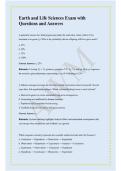
Earth and Life Sciences Exam with Questions and Answers A geneticist crosses two heterozygous pea plants for seed color, where yellow (Y) is dominant over green (y). What is the probability that an offspring will have green seeds? a. 25% b. 50% c. 75% d. 100% Correct Answer: a. 25% Rationale: Crossing Yy × Yy produces genotypes YY, Yy, Yy, and yy. Only yy expresses the recessive green phenotype, representing 1 out of 4 offspring or 25%. A fisheries manager increases the fish harvest limit to maximize short-term profit. Several years later, fish populations collapse. Which systems-thinking lesson is most relevant? a. Short-term gains can create unintended long-term consequences. b. Ecosystems are unaffected by human decisions. c. Population size is unrelated to harvesting. d. Feedback loops do not exist in biological systems. Correct Answer: a Rationale: Systems thinking highlights delayed effects and unintended consequences that can emerge when interactions and feedbacks are ignored. Which sequence correctly represents the scientific method in Earth and Life Sciences? a. Conclusion → Hypothesis → Observation → Experiment b. Observation → Hypothesis → Experiment → Analysis → Conclusion c. Experiment → Observation → Conclusion → Hypothesis d. Hypothesis → Conclusion → Observation → Experiment
Document information
- Uploaded on
- June 30, 2026
- Number of pages
- 75
- Written in
- 2025/2026
- Type
- Exam (elaborations)
- Contains
- Questions & answers


