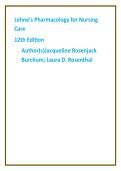
Lehne's Pharmacology for Nursing
Care
12th Edition
• Author(s)Jacqueline Rosenjack
Burchum; Laura D. Rosenthal
,TEST BANK
Question 1
Clinical Scenario
A nurse is preparing to administer the first dose of an
antihypertensive medication to a patient newly diagnosed with
hypertension. The patient asks, "How does this medication
know to lower my blood pressure without affecting everything
else in my body?"
Question
Which response by the nurse best explains the pharmacologic
principle involved?
Options
A. Drugs act only on the organ that is diseased.
B. Drugs produce effects by interacting with specific molecular
targets in the body.
C. Every medication works equally well in all body tissues.
D. Drugs permanently change the structure of body cells to
correct disease.
,Correct Answer
B. Drugs produce effects by interacting with specific molecular
targets in the body.
Rationale
Most medications exert their therapeutic effects by binding to
specific molecular targets such as receptors, enzymes, ion
channels, or transport systems. These interactions modify
normal physiologic processes to achieve the desired therapeutic
outcome. Although many drugs are selective, no medication is
perfectly selective, which explains why adverse effects may
occur.
From a nursing perspective, understanding drug selectivity
helps anticipate therapeutic responses, recognize adverse
effects, and educate patients about expected medication
outcomes.
Why the Other Options Are Incorrect
A. Incorrect. Drugs are distributed throughout the body and are
not limited to diseased organs. Their selectivity depends on the
presence of appropriate targets.
, C. Incorrect. Drug effects vary among tissues because receptors
and other molecular targets differ throughout the body.
D. Incorrect. Most medications modify physiologic function
rather than permanently altering cell structure.
Learning Objective
Explain how drugs produce therapeutic effects through
selective interactions with molecular targets.
Bloom's Taxonomy
Understand
Difficulty
Easy
NCLEX Client Needs Category
Pharmacological and Parenteral Therapies
NCJMM Clinical Judgment Skill
Recognize Cues
Care
12th Edition
• Author(s)Jacqueline Rosenjack
Burchum; Laura D. Rosenthal
,TEST BANK
Question 1
Clinical Scenario
A nurse is preparing to administer the first dose of an
antihypertensive medication to a patient newly diagnosed with
hypertension. The patient asks, "How does this medication
know to lower my blood pressure without affecting everything
else in my body?"
Question
Which response by the nurse best explains the pharmacologic
principle involved?
Options
A. Drugs act only on the organ that is diseased.
B. Drugs produce effects by interacting with specific molecular
targets in the body.
C. Every medication works equally well in all body tissues.
D. Drugs permanently change the structure of body cells to
correct disease.
,Correct Answer
B. Drugs produce effects by interacting with specific molecular
targets in the body.
Rationale
Most medications exert their therapeutic effects by binding to
specific molecular targets such as receptors, enzymes, ion
channels, or transport systems. These interactions modify
normal physiologic processes to achieve the desired therapeutic
outcome. Although many drugs are selective, no medication is
perfectly selective, which explains why adverse effects may
occur.
From a nursing perspective, understanding drug selectivity
helps anticipate therapeutic responses, recognize adverse
effects, and educate patients about expected medication
outcomes.
Why the Other Options Are Incorrect
A. Incorrect. Drugs are distributed throughout the body and are
not limited to diseased organs. Their selectivity depends on the
presence of appropriate targets.
, C. Incorrect. Drug effects vary among tissues because receptors
and other molecular targets differ throughout the body.
D. Incorrect. Most medications modify physiologic function
rather than permanently altering cell structure.
Learning Objective
Explain how drugs produce therapeutic effects through
selective interactions with molecular targets.
Bloom's Taxonomy
Understand
Difficulty
Easy
NCLEX Client Needs Category
Pharmacological and Parenteral Therapies
NCJMM Clinical Judgment Skill
Recognize Cues