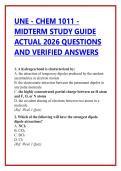
UNE - CHEM 1011 -
MIDTERM STUDY GUIDE
ACTUAL 2026 QUESTIONS
AND VERIFIED ANSWERS
1. A hydrogen bond is characterized by:
A. the attraction of temporary dipoles produced by the random
asymmetries in electron motion
B. the electrostatic attraction between the permanent dipoles in
any polar molecule
C. the highly concentrated partial charge between an H atom
and F, O, or N atoms
D. the covalent sharing of electrons between two atoms in a
molecule
(Ref: Week 1 Quiz)
2. Which of the following will have the strongest dipole-
dipole attractions?
A. NCl₃
B. CCl₄
C. BCl₃
D. Cl₂
(Ref: Week 1 Quiz)
,3. A cohesive force:
A. is the result of the intermolecular forces that attract
identical molecules
B. is the result of the intermolecular forces that attract different
molecules together
C. is the result of covalent interactions between atoms in a
molecule
D. is always stronger than an adhesive force
(Ref: Week 1 Quiz)
4. ΔHvap is:
A. the energy change when a substance changes from the
liquid phase to the gas phase
B. the energy change when a substance changes from the solid
phase to the liquid phase
C. the energy change when a substance changes from the liquid
phase to the solid phase
D. the energy change when a substance changes from the solid
phase directly to the gas phase
(Ref: Week 1 Quiz)
5. A liquid in a tube will form a convex meniscus when:
A. the adhesive forces are stronger than the cohesive forces
B. the cohesive forces are stronger than the adhesive forces
C. the adhesive forces are equal to the cohesive forces
D. it's impossible to predict
(Ref: Week 1 Quiz)
6. In a phase diagram, the critical pressure represents:
A. the temperature and pressure when gas, liquid, and solid
phases coexist
B. the maximum temperature that a liquid can exist
, C. the maximum pressure that a gas can exist
D. the minimum pressure that a solid can exist, regardless of
temperature
(Ref: Quiz Week 1)
7. Molecular solids:
A. are composed of positive and negative ions held together by
electrostatic attractions
B. are composed of atoms, with nuclei in a "sea" of delocalized
electrons
C. are composed of atoms held together by a repeating network
of covalent bonds
D. are composed of neutral molecules held together by
intermolecular forces
(Ref: Week 1 Quiz)
8. The correct expression to calculate the heat required to
convert 100 g of ice starting at -12 °C to liquid water at a
final temperature of 85 °C is:
A. (m x c x ΔT)ice + (n x ΔHfus) + (m x c x ΔT)water
B. (n x ΔHfus) + (m x c x ΔT)water
C. (m x c x ΔT)ice + (m x c x ΔT)water
D. (n x ΔHfus)
(Ref: Week 1 Quiz)
9. Acetonitrile, CH₃CN, is a common solvent used in organic
chemistry labs. Acetonitrile evaporates very quickly at room
temperature and feels noticeably cold when evaporating. If
the ΔHvap for acetonitrile is 34.2 kJ/mol, how much heat is
removed when 2.3 g of acetonitrile evaporates?
A. 1.92 kJ
B. 2.76 kJ
MIDTERM STUDY GUIDE
ACTUAL 2026 QUESTIONS
AND VERIFIED ANSWERS
1. A hydrogen bond is characterized by:
A. the attraction of temporary dipoles produced by the random
asymmetries in electron motion
B. the electrostatic attraction between the permanent dipoles in
any polar molecule
C. the highly concentrated partial charge between an H atom
and F, O, or N atoms
D. the covalent sharing of electrons between two atoms in a
molecule
(Ref: Week 1 Quiz)
2. Which of the following will have the strongest dipole-
dipole attractions?
A. NCl₃
B. CCl₄
C. BCl₃
D. Cl₂
(Ref: Week 1 Quiz)
,3. A cohesive force:
A. is the result of the intermolecular forces that attract
identical molecules
B. is the result of the intermolecular forces that attract different
molecules together
C. is the result of covalent interactions between atoms in a
molecule
D. is always stronger than an adhesive force
(Ref: Week 1 Quiz)
4. ΔHvap is:
A. the energy change when a substance changes from the
liquid phase to the gas phase
B. the energy change when a substance changes from the solid
phase to the liquid phase
C. the energy change when a substance changes from the liquid
phase to the solid phase
D. the energy change when a substance changes from the solid
phase directly to the gas phase
(Ref: Week 1 Quiz)
5. A liquid in a tube will form a convex meniscus when:
A. the adhesive forces are stronger than the cohesive forces
B. the cohesive forces are stronger than the adhesive forces
C. the adhesive forces are equal to the cohesive forces
D. it's impossible to predict
(Ref: Week 1 Quiz)
6. In a phase diagram, the critical pressure represents:
A. the temperature and pressure when gas, liquid, and solid
phases coexist
B. the maximum temperature that a liquid can exist
, C. the maximum pressure that a gas can exist
D. the minimum pressure that a solid can exist, regardless of
temperature
(Ref: Quiz Week 1)
7. Molecular solids:
A. are composed of positive and negative ions held together by
electrostatic attractions
B. are composed of atoms, with nuclei in a "sea" of delocalized
electrons
C. are composed of atoms held together by a repeating network
of covalent bonds
D. are composed of neutral molecules held together by
intermolecular forces
(Ref: Week 1 Quiz)
8. The correct expression to calculate the heat required to
convert 100 g of ice starting at -12 °C to liquid water at a
final temperature of 85 °C is:
A. (m x c x ΔT)ice + (n x ΔHfus) + (m x c x ΔT)water
B. (n x ΔHfus) + (m x c x ΔT)water
C. (m x c x ΔT)ice + (m x c x ΔT)water
D. (n x ΔHfus)
(Ref: Week 1 Quiz)
9. Acetonitrile, CH₃CN, is a common solvent used in organic
chemistry labs. Acetonitrile evaporates very quickly at room
temperature and feels noticeably cold when evaporating. If
the ΔHvap for acetonitrile is 34.2 kJ/mol, how much heat is
removed when 2.3 g of acetonitrile evaporates?
A. 1.92 kJ
B. 2.76 kJ