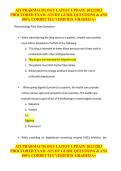
ATI PN Pharmacology Proctor Exam
NGN-Style Questions & Case Studies
Actual Exam 2026/2027 – Complete
Exam-Style Q&As | 100% Certified
Verified – Pass Guaranteed – A+ Graded
NGN Case Study 1: Cardiovascular Pharmacology
A 68-year-old client with a history of hypertension and heart failure is
admitted with shortness of breath and bilateral ankle edema. Current
prescriptions include furosemide, lisinopril, and digoxin.
Question 1 (NGN – Select All That Apply): Which findings indicate the
furosemide is having a therapeutic effect?
• A) Decreased peripheral edema
• B) Increased urine output
• C) Serum potassium of 2.9 mEq/L
• D) Decreased crackles in lung bases
• E) Blood pressure 88/54 mm Hg
Correct ,,,,answer,,,,: A, B, D
Rationale: Furosemide is a loop diuretic used to reduce fluid overload. Decreased
edema, increased urine output, and improved lung sounds indicate effectiveness.
Hypokalemia (serum potassium <3.5) and hypotension are adverse effects, not
therapeutic outcomes .
,Question 2 (NGN – Multiple Choice): The nurse reviews morning laboratory
results. Which result is most concerning for a client taking digoxin and
requires immediate action?
• A) Sodium 138 mEq/L
• B) Potassium 3.0 mEq/L
• C) BUN 22 mg/dL
• D) Hemoglobin 13.5 g/dL
Correct ,,,,answer,,,,: B
Rationale: Hypokalemia (serum potassium <3.5 mEq/L) significantly increases
the risk of digoxin toxicity. The nurse should hold digoxin, monitor for signs of
toxicity (nausea, vomiting, bradycardia, visual changes), and notify the provider .
Question 3 (NGN – Bow-Tie Item): A client receiving IV heparin for DVT
develops new petechiae and platelet count drops from 220,000 to 95,000/mm³.
Match the following:
Condition Action Parameters to Monitor
A. Heparin-induced A. Administer heparin as A. Heart rate, glucose, pai
thrombocytopenia (HIT) prescribed level
B. Discontinue heparin B. Platelet count, new
B. DVT resolution
infusion thrombosis, aPTT
,Condition Action Parameters to Monitor
C. Disseminated intravascular C. Apply warm C. Liver enzymes, BUN,
coagulation compresses creatinine
D. Prepare to administer D. Temperature, WBC,
D. Allergic reaction
warfarin appetite
Correct ,,,,answer,,,,: Condition: A | Action: B | Parameters: B
Rationale: HIT is an immune-mediated reaction to heparin characterized by a
significant platelet drop (>50%) and paradoxical thrombosis risk. Priority action is
to discontinue heparin immediately. Monitor platelet count, signs of new
thrombosis, and aPTT .
Question 4 (NGN – Multiple Choice): A client prescribed digoxin should be
monitored for which early sign of toxicity?
• A) Bradycardia
• B) Tachycardia
• C) Hypertension
• D) Hyperkalemia
Correct ,,,,answer,,,,: A
Rationale: Digoxin toxicity causes cardiac arrhythmias, with bradycardia being an
early sign. Digoxin slows heart rate and can cause heart block. Other signs include
nausea, vomiting, and visual disturbances (halos, yellow-green vision).
Therapeutic digoxin level is 0.8–2.0 ng/mL .
, Question 5 (NGN – Select All That Apply): Which medications require the
nurse to withhold the dose for a heart rate below 60 bpm?
• A) Beta-blockers (metoprolol)
• B) ACE inhibitors (lisinopril)
• C) Digoxin
• D) Calcium channel blockers (verapamil)
• E) Diuretics (furosemide)
Correct ,,,,answer,,,,: A, C, D
Rationale: Beta-blockers, digoxin, and certain calcium channel blockers
(verapamil, diltiazem) reduce heart rate. Holding the dose is indicated when HR
<60 bpm. ACE inhibitors and diuretics do not directly affect heart rate .
Question 6: A client on warfarin has an INR of 5.0. Which action should the
nurse take?
• A) Administer next dose as scheduled
• B) Hold the dose and notify the provider
• C) Increase the dose
• D) Administer vitamin K immediately
Correct ,,,,answer,,,,: B
Rationale: An INR of 5.0 indicates significant bleeding risk. The dose should be
held, and provider notified. Therapeutic INR range is 2.0–3.0. Vitamin K is the
antidote but is not typically administered unless there is active bleeding .
NGN-Style Questions & Case Studies
Actual Exam 2026/2027 – Complete
Exam-Style Q&As | 100% Certified
Verified – Pass Guaranteed – A+ Graded
NGN Case Study 1: Cardiovascular Pharmacology
A 68-year-old client with a history of hypertension and heart failure is
admitted with shortness of breath and bilateral ankle edema. Current
prescriptions include furosemide, lisinopril, and digoxin.
Question 1 (NGN – Select All That Apply): Which findings indicate the
furosemide is having a therapeutic effect?
• A) Decreased peripheral edema
• B) Increased urine output
• C) Serum potassium of 2.9 mEq/L
• D) Decreased crackles in lung bases
• E) Blood pressure 88/54 mm Hg
Correct ,,,,answer,,,,: A, B, D
Rationale: Furosemide is a loop diuretic used to reduce fluid overload. Decreased
edema, increased urine output, and improved lung sounds indicate effectiveness.
Hypokalemia (serum potassium <3.5) and hypotension are adverse effects, not
therapeutic outcomes .
,Question 2 (NGN – Multiple Choice): The nurse reviews morning laboratory
results. Which result is most concerning for a client taking digoxin and
requires immediate action?
• A) Sodium 138 mEq/L
• B) Potassium 3.0 mEq/L
• C) BUN 22 mg/dL
• D) Hemoglobin 13.5 g/dL
Correct ,,,,answer,,,,: B
Rationale: Hypokalemia (serum potassium <3.5 mEq/L) significantly increases
the risk of digoxin toxicity. The nurse should hold digoxin, monitor for signs of
toxicity (nausea, vomiting, bradycardia, visual changes), and notify the provider .
Question 3 (NGN – Bow-Tie Item): A client receiving IV heparin for DVT
develops new petechiae and platelet count drops from 220,000 to 95,000/mm³.
Match the following:
Condition Action Parameters to Monitor
A. Heparin-induced A. Administer heparin as A. Heart rate, glucose, pai
thrombocytopenia (HIT) prescribed level
B. Discontinue heparin B. Platelet count, new
B. DVT resolution
infusion thrombosis, aPTT
,Condition Action Parameters to Monitor
C. Disseminated intravascular C. Apply warm C. Liver enzymes, BUN,
coagulation compresses creatinine
D. Prepare to administer D. Temperature, WBC,
D. Allergic reaction
warfarin appetite
Correct ,,,,answer,,,,: Condition: A | Action: B | Parameters: B
Rationale: HIT is an immune-mediated reaction to heparin characterized by a
significant platelet drop (>50%) and paradoxical thrombosis risk. Priority action is
to discontinue heparin immediately. Monitor platelet count, signs of new
thrombosis, and aPTT .
Question 4 (NGN – Multiple Choice): A client prescribed digoxin should be
monitored for which early sign of toxicity?
• A) Bradycardia
• B) Tachycardia
• C) Hypertension
• D) Hyperkalemia
Correct ,,,,answer,,,,: A
Rationale: Digoxin toxicity causes cardiac arrhythmias, with bradycardia being an
early sign. Digoxin slows heart rate and can cause heart block. Other signs include
nausea, vomiting, and visual disturbances (halos, yellow-green vision).
Therapeutic digoxin level is 0.8–2.0 ng/mL .
, Question 5 (NGN – Select All That Apply): Which medications require the
nurse to withhold the dose for a heart rate below 60 bpm?
• A) Beta-blockers (metoprolol)
• B) ACE inhibitors (lisinopril)
• C) Digoxin
• D) Calcium channel blockers (verapamil)
• E) Diuretics (furosemide)
Correct ,,,,answer,,,,: A, C, D
Rationale: Beta-blockers, digoxin, and certain calcium channel blockers
(verapamil, diltiazem) reduce heart rate. Holding the dose is indicated when HR
<60 bpm. ACE inhibitors and diuretics do not directly affect heart rate .
Question 6: A client on warfarin has an INR of 5.0. Which action should the
nurse take?
• A) Administer next dose as scheduled
• B) Hold the dose and notify the provider
• C) Increase the dose
• D) Administer vitamin K immediately
Correct ,,,,answer,,,,: B
Rationale: An INR of 5.0 indicates significant bleeding risk. The dose should be
held, and provider notified. Therapeutic INR range is 2.0–3.0. Vitamin K is the
antidote but is not typically administered unless there is active bleeding .