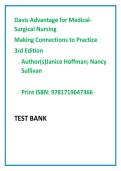
Davis Advantage for Medical-
Surgical Nursing
Making Connections to Practice
3rd Edition
• Author(s)Janice Hoffman; Nancy
Sullivan
• PublisherPublished by F.A.
Davis Copyright© 2024
• Print ISBN: 9781719647366
TEST BANK
,1) MCQ
Clinical Scenario:
A postoperative patient on the medical-surgical unit says, “I feel
a little confused and short of breath.” The nurse notes
restlessness, RR 28/min, and SpO₂ 89% on 2 L/min oxygen by
nasal cannula.
Question Stem:
What is the nurse’s best first action?
Answer Options:
A. Reassess respiratory status and check the oxygen delivery
system
B. Administer the prescribed opioid for pain
C. Document the findings as expected after surgery
D. Call the provider immediately without further assessment
Correct Answer:
A
Detailed Rationale:
Restlessness, confusion, tachypnea, and low oxygen saturation
are cues of possible hypoxemia. The nurse should first assess
the airway, breathing, and oxygen equipment before moving to
more invasive or collaborative actions.
Incorrect Option Analysis:
, • B: Incorrect. Opioids can worsen respiratory depression.
Misconception: Pain relief should come before
assessment.
Patient Safety Risk: Delayed recognition of respiratory
compromise.
• C: Incorrect. These are not expected findings and require
prompt action.
Misconception: Postoperative confusion is always normal.
Patient Safety Risk: Missed deterioration.
• D: Incorrect. A focused assessment should occur first
unless the patient is in immediate arrest.
Misconception: Calling the provider always comes before
bedside assessment.
Patient Safety Risk: Delays targeted intervention.
Nursing Process Linkage: Assessment
Clinical Judgment Competencies (NCJMM): Recognize Cues;
Analyze Cues
Difficulty Level: Moderate
Bloom’s Cognitive Level: Analyze
NCLEX Client Needs Category: Physiological Adaptation
Key Learning Objective: Identify priority assessment actions
when unexpected respiratory deterioration is suspected.
2) MCQ
, Clinical Scenario:
A nurse is revising a unit protocol for pressure injury
prevention.
Question Stem:
Which source provides the strongest evidence for updating the
protocol?
Answer Options:
A. A current clinical practice guideline based on systematic
reviews
B. A colleague’s anecdotal experience with one patient
C. A single published case report
D. A policy used on the unit for the last 10 years
Correct Answer:
A
Detailed Rationale:
Clinical practice guidelines that synthesize systematic reviews
provide the strongest evidence for practice change.
Incorrect Option Analysis:
• B: Incorrect. Anecdotal experience is low-level evidence.
Misconception: Experience alone equals evidence.
Patient Safety Risk: Inconsistent care based on opinion.
• C: Incorrect. Case reports are useful but low in the
evidence hierarchy.
Misconception: Any published article is strong evidence.
Patient Safety Risk: Practice based on limited data.
Surgical Nursing
Making Connections to Practice
3rd Edition
• Author(s)Janice Hoffman; Nancy
Sullivan
• PublisherPublished by F.A.
Davis Copyright© 2024
• Print ISBN: 9781719647366
TEST BANK
,1) MCQ
Clinical Scenario:
A postoperative patient on the medical-surgical unit says, “I feel
a little confused and short of breath.” The nurse notes
restlessness, RR 28/min, and SpO₂ 89% on 2 L/min oxygen by
nasal cannula.
Question Stem:
What is the nurse’s best first action?
Answer Options:
A. Reassess respiratory status and check the oxygen delivery
system
B. Administer the prescribed opioid for pain
C. Document the findings as expected after surgery
D. Call the provider immediately without further assessment
Correct Answer:
A
Detailed Rationale:
Restlessness, confusion, tachypnea, and low oxygen saturation
are cues of possible hypoxemia. The nurse should first assess
the airway, breathing, and oxygen equipment before moving to
more invasive or collaborative actions.
Incorrect Option Analysis:
, • B: Incorrect. Opioids can worsen respiratory depression.
Misconception: Pain relief should come before
assessment.
Patient Safety Risk: Delayed recognition of respiratory
compromise.
• C: Incorrect. These are not expected findings and require
prompt action.
Misconception: Postoperative confusion is always normal.
Patient Safety Risk: Missed deterioration.
• D: Incorrect. A focused assessment should occur first
unless the patient is in immediate arrest.
Misconception: Calling the provider always comes before
bedside assessment.
Patient Safety Risk: Delays targeted intervention.
Nursing Process Linkage: Assessment
Clinical Judgment Competencies (NCJMM): Recognize Cues;
Analyze Cues
Difficulty Level: Moderate
Bloom’s Cognitive Level: Analyze
NCLEX Client Needs Category: Physiological Adaptation
Key Learning Objective: Identify priority assessment actions
when unexpected respiratory deterioration is suspected.
2) MCQ
, Clinical Scenario:
A nurse is revising a unit protocol for pressure injury
prevention.
Question Stem:
Which source provides the strongest evidence for updating the
protocol?
Answer Options:
A. A current clinical practice guideline based on systematic
reviews
B. A colleague’s anecdotal experience with one patient
C. A single published case report
D. A policy used on the unit for the last 10 years
Correct Answer:
A
Detailed Rationale:
Clinical practice guidelines that synthesize systematic reviews
provide the strongest evidence for practice change.
Incorrect Option Analysis:
• B: Incorrect. Anecdotal experience is low-level evidence.
Misconception: Experience alone equals evidence.
Patient Safety Risk: Inconsistent care based on opinion.
• C: Incorrect. Case reports are useful but low in the
evidence hierarchy.
Misconception: Any published article is strong evidence.
Patient Safety Risk: Practice based on limited data.