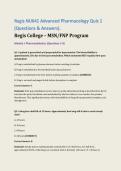
Regis NU641 Advanced Pharmacology Quiz 1
(Questions & Answers).
Regis College – MSN/FNP Program
Module I: Pharmacokinetics (Questions 1-8)
Q1: A patient is prescribed oral propranolol for hypertension. The bioavailability is
approximately 25% due to first-pass metabolism. Which statement BEST explains first-pass
metabolism?
A. Drug is metabolized by plasma esterases before reaching circulation
B. Drug is metabolized in the intestinal lumen by gut bacteria
C. Drug is metabolized in the liver before reaching systemic circulation [CORRECT]
D. Drug is excreted unchanged in bile before absorption is complete
Correct Answer: C
Rationale: First-pass metabolism occurs when an orally administered drug is absorbed from the GI
tract into the portal circulation and metabolized by the liver before it ever reaches the systemic
bloodstream. This significantly reduces the bioavailability of drugs like propranolol, morphine, and
nitroglycerin.
Q2: A drug has a half-life of 12 hours. Approximately how long will it take to reach steady
state?
A. 24 hours
B. 36 hours
C. 48 hours
D. 60 hours [CORRECT]
Correct Answer: D
Rationale: Steady state is mathematically reached after 4 to 5 half-lives. At 5 half-lives,
approximately 96.9% of the drug is at a constant level in the body. (12 hours x 5 = 60 hours).
, Q3: Which of the following factors would lead to an INCREASE in the concentration of "free"
(pharmacologically active) drug in a patient taking Warfarin?
A. Prescribing a second drug that is also highly protein-bound, such as an NSAID [CORRECT]
B. Increasing the patient's intake of dietary albumin
C. A decrease in the volume of distribution (Vd)
D. Induction of Phase II conjugation enzymes
Correct Answer: A
Rationale: Warfarin is highly protein-bound (>99%). If a second highly protein-bound drug (like
ibuprofen) is introduced, it competes for binding sites on albumin, displacing the Warfarin. This
increases the "free fraction" of Warfarin, increasing the risk of bleeding.
Q4: A patient with end-stage renal disease is prescribed a drug that is primarily eliminated
via glomerular filtration. How should the NP adjust the dose?
A. Increase the dose to overcome poor filtration
B. Decrease the dose or increase the dosing interval [CORRECT]
C. Change the route to intramuscular to bypass the kidneys
D. No adjustment is needed as the liver will compensate
Correct Answer: B
Rationale: When renal clearance is impaired, the half-life of drugs eliminated by the kidneys
increases. To prevent toxicity, the clinician must either reduce the dose amount or increase the time
between doses (interval).
Q5: Which statement regarding Zero-Order Kinetics is TRUE?
A. A constant fraction of the drug is eliminated per hour
B. The half-life is constant regardless of the dose
C. A constant amount of drug is eliminated per unit of time [CORRECT]
D. Most drugs in clinical practice follow this model
(Questions & Answers).
Regis College – MSN/FNP Program
Module I: Pharmacokinetics (Questions 1-8)
Q1: A patient is prescribed oral propranolol for hypertension. The bioavailability is
approximately 25% due to first-pass metabolism. Which statement BEST explains first-pass
metabolism?
A. Drug is metabolized by plasma esterases before reaching circulation
B. Drug is metabolized in the intestinal lumen by gut bacteria
C. Drug is metabolized in the liver before reaching systemic circulation [CORRECT]
D. Drug is excreted unchanged in bile before absorption is complete
Correct Answer: C
Rationale: First-pass metabolism occurs when an orally administered drug is absorbed from the GI
tract into the portal circulation and metabolized by the liver before it ever reaches the systemic
bloodstream. This significantly reduces the bioavailability of drugs like propranolol, morphine, and
nitroglycerin.
Q2: A drug has a half-life of 12 hours. Approximately how long will it take to reach steady
state?
A. 24 hours
B. 36 hours
C. 48 hours
D. 60 hours [CORRECT]
Correct Answer: D
Rationale: Steady state is mathematically reached after 4 to 5 half-lives. At 5 half-lives,
approximately 96.9% of the drug is at a constant level in the body. (12 hours x 5 = 60 hours).
, Q3: Which of the following factors would lead to an INCREASE in the concentration of "free"
(pharmacologically active) drug in a patient taking Warfarin?
A. Prescribing a second drug that is also highly protein-bound, such as an NSAID [CORRECT]
B. Increasing the patient's intake of dietary albumin
C. A decrease in the volume of distribution (Vd)
D. Induction of Phase II conjugation enzymes
Correct Answer: A
Rationale: Warfarin is highly protein-bound (>99%). If a second highly protein-bound drug (like
ibuprofen) is introduced, it competes for binding sites on albumin, displacing the Warfarin. This
increases the "free fraction" of Warfarin, increasing the risk of bleeding.
Q4: A patient with end-stage renal disease is prescribed a drug that is primarily eliminated
via glomerular filtration. How should the NP adjust the dose?
A. Increase the dose to overcome poor filtration
B. Decrease the dose or increase the dosing interval [CORRECT]
C. Change the route to intramuscular to bypass the kidneys
D. No adjustment is needed as the liver will compensate
Correct Answer: B
Rationale: When renal clearance is impaired, the half-life of drugs eliminated by the kidneys
increases. To prevent toxicity, the clinician must either reduce the dose amount or increase the time
between doses (interval).
Q5: Which statement regarding Zero-Order Kinetics is TRUE?
A. A constant fraction of the drug is eliminated per hour
B. The half-life is constant regardless of the dose
C. A constant amount of drug is eliminated per unit of time [CORRECT]
D. Most drugs in clinical practice follow this model