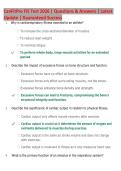
CanFitPro FIS Test 2026 | Questions & Answers | Latest
Update | Guaranteed Success
1. Why is cardiorespiratory fitness essential to an athlete?
To increase the cross-sectional diameter of muscles
To reduce lean weight
To minimize fatigue
To perform whole-body, large-muscle activities for an extended
period
2. Describe the impact of excessive forces on bone structure and function.
Excessive forces have no effect on bone structure.
Excessive forces only affect surrounding muscles, not the bones.
Excessive forces enhance bone density and strength.
Excessive forces can lead to fractures, compromising the bone's
structural integrity and function.
3. Describe the significance of cardiac output in relation to physical fitness.
Cardiac output only affects muscle recovery after exercise.
Cardiac output is crucial as it determines the amount of oxygen and
nutrients delivered to muscles during exercise.
Cardiac output is the same as stroke volume and does not change
with exercise.
Cardiac output is irrelevant to fitness as it only measures heart rate.
4. What is the primary function of an alveolus in the respiratory system?
, Carbon dioxide production
Air filtration
Oxygen storage
Gas exchange
5. What does the acronym FITT stand for in fitness training?
Frequency, Intensity, Time, Type
Flexibility, Intensity, Time, Training
Frequency, Impact, Time, Type
Fitness, Intensity, Training, Technique
6. Canada's Physical Activity Recommendations for Older Adults indicate that
adults over the age of 65 should accumulate at least minutes of
moderate-to-vigorous intensity aerobic physical activity each week.
120
150
170
100
7. Describe the role of the sarcomere in muscle contraction.
The sarcomere is involved in the transmission of nerve impulses to the
muscle.
The sarcomere is the basic unit of muscle contraction, where actin
and myosin filaments interact to produce force.
The sarcomere provides structural support to the muscle fibers.
, The sarcomere is responsible for storing calcium ions for muscle
contraction.
8. Describe how overuse injuries can impact an athlete's performance.
Overuse injuries have no impact on performance.
Overuse injuries enhance performance by building resilience.
Overuse injuries can lead to decreased performance due to pain
and reduced mobility.
Overuse injuries only affect mental health, not physical ability.
9. Which energy system is primarily responsible for fueling high-intensity efforts
lasting up to 10 seconds?
Lactic acid system
ATP-PC system
Anaerobic glycolysis
Aerobic system
10. Describe the role of alveoli in the process of respiration.
Alveoli store oxygen for later use by the body.
Alveoli produce mucus to protect the lungs.
Alveoli facilitate the exchange of oxygen and carbon dioxide
between the lungs and bloodstream.
Alveoli filter out dust and pollutants from the air.
11. Describe the role of the cardiovascular system in the cardiorespiratory
system.
The cardiovascular system stores energy for later use.
, The cardiovascular system transports oxygen and nutrients to the
body while removing carbon dioxide and waste products.
The cardiovascular system regulates body temperature during
physical activity.
The cardiovascular system is responsible for muscle contraction
during exercise.
12. There are three benefits to the warm up session:
flexibility is increased, the muscle is pushed to its full potential, and
the chance of dizziness or fainting caused by the pooling of blood in
the extremities is reduced.
the heart rate is gradually increased from the resting pulse, the
temperature within the muscle is increased, and the chance of
muscle soreness and injury is reduced.
aids in the dissipation of waste products, reduces the potential for
delayed onset of muscle soreness, and increases the heart rate
gradually
flexibility is increased, the chance of dizziness or fainting caused by
the pooling of blood in the extremities is reduced, and increases the
heart rate gradually
13. What is the recommended frequency for cardiorespiratory training to see
health benefits?
Only during competitive events
At least 150 minutes of moderate-intensity exercise per week
Once a month for maximum benefit
Every day for 30 minutes
Update | Guaranteed Success
1. Why is cardiorespiratory fitness essential to an athlete?
To increase the cross-sectional diameter of muscles
To reduce lean weight
To minimize fatigue
To perform whole-body, large-muscle activities for an extended
period
2. Describe the impact of excessive forces on bone structure and function.
Excessive forces have no effect on bone structure.
Excessive forces only affect surrounding muscles, not the bones.
Excessive forces enhance bone density and strength.
Excessive forces can lead to fractures, compromising the bone's
structural integrity and function.
3. Describe the significance of cardiac output in relation to physical fitness.
Cardiac output only affects muscle recovery after exercise.
Cardiac output is crucial as it determines the amount of oxygen and
nutrients delivered to muscles during exercise.
Cardiac output is the same as stroke volume and does not change
with exercise.
Cardiac output is irrelevant to fitness as it only measures heart rate.
4. What is the primary function of an alveolus in the respiratory system?
, Carbon dioxide production
Air filtration
Oxygen storage
Gas exchange
5. What does the acronym FITT stand for in fitness training?
Frequency, Intensity, Time, Type
Flexibility, Intensity, Time, Training
Frequency, Impact, Time, Type
Fitness, Intensity, Training, Technique
6. Canada's Physical Activity Recommendations for Older Adults indicate that
adults over the age of 65 should accumulate at least minutes of
moderate-to-vigorous intensity aerobic physical activity each week.
120
150
170
100
7. Describe the role of the sarcomere in muscle contraction.
The sarcomere is involved in the transmission of nerve impulses to the
muscle.
The sarcomere is the basic unit of muscle contraction, where actin
and myosin filaments interact to produce force.
The sarcomere provides structural support to the muscle fibers.
, The sarcomere is responsible for storing calcium ions for muscle
contraction.
8. Describe how overuse injuries can impact an athlete's performance.
Overuse injuries have no impact on performance.
Overuse injuries enhance performance by building resilience.
Overuse injuries can lead to decreased performance due to pain
and reduced mobility.
Overuse injuries only affect mental health, not physical ability.
9. Which energy system is primarily responsible for fueling high-intensity efforts
lasting up to 10 seconds?
Lactic acid system
ATP-PC system
Anaerobic glycolysis
Aerobic system
10. Describe the role of alveoli in the process of respiration.
Alveoli store oxygen for later use by the body.
Alveoli produce mucus to protect the lungs.
Alveoli facilitate the exchange of oxygen and carbon dioxide
between the lungs and bloodstream.
Alveoli filter out dust and pollutants from the air.
11. Describe the role of the cardiovascular system in the cardiorespiratory
system.
The cardiovascular system stores energy for later use.
, The cardiovascular system transports oxygen and nutrients to the
body while removing carbon dioxide and waste products.
The cardiovascular system regulates body temperature during
physical activity.
The cardiovascular system is responsible for muscle contraction
during exercise.
12. There are three benefits to the warm up session:
flexibility is increased, the muscle is pushed to its full potential, and
the chance of dizziness or fainting caused by the pooling of blood in
the extremities is reduced.
the heart rate is gradually increased from the resting pulse, the
temperature within the muscle is increased, and the chance of
muscle soreness and injury is reduced.
aids in the dissipation of waste products, reduces the potential for
delayed onset of muscle soreness, and increases the heart rate
gradually
flexibility is increased, the chance of dizziness or fainting caused by
the pooling of blood in the extremities is reduced, and increases the
heart rate gradually
13. What is the recommended frequency for cardiorespiratory training to see
health benefits?
Only during competitive events
At least 150 minutes of moderate-intensity exercise per week
Once a month for maximum benefit
Every day for 30 minutes