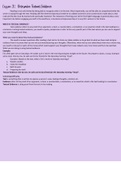
ADVANCED NURSING FUNDAMENTALS
COMPREHENSIVE STUDY GUIDE NOTES
MODULE 1: THE HEALTHCARE DELIVERY SYSTEM & LEVELS OF PREVENTION
Nursing practice is grounded in understanding where and why care is delivered. This framework
determines the nursing interventions required.
1.1 Levels of Prevention (The Core Framework)
• Primary Prevention (Health Promotion & Protection):
o Goal: To prevent the initial occurrence of disease or injury.
o Deep Dive: This occurs in healthy populations. It includes health education,
"wellness" programs, and immunizations.
o Clinical Examples: Nutrition counseling for young adults to prevent obesity;
providing flu vaccines in a community center; family planning services.
• Secondary Prevention (Early Diagnosis & Prompt Intervention):
o Goal: To detect and treat a disease in its early stages to prevent complications or
spread.
o Deep Dive: This involves screening asymptomatic individuals or treating acute
illnesses (colds, fevers).
o Clinical Examples: Performing endotracheal suctioning for a patient on a
ventilator in the ICU; screening for high blood pressure or breast cancer;
admitting a patient for acute respiratory distress.
• Tertiary Prevention (Rehabilitation & Restoration):
o Goal: To stop the progression of a permanent or irreversible disease and return
the patient to a functional state.
o Deep Dive: This focuses on minimizing long-term effects of permanent disability.
o Clinical Examples: Cardiac rehabilitation after a myocardial infarction (heart
attack); support groups for chronic illnesses; pressure ulcer prevention in
paralyzed patients.
1.2 Settings of Health Care Services
, • Preventive Care: Focuses on screenings (Blood pressure, Cancer).
• Primary Care: Focuses on improved health outcomes for an entire population (Prenatal
care, Well-baby care).
• Restorative Care: Specifically for patients recovering from acute or chronic
illness/disability.
o Spinal Cord Injury Programs: Aimed at independence.
o Home Care: Professional services provided at home (wound care, PT).
MODULE 2: PROFESSIONAL NURSING ROLES & ETHICS
A nurse is not just a caregiver; they are a multi-faceted professional.
2.1 Key Functional Roles
• Advocate: The nurse acts as the bridge between the patient and the healthcare system.
You protect the patient's human and legal rights. If a patient is confused about a surgery,
you are the one who ensures they get the information before signing.
• Educator: Teaching is a legal and professional responsibility. You must explain facts about
health, demonstrate self-care activities (like insulin injections), and—crucially—evaluate
if the patient actually learned.
• Manager: Coordinating a multidisciplinary team. This includes budgeting, staffing, and
overseeing care quality on a unit.
• Autonomy: This is a vital exam concept. It is defined as the will to decide. It involves the
nurse initiating independent interventions (like starting a fall precaution protocol)
without a physician's order.
• Nurse Researcher: Evidence-Based Practice (EBP) starts here. If you compare two brands
of thermometers to find the most accurate one for your unit, you are acting as a
researcher.
2.2 The Code of Ethics
The Code of Ethics is the collective philosophy of the profession. It provides the "right and
wrong" principles for care.
• Accountability: Being answerable for your own actions.
• Responsibility: The reliability and dependability in performing duties.
COMPREHENSIVE STUDY GUIDE NOTES
MODULE 1: THE HEALTHCARE DELIVERY SYSTEM & LEVELS OF PREVENTION
Nursing practice is grounded in understanding where and why care is delivered. This framework
determines the nursing interventions required.
1.1 Levels of Prevention (The Core Framework)
• Primary Prevention (Health Promotion & Protection):
o Goal: To prevent the initial occurrence of disease or injury.
o Deep Dive: This occurs in healthy populations. It includes health education,
"wellness" programs, and immunizations.
o Clinical Examples: Nutrition counseling for young adults to prevent obesity;
providing flu vaccines in a community center; family planning services.
• Secondary Prevention (Early Diagnosis & Prompt Intervention):
o Goal: To detect and treat a disease in its early stages to prevent complications or
spread.
o Deep Dive: This involves screening asymptomatic individuals or treating acute
illnesses (colds, fevers).
o Clinical Examples: Performing endotracheal suctioning for a patient on a
ventilator in the ICU; screening for high blood pressure or breast cancer;
admitting a patient for acute respiratory distress.
• Tertiary Prevention (Rehabilitation & Restoration):
o Goal: To stop the progression of a permanent or irreversible disease and return
the patient to a functional state.
o Deep Dive: This focuses on minimizing long-term effects of permanent disability.
o Clinical Examples: Cardiac rehabilitation after a myocardial infarction (heart
attack); support groups for chronic illnesses; pressure ulcer prevention in
paralyzed patients.
1.2 Settings of Health Care Services
, • Preventive Care: Focuses on screenings (Blood pressure, Cancer).
• Primary Care: Focuses on improved health outcomes for an entire population (Prenatal
care, Well-baby care).
• Restorative Care: Specifically for patients recovering from acute or chronic
illness/disability.
o Spinal Cord Injury Programs: Aimed at independence.
o Home Care: Professional services provided at home (wound care, PT).
MODULE 2: PROFESSIONAL NURSING ROLES & ETHICS
A nurse is not just a caregiver; they are a multi-faceted professional.
2.1 Key Functional Roles
• Advocate: The nurse acts as the bridge between the patient and the healthcare system.
You protect the patient's human and legal rights. If a patient is confused about a surgery,
you are the one who ensures they get the information before signing.
• Educator: Teaching is a legal and professional responsibility. You must explain facts about
health, demonstrate self-care activities (like insulin injections), and—crucially—evaluate
if the patient actually learned.
• Manager: Coordinating a multidisciplinary team. This includes budgeting, staffing, and
overseeing care quality on a unit.
• Autonomy: This is a vital exam concept. It is defined as the will to decide. It involves the
nurse initiating independent interventions (like starting a fall precaution protocol)
without a physician's order.
• Nurse Researcher: Evidence-Based Practice (EBP) starts here. If you compare two brands
of thermometers to find the most accurate one for your unit, you are acting as a
researcher.
2.2 The Code of Ethics
The Code of Ethics is the collective philosophy of the profession. It provides the "right and
wrong" principles for care.
• Accountability: Being answerable for your own actions.
• Responsibility: The reliability and dependability in performing duties.