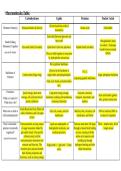
Macromolecules Table:
Carbohydrates Lipids Proteins Nucleic Acids
Glycerol and fatty acids (2
Monomer Name(s) Monosaccharides (Glucose) Amino acids Nucleotides
monomers)
Ester link (Between glycerol and
Bond Holding fatty acid) Phosphodiester bond
Monomers Together (covalent) + hydrogen
Glycosidic bond (Covalent) Lipids don’t form true polymers. Peptide bond (covalent)
bonds between strands
(special for lipids) They are held together in structures (DNA)
by hydrophobic interactions.
Not a polymer backbone.
Glycerol is the backbone in N-C-C
Backbone of
Carbon chain (Sugar ring) triglycerides and phospholipids. Sugar–phosphate backbone
Polymer (repeating peptide backbone)
Fatty acyl chains are hydrocarbon
tails.
Functions: Quick energy, short-term Long-term energy storage, Enzymes, structure,
Store and transfer genetic
What is it used for? storage, cell wall structure in insulation, making cell membranes, transport, movement, and
info, protein instructions
What does it do? plants (cellulose) hormones (Steroids) defense
Food (Bread and rice), Plant cell
Where do we find in Fats, oils, waxes, and cell Muscles, hair, enzymes, cell DNA in nucleus, RNA in
walls (cellulose), and Glycogen
cells/animals/plants? membranes membranes, and blood nucleus & cytoplasm
in liver
How is monomer / Polysaccharides are long chains Lipids are amphipathic or Proteins make their 3D shape DNA = double helix; RNA
polymer structurally of sugar monomers linked by hydrophobic molecules, not through a hierarchical folding = single strand
organized? glycosidic bonds. The specific covalent polymers. process, starting with the
carbons joined, and the amino acid sequence and
(special for proteins)
stereochemistry determines the building up through
structure and function. The Triglyceride = 1 glycerol + 3 fatty hydrogen bonding and side
structure gives polysaccharides acids. chain interactions.
their distinct properties and
functions, such as storing energy
Carbohydrates Lipids Proteins Nucleic Acids
Glycerol and fatty acids (2
Monomer Name(s) Monosaccharides (Glucose) Amino acids Nucleotides
monomers)
Ester link (Between glycerol and
Bond Holding fatty acid) Phosphodiester bond
Monomers Together (covalent) + hydrogen
Glycosidic bond (Covalent) Lipids don’t form true polymers. Peptide bond (covalent)
bonds between strands
(special for lipids) They are held together in structures (DNA)
by hydrophobic interactions.
Not a polymer backbone.
Glycerol is the backbone in N-C-C
Backbone of
Carbon chain (Sugar ring) triglycerides and phospholipids. Sugar–phosphate backbone
Polymer (repeating peptide backbone)
Fatty acyl chains are hydrocarbon
tails.
Functions: Quick energy, short-term Long-term energy storage, Enzymes, structure,
Store and transfer genetic
What is it used for? storage, cell wall structure in insulation, making cell membranes, transport, movement, and
info, protein instructions
What does it do? plants (cellulose) hormones (Steroids) defense
Food (Bread and rice), Plant cell
Where do we find in Fats, oils, waxes, and cell Muscles, hair, enzymes, cell DNA in nucleus, RNA in
walls (cellulose), and Glycogen
cells/animals/plants? membranes membranes, and blood nucleus & cytoplasm
in liver
How is monomer / Polysaccharides are long chains Lipids are amphipathic or Proteins make their 3D shape DNA = double helix; RNA
polymer structurally of sugar monomers linked by hydrophobic molecules, not through a hierarchical folding = single strand
organized? glycosidic bonds. The specific covalent polymers. process, starting with the
carbons joined, and the amino acid sequence and
(special for proteins)
stereochemistry determines the building up through
structure and function. The Triglyceride = 1 glycerol + 3 fatty hydrogen bonding and side
structure gives polysaccharides acids. chain interactions.
their distinct properties and
functions, such as storing energy