

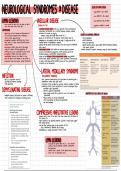
NELROLOGICAL SYNDROMES DISEASE LEVEL OF UMN LESION
>
-
leg affected :
11 or above
>
-
arm affected =
C3 or above
"VASCULAR DISEASE
Lintharain
>
-
face affected =
pons or above
or spinal
(STROKE OR TIA) >
-
diplopia = midbrain or above
-
transient isshemic attask (TIA) is an episode of facal neurological
DEFINITIONS disturbance attributable to a transient vascular occlusion without ,
J
-
spasticity -> occurs because of destruction of evidence of a stroke on
imaging CALISES Of CEREBRAL EMBOLISM
the corticoreticulospinal tract resulting in , doesn't usually last larger than an hour or 2
>
-
Stretch reflex hyperactivity -
lesions in the territory of the internal sarotid artery result in >
-
atrial fibrillation
-
monaplegia > paralysis affecting only 1 limb
-
,
hemiplegia on the apposite side of the body if a large area of the >
-
carotid atheroma
When there is a motor cartex/ partial internal internal capsule of hemisphere is involved cortis arch atheroma
>
-
capsule lesion -
stenasis of the internal carotid artery in the neck may be associated >
-
patent foramen audie or strial septal defect sparadoxical embolus
-
hemiplegia -> affects are side of the body with a bruit from venoussystem)
Owing to a lesion affecting projection of -
haemorrhagic stookes often involve the internal capsule putamen
-
cerebral abscesses mysatis aneurysms may also sause hemiplegia
pathways from the contralateral motor cortex (sansing santralateral hemiparesis often sensory lass)
a or the
-
paraplegia > affects both legs whereas
-
,
thalamus /sausing a contralateral hemianaesthesial
&uadriplegia affects all 4 limbs 3 is the lesians in the territory of the vertebrabasilar artery may produce
-
result of spinal cord trauma or , less after , a cranial nerve palsies Cerebellar signs Hooner syndrome 3 sensory loss
, .
,
. basilar sirtery thrombosis/
brainstem lesion Se g . as well as UMN signs (often bilateral because of close proximity of
structures in the brainster)
·
LATERAL MEDLILLARY SYNDROME
INFECTION (WALLENBERG SYNDROME)
-
HIV is an importantsause of -
this syndrome demonstrates the importance of examining pain 3
neurological problems including , temperature rather than light taush
LI MN syndromes
L
-
occlusion of the posterior inferior cerebellar or lateral
vertebral
or
medullary arteries ipsilateral' crossed' neurological signs
causes :
DEMYELINATING DISEASE signs (ipsilateral)
> carebellar
-
> Horner's
-
syndrome Sipsilateral)
>
-
lower cranial nerves /IX X)- Palate is vocal cord weakness
.
ANATOMY OF THE CIRCLE OF WILLIS
-
multiple sclerosis SMS) results in lesians in different lipsilateral)
sensoryloss of painipsilateralla lateral)
relapsing
> facial
areas , usually with a is remitting course
-
>
-
na UMN weakness
J
COMPRESSIVE BINFILTRATIVE LESIONS
in the lobes of the brain focal signs will depend a
Tumourstendto
-
occur in
-
signs localised to the parietal temporal occipital
, , or frontal lobe suggest
this disease process
may be false localising signs in the presence of 41P
-
2 g a unilateral or bilateral 6th [N palsy
>
-
. .
-
Papilloedema is usuallyassociated if there is ↑1P
LMLSON wasting ,
ex arc
recused/absent reflexes 3 sometimes
3 : cause musale
- asciculations
-
results from a lesion of the spinal motor neurons
,
mator root or peripheral nerve
, ·
MONONEURITIS MULTIPLEX
DEFINITION
LNERVES refers to the separate involvement of >1
-
-
often cranial) nerve by a
peripheral for less
-
if there is evidence of a peripheral nerve lesion peripheral ,
neuropathy single disease
or a mononeuritis multiplex palpate for thiskened nerves
,
>
-
Median nervs at wrist , ulnar nerve at elbow , greater auricular
in the neck nerve at the head of the
A CLITE CALISES (USUALLY VASCULARI
nerve common peroneal
fibula are the most easily accessible -
7
polyarteritis nadosa
-
if nerves are thickened , consider the following diagnoses : >
-
diabetes mellitus
>
-
acromegaly >
-
connective tissue disease Je g . . rheumatoid
>
-
amyloidosis arthritis , systemis lupus erythematosus)
>
-
shronis inflammatory demyelinating polyradiculoneuropathy
CHRONIC SAUSES
>
-
leprosy
>
-
hereditary motor 3 sensory neuropathy >
-
multiple compressive neuropathies
>
-
other (e g
. . sarcoidosis , diabetes mellitus , neurafibromatosis) >
-
sarcoidosis
>
-
asromegaly
>
-
HIV infection
>
-
leprasy
> lyme disease
-
>
-
others /e g . . Carcinoma-rarel
>
-
leg affected :
11 or above
>
-
arm affected =
C3 or above
"VASCULAR DISEASE
Lintharain
>
-
face affected =
pons or above
or spinal
(STROKE OR TIA) >
-
diplopia = midbrain or above
-
transient isshemic attask (TIA) is an episode of facal neurological
DEFINITIONS disturbance attributable to a transient vascular occlusion without ,
J
-
spasticity -> occurs because of destruction of evidence of a stroke on
imaging CALISES Of CEREBRAL EMBOLISM
the corticoreticulospinal tract resulting in , doesn't usually last larger than an hour or 2
>
-
Stretch reflex hyperactivity -
lesions in the territory of the internal sarotid artery result in >
-
atrial fibrillation
-
monaplegia > paralysis affecting only 1 limb
-
,
hemiplegia on the apposite side of the body if a large area of the >
-
carotid atheroma
When there is a motor cartex/ partial internal internal capsule of hemisphere is involved cortis arch atheroma
>
-
capsule lesion -
stenasis of the internal carotid artery in the neck may be associated >
-
patent foramen audie or strial septal defect sparadoxical embolus
-
hemiplegia -> affects are side of the body with a bruit from venoussystem)
Owing to a lesion affecting projection of -
haemorrhagic stookes often involve the internal capsule putamen
-
cerebral abscesses mysatis aneurysms may also sause hemiplegia
pathways from the contralateral motor cortex (sansing santralateral hemiparesis often sensory lass)
a or the
-
paraplegia > affects both legs whereas
-
,
thalamus /sausing a contralateral hemianaesthesial
&uadriplegia affects all 4 limbs 3 is the lesians in the territory of the vertebrabasilar artery may produce
-
result of spinal cord trauma or , less after , a cranial nerve palsies Cerebellar signs Hooner syndrome 3 sensory loss
, .
,
. basilar sirtery thrombosis/
brainstem lesion Se g . as well as UMN signs (often bilateral because of close proximity of
structures in the brainster)
·
LATERAL MEDLILLARY SYNDROME
INFECTION (WALLENBERG SYNDROME)
-
HIV is an importantsause of -
this syndrome demonstrates the importance of examining pain 3
neurological problems including , temperature rather than light taush
LI MN syndromes
L
-
occlusion of the posterior inferior cerebellar or lateral
vertebral
or
medullary arteries ipsilateral' crossed' neurological signs
causes :
DEMYELINATING DISEASE signs (ipsilateral)
> carebellar
-
> Horner's
-
syndrome Sipsilateral)
>
-
lower cranial nerves /IX X)- Palate is vocal cord weakness
.
ANATOMY OF THE CIRCLE OF WILLIS
-
multiple sclerosis SMS) results in lesians in different lipsilateral)
sensoryloss of painipsilateralla lateral)
relapsing
> facial
areas , usually with a is remitting course
-
>
-
na UMN weakness
J
COMPRESSIVE BINFILTRATIVE LESIONS
in the lobes of the brain focal signs will depend a
Tumourstendto
-
occur in
-
signs localised to the parietal temporal occipital
, , or frontal lobe suggest
this disease process
may be false localising signs in the presence of 41P
-
2 g a unilateral or bilateral 6th [N palsy
>
-
. .
-
Papilloedema is usuallyassociated if there is ↑1P
LMLSON wasting ,
ex arc
recused/absent reflexes 3 sometimes
3 : cause musale
- asciculations
-
results from a lesion of the spinal motor neurons
,
mator root or peripheral nerve
, ·
MONONEURITIS MULTIPLEX
DEFINITION
LNERVES refers to the separate involvement of >1
-
-
often cranial) nerve by a
peripheral for less
-
if there is evidence of a peripheral nerve lesion peripheral ,
neuropathy single disease
or a mononeuritis multiplex palpate for thiskened nerves
,
>
-
Median nervs at wrist , ulnar nerve at elbow , greater auricular
in the neck nerve at the head of the
A CLITE CALISES (USUALLY VASCULARI
nerve common peroneal
fibula are the most easily accessible -
7
polyarteritis nadosa
-
if nerves are thickened , consider the following diagnoses : >
-
diabetes mellitus
>
-
acromegaly >
-
connective tissue disease Je g . . rheumatoid
>
-
amyloidosis arthritis , systemis lupus erythematosus)
>
-
shronis inflammatory demyelinating polyradiculoneuropathy
CHRONIC SAUSES
>
-
leprosy
>
-
hereditary motor 3 sensory neuropathy >
-
multiple compressive neuropathies
>
-
other (e g
. . sarcoidosis , diabetes mellitus , neurafibromatosis) >
-
sarcoidosis
>
-
asromegaly
>
-
HIV infection
>
-
leprasy
> lyme disease
-
>
-
others /e g . . Carcinoma-rarel


